

Our purpose is to help a reader understand which account or tool fits a defined task. A comparison titled “Best” is a search label, not a claim that one broker is right for everyone. The general broker comparison weighs an account's products, costs and service conditions. The platform comparison examines the trading workspace. The review directory links to individual provider assessments. Each page should say which reader and workflow its conclusions address.
How partner links and editorial decisions work
Partner links are planned for this site. When a link is part of a commercial arrangement, we will identify it to readers near the link or in its immediate context. Following such a link may lead to compensation for the site if the visitor completes a qualifying action under the partner's terms. A reader should not have to guess whether a link is commercial. Source links to official tariffs, legal terms, regulators and public authorities are evidence links. We do not treat them as partner endorsements.
A potential commission does not determine the order of a comparison or turn a broker into a universal recommendation. We use the criteria stated on the relevant page, such as product eligibility for a Netherlands resident, full costs for the illustrated transaction, account and custody conditions, and the information available before an order is confirmed. If a provider has no partner arrangement, it can still appear when it is relevant and documented. If a provider has a commercial arrangement, its conditions still have to pass the same factual and suitability checks. We do not present paid placement as an independent ranking result. If a commercial relationship is introduced to an existing page, the disclosure should be updated with the page.
Commercial links and source citations have different jobs. A source citation takes the reader to the official document supporting a specific claim. A partner link is a route to the provider under a commercial arrangement. The presence of either kind of link does not establish that the provider offers the product in every account or that its terms suit a particular person. Current prices and legal terms are checked against official sources. The methodology explains how we assess account routes and products.
How we research a provider
We start with the exact question on the page. For a real-share comparison, we look for an account route that buys the underlying security. A CFD with the same company name does not qualify. For a mobile-app page, we examine the documented phone workflow, not just the broker's desktop product catalogue. For a Netherlands resident, the legal company offering the account can differ from the better-known group or a company shown on another country's website. We therefore check country access, the offered entity, product documentation and tariffs together.
Our primary evidence is the relevant broker's own terms, tariff and help material, plus regulator or public-authority material for questions within their remit. The AFM investment-firm register can help identify a firm authorised in the Netherlands or operating through a European passport. The account agreement remains the document that tells an applicant which company is contracting with them. For Dutch tax questions, we direct readers to Belastingdienst's Box 3 information, not a broker's sales summary.
We record changing figures and conditions internally with the official document, account context and date of verification. In public, an article has one overall Updated date. That date tells the reader when the article was revised. It is not a promise that a spread or a promotional rate will remain unchanged. Where a public document is ambiguous, the article should say what remains unconfirmed rather than copy a more attractive rate from a different jurisdiction. The XTB review shows how we handle conflicting official product pages without asserting real-share access for a new Dutch account that we cannot establish.
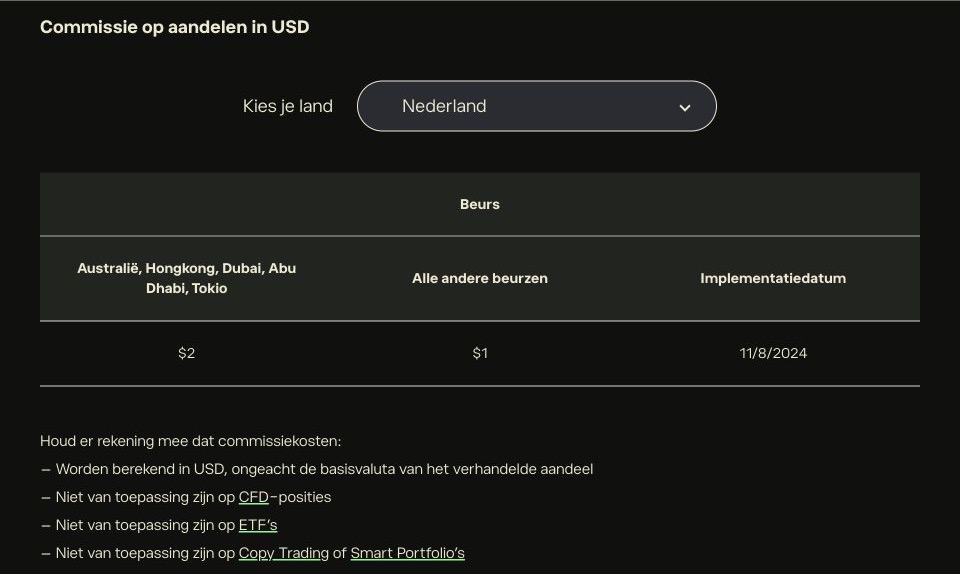
Our research checks current account and product information. Claims about fills, order-book quality, customer-service speed or uptime need a specific observation or measurement. A screenshot of a provider page records what that page displayed. It does not prove that an individual account received a quoted rate. Reviews explain the product and account conditions that a reader can inspect before deciding whether to apply.
Corrections and editorial updates
If a product becomes unavailable, a fee changes, an entity route differs from the one described or a source link stops supporting a claim, send the page URL and the relevant official source to contact@leerzelfbeleggen.com. The Editorial Team will compare the report with the applicable documents and correct the article when the evidence warrants it. A correction should change the substantive text and its overall update date where appropriate. We do not leave a known inaccurate figure in place because it appeared in an older screenshot. A reader can also use that address to ask how a partner link is labelled or to flag an unclear commercial disclosure.
We may update rankings when product access, costs or other criteria change. A change in order should be explained by the page's own scenario and evidence. An article can remain useful even when one term cannot be publicly confirmed, provided the uncertainty is stated and the recommendation does not rely on that unknown. We will not fill gaps with invented rates, claim that a compensation scheme protects against ordinary price falls, or copy another review site's test results as our own.
The site provides comparisons and explanations, not a personalised instruction to open an account or buy a specific instrument. The practical next step for a reader is to check the actual company, product type, order summary and contract terms offered to them. For that workflow, use the broker-safety guide and the relevant product comparison. For a factual error or a question about this policy, write to contact@leerzelfbeleggen.com.