

We do not award a universal winner. A low-cost recurring EUR ETF buyer, a person buying US shares, and a trader using a currency derivative can face different fees, product rights and interface needs at the same firm. Our ordering is an editorial judgement for the scenario stated on each page. We describe the criteria and the conditions under which another option could suit the reader better.
How a provider enters a comparison
We start from the question in the page title: a real-stock comparison requires a route to buy underlying shares. A CFD comparison requires a CFD route. A platform comparison requires an interface available through an account open to a Netherlands resident. Brand advertising to a global audience is not enough. We check the provider’s applicable country and entity pages, product list, fee schedule and terms. We also check official registers where they clarify the legal firm. The AFM investment-firm register is one starting point for Netherlands and passported firms. The contractual entity still matters to a particular applicant.
The page scope determines the candidate set. An ETF page includes brokers where a Dutch resident can purchase relevant listed funds, not a CFD contract merely labelled with an ETF name. A forex page identifies whether the exposure is a spot currency trade, a CFD or another derivative. A platform or app can appear as a distinct interface within a broker’s account, but it is not presented as an independently regulated firm. A provider can therefore appear in several articles for different reasons without receiving the same placement everywhere.
We aim to compare at least ten confirmed relevant options on every “Best” page. The number is a coverage floor, not a reason to include an inaccessible product. If a product, entity or country route cannot be confirmed, we continue research before including it. Individual reviews and guides do not need ten brands to answer their own questions.
How we check costs
We use official tariff and product documents for published numbers, then state the account, market, instrument and funding route to which each number applies. Commission, market spread, foreign-exchange conversion, fund charge, custody or account charge, withdrawal and financing can be distinct costs. A low stock commission does not describe the cost of converting euros to dollars. A CFD spread does not include every overnight charge. The stock comparison and CFD comparison consequently use different cost worksheets.
Our arithmetic examples use stated hypothetical trade sizes. We distinguish a provider’s published commission from an estimated total and from a live execution price. We do not assert a current bid-ask spread, a fill, or an actual account-specific discount where we have not observed it. When a fee depends on tier, exchange, symbol or account route, we name the dependency and direct the reader to the relevant order preview. An absent public rate is not filled with a guess. Internally, we record the source, conditions and verification date for changing figures. Articles show one overall update date so readers can see when the page was revised without a separate date beside each tariff line.
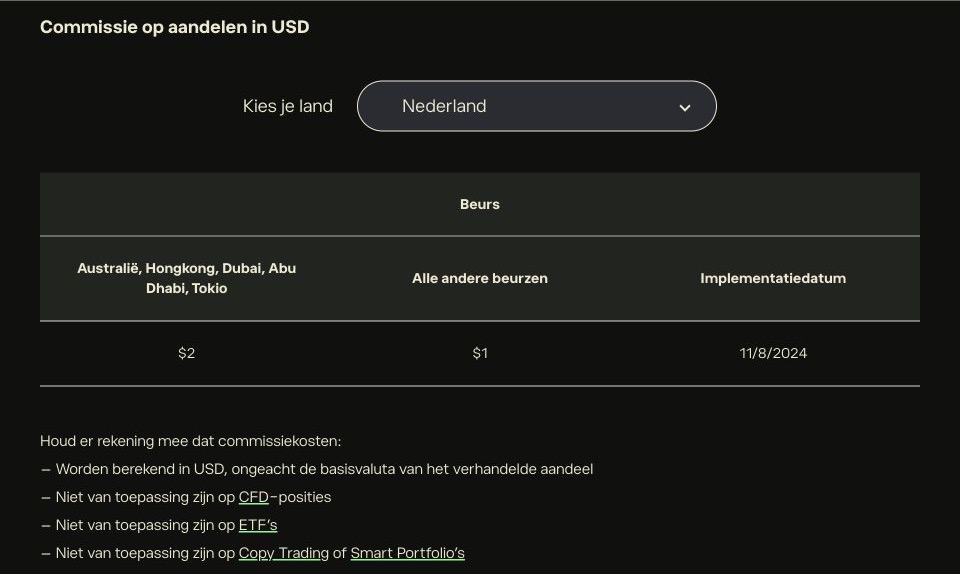
For example, eToro’s Dutch share-fee selector changes its stock commission display when Nederland is chosen and separates real-share commission from CFD charges. We selected Nederland and retained a cropped image of that actual table as evidence of the category used in our eToro review. The image does not prove what a logged-in customer ultimately paid for a particular order. The order ticket remains the final account-specific check.
How we assess other factors
We examine the legal entity, available instruments, custody description, relevant investor-compensation conditions, account opening, funding and withdrawal methods, order controls, reporting and support information. Regulation is a jurisdiction and firm question, not a simple safety badge. A compensation scheme typically addresses eligible claims when a firm cannot return assets. It does not insure an ordinary change in market price. The broker-safety guide shows what a reader can verify in the AFM register and in an account agreement.
For interface comparisons, we consider the relevant account workflow alongside current provider descriptions and country-facing pages. We verify changing prices and legal terms against official sources. Where evidence permits only a limited conclusion, the comparison says so.
Each comparison explains why its order reflects its own task. A beginner page puts greater weight on the clarity of the first order, product labels and small-order cost. A stock page prioritises underlying share access, EUR and foreign-market costs and ownership records. An app page prioritises mobile tasks and the information displayed before confirmation. We do not turn these criteria into a purportedly objective universal score. A provider can be appropriate for one task and cumbersome for another. Readers should compare the disclosed trade-offs with their own intended products and frequency.
Sources, corrections and updates
Primary links sit in the article text next to the facts they support: official provider terms and tariffs for account conditions, regulator registers for firm status, and public-authority pages for Netherlands-specific rules. The Belastingdienst’s Box 3 information, for example, is preferable to a broker’s marketing summary when the question is Dutch taxation. A linked provider page is evidence for what it publishes, not an independent guarantee of service quality. We keep internal fact notes and a page-by-page editorial check so that a correction can be traced to a specific claim.
If you spot an incorrect rate, an inaccessible product, a broken source or a change in an entity or account route, email contact@leerzelfbeleggen.com with the page URL and the official document or screenshot that shows the issue. We will re-check the claim and amend the page where the evidence supports a correction. The page’s update date refers to the article as a whole. Our editorial policy describes how we separate the content from any commercial relationship and how we handle corrections.