

 Lightyear
The important limitation is product scope. Lightyear lists shares, funds and bonds for its investment account and also offers crypto-assets to eligible EU customers. Its NL-facing service description says it does not offer options, CFDs, futures, short selling or US pre-market and after-hours trading. Currency conversion in a multi-currency account is not the same as a leveraged forex trading product. Someone who needs those instruments should use the relevant forex or CFD comparison instead. Our methodology describes how we checked the account and fees.
Who is Lightyear for?
The account is a plausible fit for an investor who buys an ETF periodically, chooses a listed EUR share occasionally, and values a clear difference between the order charge and currency charge. Lightyear's Plans guidance describes recurring investing in eligible instruments and the option to build your own plan. A resident who needs the same instrument on a particular venue should first confirm it is offered in that currency and that the plan can buy it. The absence of a Lightyear ETF execution fee does not prove every ETF is available or that every order is economical.
Lightyear is less suitable if you need listed options, futures, CFDs, direct short selling, specialist market feeds or US extended-hours execution. Its service page explicitly excludes those routes. It may also be less suitable if your portfolio contains many small positions you expect to transfer in kind: Lightyear accepts and sends only qualifying whole positions, with minimum values and matching instrument, exchange and currency rules. A fractional holding cannot be moved in kind. The beginner broker comparison weighs the simpler order path against transfer, records and full-cost questions. The app comparison considers phone use separately.
The Dutch resident's account and product range
The EU account is supplied by Lightyear Europe AS, an Estonian investment firm supervised by Finantsinspektsioon. The company's regulatory and availability page explicitly includes the Netherlands in its service countries. The UK company serves a different jurisdiction. A Dutch visitor should use the EU account documents and the actual onboarding agreement for the legal relationship, even though the same brand operates in both regions.
The service inventory describes a multi-currency account with local details for EUR, GBP and USD, plus shares, funds and bonds. The Dutch stock catalogue shows US and European markets, including Netherlands-listed companies. For ETFs, the ETF help page says the selection includes European and UK-listed funds and does not include US-listed ETFs for European clients. A similar index name is not proof of identical domicile, distribution class, cost or currency. Search by ISIN, exchange and trading currency when choosing a fund.
Crypto-assets are a separate product, not shares or fund units. Lightyear's Dutch crypto help describes a custody model without a personal wallet or external crypto transfers, and a 0.45% order charge. A crypto position must be sold to take cash out through the account. That account feature does not make Lightyear a derivatives broker, and the custody and compensation treatment differs from listed financial instruments as explained below. We do not include crypto orders in the three share/ETF examples.
Lightyear's published charges
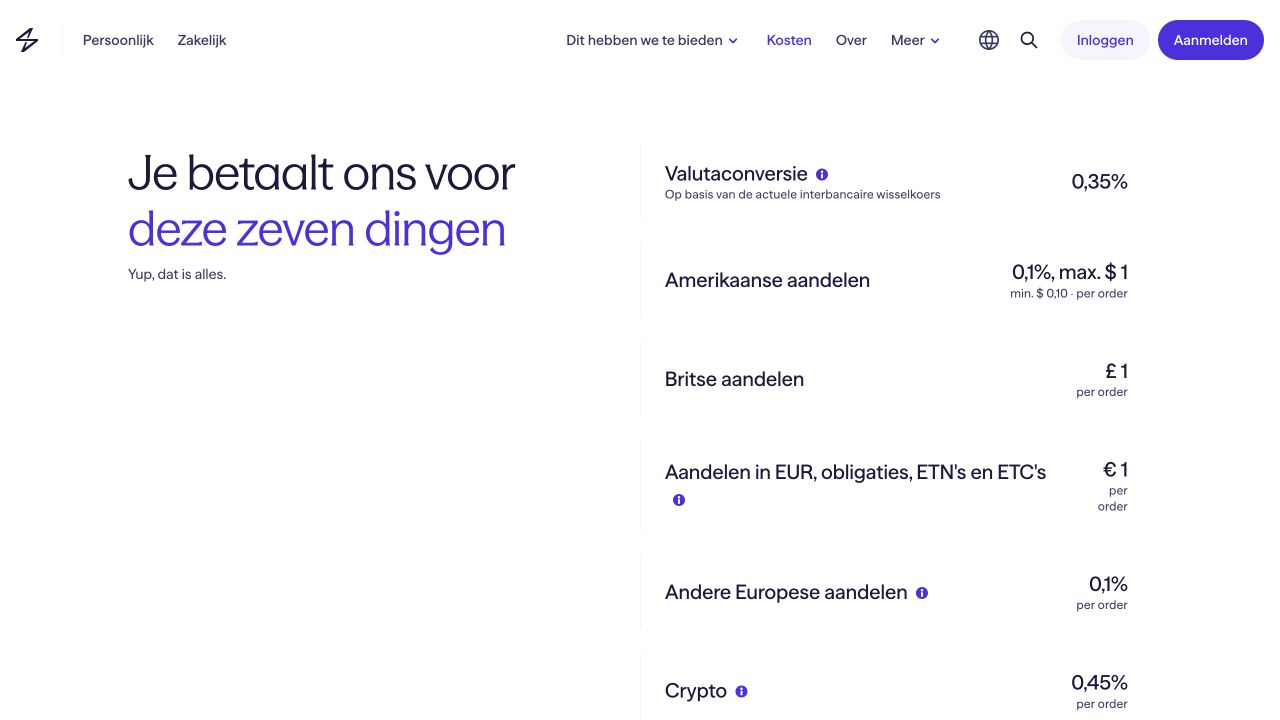
Lightyear's Dutch fee and tax schedule is the base for this table. These are provider charges for the named order or account action. The price paid in the market, bid-ask spread, applicable transaction tax, an ETF issuer's ongoing charge and any third-party transfer charge are separate. A customer may also see instrument-specific charges in the order review.
| Account action or instrument | Published Lightyear charge | Condition that changes the full cost |
|---|---|---|
| EUR-denominated share, bond, ETN or ETC order | €1 per order | An ETF is not in this fee line. Spread and relevant tax can still apply. |
| US-listed share order | 0.10%, minimum $0.10, maximum $1 | Denominated in USD. Converting euro cash adds FX cost. |
| UK-listed share order | £1 per order | GBP funding or conversion, spread and possible UK stamp duty remain. |
| Share in specified other European currencies | 0.10% per order | Currency-specific minimums apply. Inspect the instrument and tariff. |
| ETF buy or sell order | €0 Lightyear execution fee | Fund charge, spread, tax where applicable and FX for a foreign-currency line can remain. |
| Currency conversion | 0.35% of converted amount | Applied using Lightyear's stated live interbank exchange-rate basis. |
| Account management and custody of listed securities | €0 Lightyear fee | Does not remove fund-level or transaction costs. |
| Local bank transfer in or out | €0 Lightyear fee | A sending or receiving institution can have its own fee. |
| Fast card/Apple Pay/Google Pay deposit | 0.6% | Optional alternative to a local bank transfer. |
The Dutch price display separately shows the 0.35% conversion rate, the €1 EUR-denominated share line and the US share cap. The fuller fee help gives currency-specific minimums for other European shares, a charge for an incoming USD bank transfer and statutory charges on certain instruments. Do not generalise the €1 line to every European exchange or the zero ETF execution fee to a zero cost of ownership. A fund's key information document is the place to check its own charges.
Three Netherlands cost scenarios
One €1,000 EUR-denominated listed share purchase. For a share quoted in euros and paid from euro cash, the listed Lightyear execution charge is €1. No currency conversion is needed for that assumption. A later sale is another order and has another charge. If the share is on a market with statutory transaction tax, or if its bid-ask spread is wide, the complete economic cost is higher than the €1 provider charge. The fee help distinguishes the provider charge from applicable taxes. This example does not claim that any named security was bought at a particular price.
A €200 monthly EUR-denominated ETF plan purchase. Lightyear publishes €0 of its own ETF execution fee, including ETF orders through a custom Plan. Paying from euros into a EUR-quoted line avoids Lightyear's currency-conversion charge. The ETF issuer's ongoing charge is reflected within the fund, and a bid-ask spread can affect the purchase price. The Plans rules explain that an individual-share order in a custom plan still pays the applicable share charge, whereas ETF execution is free. The selected ETF must be available, and a small contribution can fail to buy a whole-only instrument. This is why the apparent €0 order charge is not a promise of zero all-in cost or successful monthly execution.
A US share purchase after converting €1,000 of euro cash. A 0.35% FX charge on €1,000 is €3.50 as a simple fee illustration, before the USD share-order commission. Lightyear publishes that commission as 0.10% of the USD order, with a $0.10 minimum and $1 maximum. The actual USD notional and exchange rate determine the commission, so it should not be added to €3.50 as though dollars and euros were the same currency. A sale and reconversion can create later charges. If the investor already holds enough USD cash, conversion is not required for that purchase. The share commission still applies. The Dutch tariff establishes both published rates. No live execution price, spread or US sale levy is assumed here.
These scenarios show why a provider comparison should hold constant the instrument, venue, currency, order size and frequency. The stock broker comparison uses relevant stock-order conditions. The ETF broker comparison evaluates recurring fund use. A seemingly small share commission can be less relevant than repeated FX conversions, while an ETF fee of zero says nothing about the issuer's fee or a thinly traded line's spread.
Plans, fractions and the web/app workflow
Lightyear's Plans guide distinguishes a custom basket from a ready-made plan. You can set weights and a recurrence for a custom plan, and the plan can include eligible shares, ETFs and crypto-assets. Custom share purchases retain their applicable order fee. ETF orders have no Lightyear execution fee. Lightyear says ready-made plan orders have no execution charge, regardless of account type. Both types can still incur FX conversion when the plan lacks enough cash in the instrument's currency. A recurring bank transfer and plan recurrence are separate settings, so stopping one does not necessarily stop the other.
Two Dutch customer reports show both appeal and friction in the interface. One five-star reviewer who said they moved from two other brokers valued the cost display and investing insights, while finding the screen somewhat busy. Another five-star reviewer liked the clear design and company information but was frustrated that some European shares could not be bought fractionally in euros. Lightyear replied that it was expanding fractional availability. Neither customer's cost comparison or named-share availability is a current tariff or catalogue check; those details depend on the exact instrument and date. The actionable test is to search your intended ISIN and currency in the live catalogue, look for the Fractional label and compare the order preview with the published fee schedule.
Most ETFs on Lightyear can be bought fractionally, but the ETF help notes exceptions and marks eligible products on the instrument page. Lightyear's Plan conditions say a sub-order can be only partly completed if an instrument becomes unavailable or loses fractional eligibility. The other plan orders may still proceed. For a Dutch resident using a fixed monthly amount, check the selected ISIN and unit price rather than assuming every plan allocates the full amount every time. Dividends go to the Lightyear account balance, not automatically back into the Plan.
Lightyear's fractional-share guide confirms that not every instrument has that label and that fractions can be bought and sold only with market orders. Its Plan rules further say automatic recurring investment applies only to fractional instruments; a whole-only share added to a custom plan must be bought separately. This is the practical consequence of the limitation in the customer report: a plan may display a desired share without automatically buying it on each recurrence.
The service is accessible by mobile app and web. Its statement instructions give separate download paths for both interfaces. The pricing-data help says some displayed quotes are live and others delayed, depending on market-data agreements. A displayed indication or limit-order estimate is not an execution guarantee. The account route is therefore suitable for straightforward recurring orders and basic portfolio tracking, but the user should examine the instrument page and order preview for venue, currency, quantity and estimated cost. The ETF broker comparison explains those checks across providers.
Lightyear's country-specific tax-advantaged accounts are listed for Estonia, Hungary and the UK in its service inventory. That list does not describe a Dutch tax-advantaged wrapper. A Netherlands resident is using a standard investment account and should examine their own tax obligations independently. The Dutch investing-tax guide covers the tax-authority framework.
Ownership, custody and protection
Lightyear says the customer remains the beneficial owner of listed securities held through the service. Its ownership explanation says shares, ETFs and bonds are held for customers in client-asset arrangements, with an omnibus account in Lightyear's name and records of each customer's entitlement. US and European securities use different custody chains. An omnibus registration is not the same as Lightyear becoming the beneficial owner of the customer's position, but it does make the broker's recordkeeping and custodians relevant.
Its client-asset protection explanation says uninvested funds are held separately from its own assets at regulated EU credit institutions and qualifying money-market funds, and invested instruments are held with custodians. It describes the Estonian Investor Protection Sectoral Fund as covering an eligible client-asset shortfall up to €20,000 in a qualifying failure case. That is a compensation backstop for failure to return assets, not reimbursement for a decline in the market price. Lightyear's cash explanation says the account balance is not a bank deposit covered by a deposit-guarantee scheme. The coverage is associated with the Estonian EU service entity, not with the UK company's regulatory regime. The broker-safety guide explains how to read custody, firm identity and cash arrangements separately.
Crypto-assets are excluded from that Estonian investor-compensation scheme, according to Lightyear's protection FAQ. The separate crypto custody article says customers cannot send their Lightyear crypto holdings to an external wallet. This matters if someone is considering a mixed portfolio: the same app interface does not make all assets identical in ownership mechanism, transferability or compensation.
Statements and transfer limits
For recordkeeping, Lightyear's Dutch statement help lists an account statement, annual income statement, capital-gains report and annual ex-post cost report. The reports can be exported as PDFs through the app or web interface. Dividend entries appear in broader account and income statements. There is no separate dividend-only report. A Dutch resident should retain year-end balances, transaction confirmations, currency conversions and income records for their own filing. Provider exports can aid that work, but they are not individual Dutch tax advice.
Lightyear's portfolio-transfer rules allow qualifying whole shares, ETFs and bonds to move in or out when the receiving broker supports them. The instrument must match the relevant exchange and currency. A share or ETF position normally has a minimum transfer value of €1,000, £1,000 or $1,000 in those currencies. Fractional positions and crypto-assets cannot transfer in kind. Lightyear says it currently does not charge its own transfer fee, while the other provider may charge. A smaller holding may have to remain in place or be sold, with any resulting order, spread and FX costs. This is a concrete portability limitation for an investor who expects to change providers later.
When to consider another account
Lightyear can suit a resident who wants a compact web/app investing route, EUR ETF plans and transparent published share and FX charges. It can be less suitable for someone who needs listed derivatives or a specialised trading workspace, wants to move many fractional holdings, or expects every market quote to be live. It is also worth comparing a euro-listed fund against a foreign-currency line before choosing on an ETF execution-fee headline alone. The review directory links to other accounts, and the broker comparison weighs different account types by investor scenario. The appropriate account depends on the exact instruments, funding currency, records and transfer needs.
Frequently asked questions
Does Lightyear charge for an ETF purchase in the Netherlands?
Lightyear publishes no own ETF execution or custody fee. An ETF issuer's charge, market spread, applicable tax and currency conversion for a non-euro line can still affect the total. Check the selected ISIN and order preview rather than treating every ETF as cost-free.
Is a US stock order free if I already hold dollars?
No. The published US stock commission is 0.10% of the USD order, subject to the $0.10 minimum and $1 maximum. Holding enough dollars can remove the need for a new euro-to-dollar conversion for that purchase, but it does not remove the share-order charge.
Can I buy a fraction of every ETF and transfer it later?
Most, but not all, offered ETFs permit fractional purchases. Lightyear's transfer policy accepts whole qualifying positions, not fractions, and applies matching venue/currency and minimum position conditions. Check both the instrument's fractional label and the transfer rules before using a small recurring plan.
Is Lightyear a forex or CFD broker for Dutch residents?
No CFD, options or futures service is listed for the account, and the provider's service inventory explicitly excludes those instruments. Its currency conversion supports investing and multi-currency cash management. It is not itself a leveraged forex trading account.
Which company holds my account and what protection applies?
The Netherlands is listed among countries served by Lightyear Europe AS, the Estonian investment firm. Customers are described as beneficial owners of segregated listed assets. The Estonian investor scheme is a conditional backstop of up to €20,000 for an eligible failure to return client assets. It does not cover a fall in the price of an investment. Crypto-assets are outside that scheme.
How can I test Lightyear against a monthly ETF plan?
Write down the ETF's ISIN and the exchange line you actually want. Lightyear's ETF guidance explains that the catalogue focuses on supported funds and does not include US-domiciled ETFs. Its Dutch charges page separates ETF execution, share trading and currency conversion. A zero provider execution charge for an eligible ETF does not remove the fund's own ongoing expense or spread. Estimate twelve purchases, any sale and the cash currency used. If a specific ETF line is unavailable, the low published fee for a different fund does not solve the investor's product choice.
When does a multi-currency balance help, and when does it add work?
If a resident already holds the instrument's currency in the account, they may avoid a new conversion at the moment of purchase. That does not mean the currency was obtained without cost, or that its euro value cannot change before the investment is sold. Lightyear's fee page gives the conversion and order components separately. A reader buying occasional euro ETFs may value the simpler one-currency path, while a person holding US shares may benefit from planning conversions and cash balances. Record each funding, conversion, trade and withdrawal step to compare the full account with a broker that automatically converts on every order.
What should I verify before relying on a fractional position?
Check whether the exact share or ETF supports fractions, how the holding is recorded and whether another broker accepts it in kind. Lightyear's plan information explains the automation route, but a plan's convenience is only one part of its long-term suitability. A fraction can let a small contribution buy exposure to an expensive unit, yet a later portfolio move may require sale or leave a remainder. Download statements and note the security identifier and currency. If portability is central, compare that exit path with the initial ease of purchase rather than treating fractional dealing as an unconditional advantage.