

Start with the name on the agreement
The logo on an app may be shared by several companies. A broker can use one company for investments, another for CFDs, and a bank for cash. Find the contracting entity in the proposed client agreement, account terms or onboarding disclosure. Write down its full legal name, registration number, registered country and the service or product you intend to use. Do the same if the broker changes its terms or moves accounts to a new entity. A review that says only “regulated in Europe” leaves this essential question unanswered.
If the public website and agreement show different names, do not assume they are interchangeable. The trade name may legitimately differ from the registered legal name, but the company should explain the relationship. Ask the broker to identify the exact entity providing the service to a Netherlands resident and to provide its regulator and register number. This is particularly important for a group with separate investment and derivatives businesses.
Who regulates an investment firm serving the Netherlands?
The Netherlands has two relevant supervisors with different roles. The AFM licenses and supervises the conduct of Dutch investment firms. DNB handles prudential supervision of investment firms in the Netherlands, including financial requirements. This division does not mean that every firm listed in the AFM register has a Dutch licence or that DNB is the primary supervisor of every foreign broker.
| Entity serving the Dutch client | Who supervises it? | What to verify |
|---|---|---|
| Dutch investment firm with an AFM licence | AFM for conduct; DNB for applicable prudential requirements. | The AFM licence, legal name and permitted investment services. |
| Investment firm established in another EEA country and operating through a European passport | Its home-country regulator is the primary supervisor; the AFM has a limited role. | The incoming passport entry in the AFM register, the home-country authorisation and the services covered. |
| Investment firm based outside the EEA | A licence from its home country alone does not create an EEA passport. The Dutch route depends on the client and service. | Whether the firm has the required Dutch authorisation or an applicable exemption for the proposed service. |
An EEA investment firm can serve Netherlands residents under a European passport when it is authorised for the relevant services at home and the cross-border notification has been made. The AFM explains that the firm remains under home-country supervision; the passport is not an AFM quality endorsement. For a firm outside the EEA, the AFM's third-country rules say that an investment firm serving Dutch retail clients generally needs a Dutch branch and AFM authorisation. Other client categories and exemptions have different rules. Check the actual entity and proposed service rather than treating an overseas licence as permission to serve Dutch retail investors.
Search the AFM register correctly
The AFM investment firms register includes Dutch-licensed firms and firms operating in the Netherlands through a European passport. A European-passport firm is authorised by its home-country regulator and has notified the AFM that it will provide investment services in the Netherlands. The AFM explicitly says that such a firm does not hold an AFM licence and is subject to more limited AFM supervision. Therefore, an entry in the register supports a precise statement about the entity and its status. It does not justify calling every listed broker “AFM licensed”.
Search by the legal name from the agreement, not only the marketing brand. Compare the address, registered country, trading names and services in the result. The AFM’s provider-check guidance also advises asking the firm for its exact licensed name if a search does not match. Its simplified search tool does not contain every registration, so a missing first result is a reason to investigate further, not proof on its own that a provider is unauthorised. Search the full relevant register and, for a passported entity, the home regulator’s entry as well.
Record what you found: the exact legal name. Register entry. Permission or passport category. Home regulator. And the product or investment service. A firm’s registered status is only one part of the decision. It cannot tell you whether an investment strategy is suitable, whether the broker’s prices are competitive or whether its app is easy to use.
Consider a trading app that accepts a Dutch address but whose client contract names a company established elsewhere in the EEA. Search the contracting company's exact name in the AFM register. If the result is a European-passport entry, compare its legal name, country and permitted services with the home regulator's register and the proposed account. Then check that company's custody agreement and home-country compensation scheme. The app's availability in the Netherlands does not establish any of these points.
Separate the three forms of protection
When people ask whether a broker is “safe”, they often combine three different issues. They should be checked separately:
| Question | What to inspect | What it does not answer |
|---|---|---|
| Are client assets kept apart from the firm's own assets? | Client-asset and custody terms. Named custodian or bank. Legal title and account structure. | Whether the price of an investment will rise or fall. |
| What applies to uninvested cash? | Whether cash is a bank deposit, segregated client money or another arrangement. The bank and jurisdiction. | Whether securities or derivatives are covered by deposit insurance. |
| What if an investment firm cannot return assets? | The applicable investor-compensation scheme for the contracting entity and account. | Ordinary market losses or every loss arising from a broker failure. |
The AFM’s explanation of asset segregation describes several ways client holdings and money can be separated from a broker’s own estate. A broker may use a separate legal custody entity, arrange for a bank to hold assets, or use a segregated cash account. You need the arrangement for the specific account you will open, because an investing account and a derivative account under the same brand can have different terms.
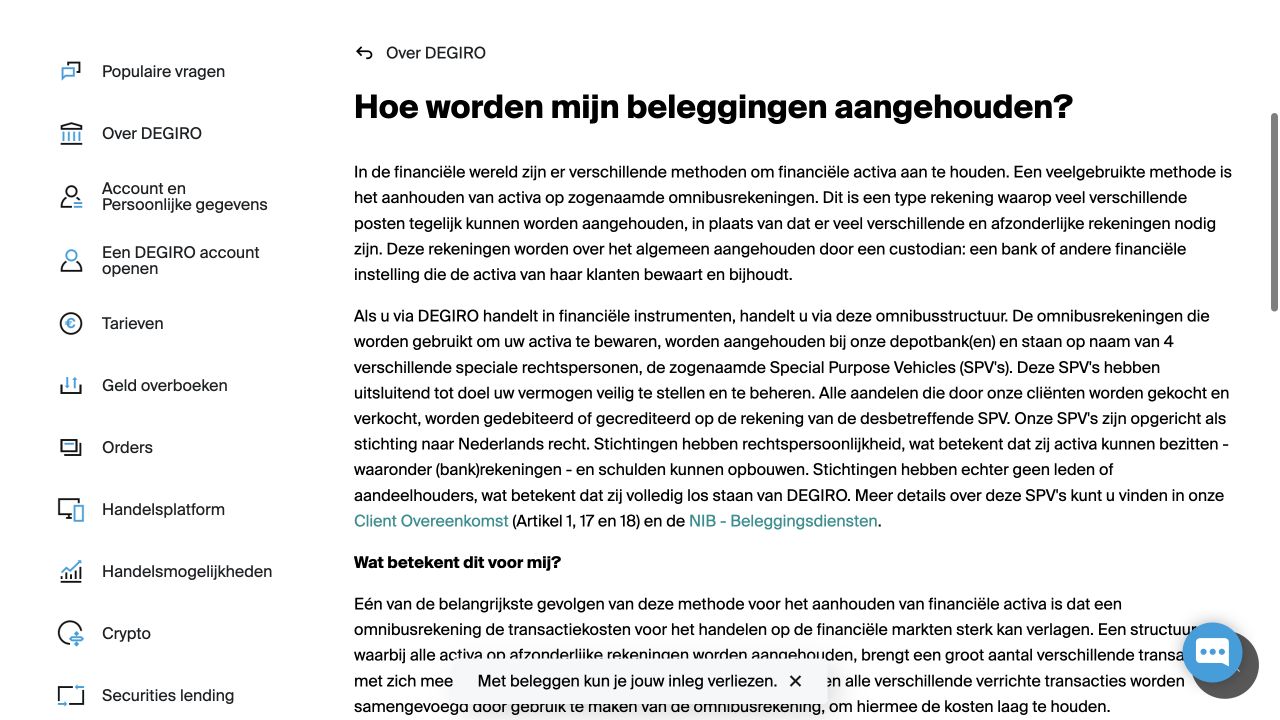
For a concrete example of the kind of document to look for, DEGIRO’s Dutch custody explanation describes omnibus accounts held through separate special-purpose foundations. This illustrates the questions to ask about the holder of securities. It does not establish that every broker uses the same structure. Read the linked client agreement as well as the summary when checking a particular account.
For Dutch bank accounts, De Nederlandsche Bank (DNB) distinguishes the deposit guarantee from investor compensation. Its explanation states that the Dutch deposit guarantee generally protects eligible bank balances up to €100,000 per person, per bank. That is a rule about qualifying deposits and banks. It is not an automatic guarantee for every amount displayed as “cash” in a trading app. Check the bank, the legal nature of the balance and the applicable country before claiming that a particular account is protected by this scheme.
Understand investor compensation without treating it as a portfolio guarantee
The Dutch investor-compensation scheme can apply when a covered financial institution that provides investment services fails and cannot return client financial instruments or funds. DNB says the Dutch scheme has a limit of €20,000 per eligible investor. That figure describes the Dutch scheme, not a universal benefit attached to a Dutch postal address. Where the broker’s head office is in another country, DNB says the home-country scheme will usually apply. EEA countries must offer at least the minimum established by European legislation, although individual national rules may differ. Ask the broker which scheme applies to your particular account.
Asset segregation comes first: if assets remain identifiable and can be returned by an administrator after a firm fails, those holdings are not automatically reduced to a compensation limit. Compensation concerns the shortfall when return is not possible under the applicable conditions. DNB gives an example in which a fund’s value falls but the holdings are still available: that is not a claim under investor compensation. This is why a review should describe custody and the applicable scheme separately.
There is also a practical difference between a balance shown in an app and the legal claim behind it. A broker may transfer uninvested cash to a bank, hold it in a segregated client-money structure or use another arrangement described in its terms. The label “cash” in a portfolio screen is not enough to identify the bank, country or protection. Read the client-money disclosure and ask where the money is placed, whose name appears on the bank account, and which scheme the provider says applies. Keep the written answer with the contract. It is more useful than a generic support-page promise if an account is later migrated.
Check the product, not just the company
“Stock trading” on a broker website may refer to actual shares, fractional interests or a derivative that tracks a share price. The position confirmation and product information should tell you which one you would hold. A real share, an ETF unit and a CFD create different legal and financial positions. Check the instrument name or ISIN where applicable, the account type and whether you will own the underlying security. If the broker offers both investing and CFD accounts, repeat the entity and custody checks for each account rather than transferring the investing account’s description to the CFD product.
Read the order preview and applicable fee schedule before proceeding. A claim such as “zero commission” does not by itself settle the total cost: FX conversion, bid–ask spread, financing, custody, market data or withdrawal terms may still matter for the intended trade. For a US share bought with euros, FX and market access are relevant. For a Dutch-listed ETF bought each month, recurring-plan terms and the ETF’s own ongoing charges matter. Our stock-broker comparison and ETF-broker comparison use those separate scenarios.
A practical verification sequence
- Choose the exact product and account you want to use. “Invest” and “CFD” are not interchangeable labels.
- Save the legal name and registered country from the proposed client agreement. Check whether a bank or other custodian is separately named.
- Match that name to the AFM investment-firm register. Distinguish an AFM licence, an incoming EEA passport and any third-country route. For a passported firm, check the home regulator too. Compare the allowed service with the intended account.
- Read the custody and client-money terms. Identify where securities and uninvested cash are held and what the agreement says about segregation.
- Identify the investor-compensation and, if relevant, deposit-guarantee scheme. Verify who qualifies and which legal entity participates. Do not infer protection from the brand alone.
- Compare the product and costs against your actual use: instrument, exchange, currency, order size and holding period. Use the broker’s official terms and tariff for the account available in the Netherlands.
- Keep copies or links to the agreement and relevant disclosures. Recheck when the broker notifies you of an entity, custody or tariff change.
This process is an account-verification method, not an endorsement of a particular provider. Our review methodology explains how the same checks are used in our comparisons and individual broker reviews.
Frequently asked questions
Is every firm in the AFM register licensed by the AFM?
No. The AFM register also includes firms operating through a European passport, which are authorised in their home country. State the actual status and supervising authority for the entity serving the Dutch customer.
Can a broker regulated in another EEA country serve Dutch residents?
Yes, if the relevant investment firm is authorised at home for the service and has completed the European-passport notification for the Netherlands. Check the legal entity in the AFM register and its home regulator's register. This is a valid cross-border route, but it is not an AFM licence.
Is a licence from outside the EEA enough to serve Dutch retail investors?
No. A non-EEA licence does not provide a European passport. The AFM's third-country guidance sets a Dutch branch and AFM authorisation requirement for investment firms serving retail clients in the Netherlands. Rules for other clients or specific exemptions differ, so verify the exact legal route instead of relying on the foreign licence alone.
Does Dutch investor compensation cover a fall in my ETF or share price?
No. The DNB scheme explanation addresses situations where a covered firm cannot return assets or money. Price movements in holdings that are still available are a different matter.
Does a Dutch resident always get the Dutch compensation scheme?
No. DNB says that an investment firm headquartered in another country will usually be covered by that country’s scheme. Check the contracting entity and obtain confirmation from the broker about the applicable arrangement.
What if the broker’s brand does not appear in the AFM’s quick search?
Use the exact legal name in the full register and check trading names and passport status. The AFM says its simplified provider search does not include all registrations. Ask the firm for its legal name and registration reference if the result remains unclear.