

Step 1: Give the money a purpose and a time horizon
Write down the objective before choosing a product: building long-term capital, making a future purchase, or learning how the market works are different purposes. Then ask when the money might be needed. A sum required soon for rent, tuition or an emergency has a different job from money set aside for many years. The AFM’s consumer guidance recommends maintaining sufficient savings as a buffer and investing money that can be left for a longer period. It also describes diversification, low costs and avoiding unnecessary trading as practical considerations.
You do not need a precise future-return forecast to make this first decision. Try an adverse scenario instead: if the investment were worth materially less when you needed the cash, would you have to sell at an inconvenient time? If the answer is yes, reconsider the amount or timing. This is about matching the investment to the purpose, not predicting prices. Likewise, a broker’s attractive sign-up flow does not change the fact that an asset can fluctuate after purchase.
Step 2: Choose the kind of asset before the provider
A share is an interest in a particular company. An exchange-traded fund (ETF) is a fund that trades on an exchange. Its portfolio and strategy depend on the specific fund. Neither label alone tells you whether the investment is diversified or suitable. Read the instrument name, ISIN, investment objective and relevant fund documents. Where there is a choice between an Amsterdam listing in euros and another listing in a different currency, the exchange and currency can change the total purchase cost.
An instrument that only follows the price of a share is not necessarily that share. Some trading interfaces show real stocks, stock CFDs and other derivatives in adjacent search results. Check the account type and product description before pressing buy. For a first long-term purchase, the distinction matters because the ownership, financing and price exposure differ. Our CFD guide explains the contract mechanics separately. Our stock-purchase guide explains a real-share order.
Diversification also happens at the holdings level, not just the number of buttons in an app. A portfolio of several shares concentrated in one industry may still depend on similar economic drivers. An ETF may hold many securities, but you still need to read what it tracks, how concentrated it is, and its ongoing fund charge. An account comparison should therefore ask which intended instruments the broker actually makes available to a Dutch client.
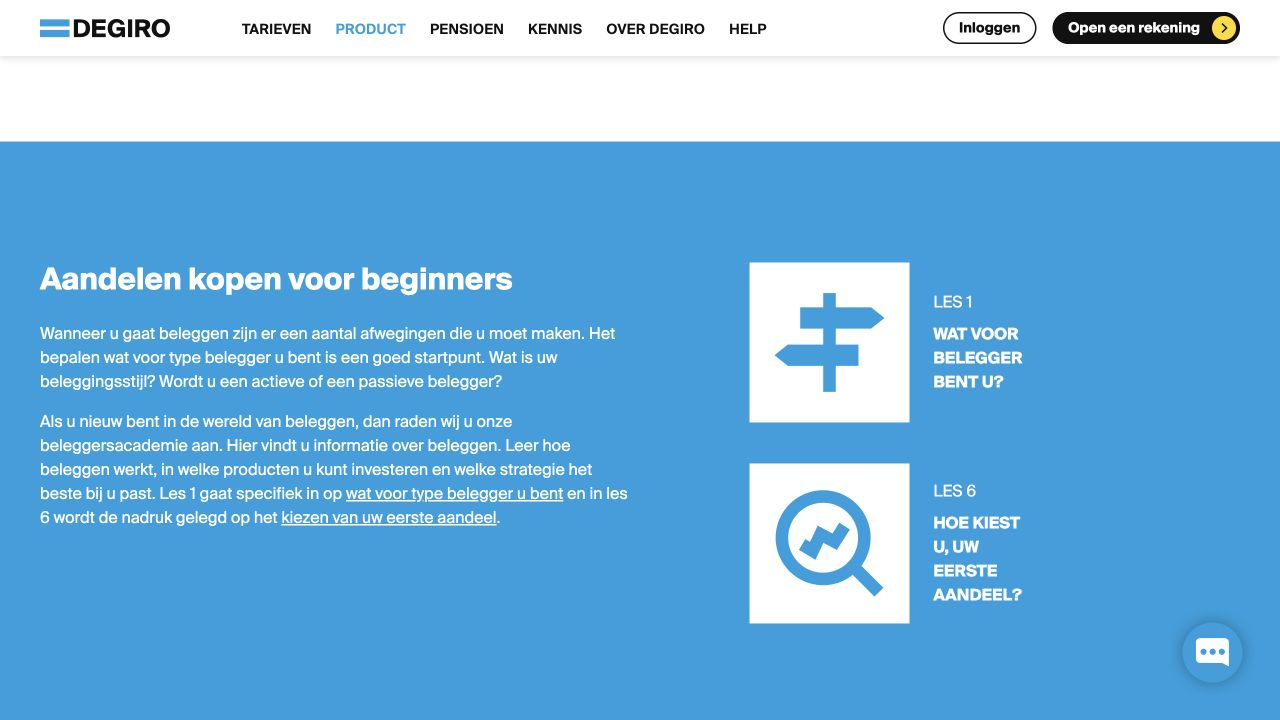
Broker education pages can help you learn the vocabulary, but they are written by providers with an interest in acquiring customers. For example, the DEGIRO Netherlands share page separates lessons about your investor type and choosing a first share. Use such material to identify questions, then verify product terms and costs in the broker's formal documents and compare other providers as well.
Step 3: Select the account that fits that use
Begin with the exact order you expect to place: perhaps one Euronext-listed ETF each month, or a small purchase of a Dutch-listed company. Use that scenario to compare brokers. A provider with broad international markets may suit someone who wants many exchanges, while an uncluttered interface may suit someone who values a simple first order. The account’s legal entity and the availability of the intended asset are more basic tests than its marketing label. Our broker-verification guide explains how to identify the firm serving a Netherlands resident and check its status.
When reading a broker page, separate these questions:
| Question | Why it matters to a first investor |
|---|---|
| Can I buy the exact real share or ETF? | A search result may be a different listing, fund share class or derivative. |
| Which legal entity opens my account? | It determines the agreement, supervision and potentially the applicable compensation arrangement. |
| What will my intended order cost? | Commission is only one component. FX and service charges can change the result. |
| Can I understand the order preview? | You should be able to identify the instrument, units, estimated price and fee before confirmation. |
| What records will I receive? | Contract notes and annual statements help with your own records and Dutch tax reporting. |
The table is a decision checklist, not a score. Different people may weigh the answers differently. Read the beginner-broker comparison for account choices and the ETF-broker comparison if recurring ETF purchases are your intended use.
Step 4: Work out the full cost of a small purchase
The AFM separates costs of investment services from costs inside the investment product. On the service side, a broker may charge transaction, custody, account or ancillary fees. On the product side, a fund has its own ongoing expenses. A leveraged derivative can have financing costs. This is why “commission free” is not a complete answer.
Use a simple worksheet for your intended order. List the amount in euros, the instrument and listing venue, the broker’s dealing charge, any exchange or third-party charge, any FX conversion, and the product’s ongoing charge where relevant. If you expect to buy each month, multiply only those costs that actually repeat. An annual account charge should not be multiplied by twelve. A per-order charge may be. If you intend to hold a share priced in US dollars while funding in euros, check how both the purchase and a later sale are converted. If a rate is not clear from the official tariff for your account, leave it unresolved until you have the answer instead of relying on a generic calculator.
For example, compare two hypothetical accounts for the same €100 monthly ETF purchase. One has a visible dealing charge for every order. The other advertises no dealing commission but applies a currency-conversion charge because the chosen listing is not in euros. The cheaper route cannot be inferred from either headline. You need the exact instrument, exchange, payment currency and fee schedule. This example uses no broker-specific figures because the exercise is about the method. Published comparisons should use verified current tariffs for actual options.
Step 5: Check the first order screen carefully
Before placing an order, verify the company or fund name, ISIN or ticker, exchange, trading currency and whether the product is a real security. Then read the order type. A market order generally prioritises execution at an available price. A limit order sets the highest purchase price you are willing to pay, but might not execute. The precise behaviour can depend on the venue and broker terms, so read the broker’s order explanation before using a type you do not understand. The transaction preview should show estimated value and charges. Retain the confirmation after execution.
A trial or demo screen can help you learn where the controls are, but a simulated trade does not prove what a real execution will cost or how it will fill. We do not treat a polished demo as evidence of low real-world fees. A useful first transaction is one small enough that you can study each stage while still following the plan you set in Step 1. Once the trade settles, compare the contract note with your estimate, and make a note of any difference attributable to price movement, FX or fees.
Step 6: Keep the Netherlands tax context in view
Your account’s location does not by itself remove Dutch tax-reporting obligations. The Belastingdienst’s Box 3 guidance includes relevant assets held in the Netherlands and abroad. Keep year-end and valuation-date statements, cash balances, transaction reports and dividend records so that you can follow the instructions for the applicable tax year. The details of Box 3 and dividend withholding are separate topics, covered in our Netherlands investing-tax guide. Do not choose a broker solely because its interface offers a generic “tax report”. Check what information the report actually contains for a Dutch taxpayer.
A first-investment checklist
- State why you are investing and when you might need the money.
- Keep a cash buffer appropriate to your situation.
- Choose whether the intended asset is a real share, an ETF or something else, and read its documents.
- Confirm that a Dutch resident can open the relevant account with the named legal entity.
- Check the broker’s register entry and the custody/cash terms.
- Calculate all relevant costs for the exact instrument and order size.
- Read the order preview, use an order type you understand, and save the trade record.
- Review the holding against your original purpose and keep records for the correct tax year.
Frequently asked questions
How much do I need to start investing?
There is no single sensible amount for everyone. The practical minimum depends on the instrument price, whether fractional orders are available, and how any fixed fee compares with the order size. Start from a cash buffer and time horizon, then check the broker’s actual minimum and full order cost for the asset you want. Avoid using a provider’s advertised minimum as a recommendation about how much you personally should invest.
Do I need a Dutch broker to invest while living in the Netherlands?
An account can be provided by a Dutch firm or by an eligible firm from another country, depending on the service and legal entity. What matters is whether the specific provider may serve you and what agreement, supervision and protection apply. The AFM register includes firms operating through a European passport as well as Dutch-licensed firms. Check the entity rather than assuming that the language or address of a website identifies the regulator.
Is an ETF automatically safer than a single share?
An ETF can hold a basket of assets, which may reduce concentration in a single company, but its holdings, strategy, currency exposure and charges vary. Read the fund documents and decide whether the particular ETF fits your purpose. A fund label alone does not settle the question.
Should I choose the broker with the lowest advertised commission?
Only after comparing the full cost for your intended use and checking product access and the legal entity. The AFM cost guide lists multiple service and product cost categories. A small recurring ETF order and an occasional foreign-share order can favour different fee structures.