

 XTB
We examined the XTB EU onboarding guidance, Cyprus account and fee pages, product documents and the relevant legal index. Our research is based on published documents. The review examines the Cyprus account route and product documents. The editorial methodology explains the approach. For a broader set of CFD routes, see Best CFD Brokers. The stock-broker comparison concerns actual share ownership.
Which XTB company would serve a new Dutch applicant?
XTB's country guidance says residents of EU countries select XTB Limited in Cyprus for registration. The Cyprus legal page identifies XTB Limited as a firm authorised by the Cyprus Securities and Exchange Commission, licence 169/12. This is the entity whose documents we use for the account examples below. XTB also has Polish, UK and other companies. A fee schedule from one of those companies is not automatically a Dutch applicant's tariff. Before depositing, compare the name on the application and agreement with the name on the product and cost document shown in the account.
The relevant distinction goes beyond regulation. A real share, a fractional right linked to a listed instrument and a share CFD are different claims. The first is a security holding, the second has contract-specific rights, and the third is a derivative with XTB on a price difference. The account screen should identify which one is being ordered. A company-wide product catalogue cannot settle that for an individual signup route.
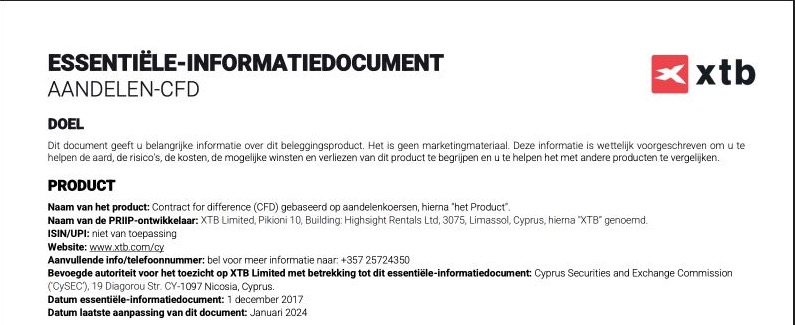
The share-CFD label in XTB Limited's Dutch-language key information document makes the derivative product explicit. This document identifies a CFD. It does not establish the current availability of real shares in a new Dutch account.
Can a new Dutch client buy real shares or ETFs?
The public record does not give a dependable yes-or-no answer. XTB's Cyprus stock-and-ETF help answer says that clients registered under the Cyprus jurisdiction can trade only stock and ETF CFDs, with no real shares or ETFs. Yet the newer Cyprus legal index lists September 2026 terms for CFDs plus organized-market instruments and key documents for ETFs and fractional rights. The instrument-document index also lists an organized-market and fractional-rights specification from October 2026. The Cyprus stock page refers to real stocks alongside stock CFDs. These sources may reflect a recent product change, different eligibility groups or unevenly updated help content. The pages do not resolve which applies to a new Netherlands resident.
Our practical conclusion is limited. The Cyprus CFD range is documented. Underlying-share or ETF access for a new Dutch account is unconfirmed. Do not assume the stock-CFD help answer remains the whole catalogue, and do not assume the newer document list guarantees access. Ask XTB which product type and legal entity the actual account will show, then check one intended share or ETF symbol before funding. If you need a proven listed-security route now, compare providers with explicit Dutch-account share conditions in Best Stock Brokers and Best ETF Brokers.
XTB fees for the Cyprus route
The Cyprus account FAQ describes one Standard account. It says CFD markets have no separate dealing commission, with much of the trading cost in a wider spread. That does not make the order free: a round trip crosses bid and ask, and a held position can add financing. The Cyprus fee explanation also covers conversion and inactivity. Use the contract specification for the exact symbol rather than a group-wide “from” spread.
| Cost item | Cyprus document and condition | What to inspect before deciding |
|---|---|---|
| CFD dealing | Standard account generally has no separate CFD commission. Spread includes much of the cost. | Live bid, ask, contract size and whether the selected symbol has any different term. |
| Overnight CFD position | Some CFDs accrue daily swap points, credited or debited according to symbol and direction. | Symbol-specific swap rate, cut-off and planned holding days. |
| CFD currency conversion | A 0.5% margin is included in XTB's exchange rate for applicable CFD cash-flow conversions. | Account currency, instrument currency and whether a conversion actually occurs. |
| Inactivity | €10 monthly only when both inactivity conditions are met and available cash exists. An open position prevents the charge. | Last open/close, last deposit, open positions and cash balance. |
| Withdrawal | XTB says no fee above €100, €10 under €100. Other banks can charge. | Amount, receiving bank and current payout instructions. |
| Real share/ETF dealing | Public Cyprus product-eligibility pages conflict. | Do not apply another XTB entity's advertised share commission to a Dutch signup. |
The Cyprus conversion explanation describes a 0.5% margin on the XTB exchange rate for relevant transactions and corporate actions in stock/ETF CFDs and other CFD instruments. For stock and ETF CFDs it identifies closing a position or settling a corporate action. For other CFDs the effect enters the result on closure. It is not a 0.5% charge on every euro-denominated trade. Suppose a Dutch user holds an account in euros and the chosen CFD generates a non-euro result: the rate used to translate that result can include the margin. A euro account trading a euro-denominated contract need not trigger that same conversion. The order and account statements are where the applicable rate should be checked.
An overnight position adds a separate question. XTB says some CFD instruments receive or pay daily swap points. The Cyprus instrument page provides specification and swap tables, including stock/ETF CFD financing material. A minimum spread is a possible opening-price component, not an all-in daily holding cost. For an index CFD held over a weekend, inspect the actual symbol, position direction and the platform's overnight schedule before comparing it with another broker's cash or futures-based contract. We do not quote a live spread or swap because neither is stable for every order.
The inactivity rule requires both no opened or closed position in the previous 365 days and no deposit in the previous 90 days. If both hold, XTB describes a €10 monthly charge from available account funds. It says the charge is not taken if an open position exists or no available funds remain. A reader who holds cash without trading for a long time should model this. A reader who regularly trades or deposits may never meet both conditions. Check the actual statement and account terms if activity crosses the thresholds.
For withdrawals, the Cyprus payout guide says XTB charges no fee for amounts above €100 and €10 for amounts under €100. It does not specify the exact €100 case in that wording, so use the current payout screen for that boundary. The guide says beneficiary or intermediary banks may charge separately and that the first withdrawal requires bank-account verification. XTB says it processes Cyprus requests no later than the next business day after receiving them. The beneficiary's receipt time can differ. The Client Office shows payout history, useful when reconciling account cash.
What xStation gives you
The current Cyprus platform FAQ identifies XTB's own web platform and iOS/Android app. It lists charts and technical-analysis tools, order and portfolio management, market data, a calendar, market statistics and layout customization. That makes xStation a coherent route for someone who wants to monitor a CFD position and its collateral in one interface. It does not prove the quality of live execution, app stability or every instrument's availability. Account permissions depend on the agreement and enabled products.
What users report, with the country limit. A German customer writing in July 2026 liked the clear layout and reported fast orders in their own use, but said drawings made on the phone chart did not appear in the web platform. XTB's reply acknowledged that freehand drawings did not sync across those surfaces then, while saying price alerts did. A second German customer describing CFD use in August 2026 reported long mobile loading times, occasional frozen charts and slow switching between contracts; XTB asked for app logs to investigate and said those delays were not known to it. Neither review identifies a Cyprus account, and neither measures platform-wide speed or the current performance of a Dutch applicant's setup. Together they suggest a practical check: use the Cyprus demo account to open the exact CFD symbols on both devices, test the charts and alerts you rely on, and verify any drawing or template sync before putting a live trade through that workflow. The current Cyprus web-platform guide confirms saved chart tabs and indicator templates can be available on mobile, but does not establish that every drawing is shared.
The same current FAQ says XTB does not presently offer MetaTrader 4 or MetaTrader 5 on this route. Older help-directory links still mention MT4, so the current account-specific platform answer is more useful than an old article title. A reader whose method depends on an MT4 expert adviser or a particular third-party platform should check a different broker route. See Best Trading Platforms for how platform requirements differ from the broker's product and account conditions.
To inspect xStation for a planned order, first search the exact symbol and read its full product label: an index CFD, a share CFD and a listed share must not be treated as substitutes. Then note bid, ask, contract size, currency and margin before opening the ticket. If holding beyond the day, locate the instrument's overnight conditions. A limit or stop instruction changes how the order is submitted, but it does not turn a CFD into an owned security. Use these checks for the exact account and product shown in the order ticket.
Client funds, account records and the relevant protection
The XTB Cyprus site says retail client cash is covered by the Cyprus Investor Compensation Fund up to €20,000 per eligible client in the event of the firm's insolvency. Its legal-document page links the scheme information and company details. Eligibility and the recoverable claim depend on the scheme's rules. This is not reimbursement of market-price losses or CFD trading losses. XTB's product documents also describe the segregation of client funds from company funds. Verify the company on the agreement before attaching that Cyprus scheme description to an account.
For records, the withdrawal guide points to Client Office payout history. Keep account statements, transactions and any currency conversions for your own records. A Netherlands resident may need them to understand account values and transactions when preparing tax information. The review does not infer a tax treatment from a broker's product label. The Netherlands investment-tax guide gives the separate public-source context.
Three account decisions in practice
A Dutch resident wants to buy one Amsterdam share and hold it for years. The decisive question is whether the new account will deliver the underlying listed share. XTB's Cyprus help answer says only stock and ETF CFDs are available, while its newer legal documents refer to organized-market instruments. The reader should not treat a search result for the company name as evidence of ownership. They need the exact share ISIN in the application, the ticket's product category and terms on dividends, custody and transfer. If XTB cannot confirm those before funding, the appropriate comparison is with a broker whose Dutch account clearly supports the security. A CFD opened under a similarly named ticker will not meet this holding objective.
Another resident wants a short index CFD position. Their comparison starts with the exact index symbol, bid and ask, contract multiplier and required margin. XTB's Standard-account description says most dealing cost is in the spread, but the order preview is needed to turn that statement into an estimated euro cost for the chosen size. If the position may remain open after the market closes, add the symbol-specific swap schedule from the instrument specifications. A comparison with another provider should use the same underlying index, trade size, direction and holding period. Otherwise a headline minimum spread will mislead. The result is a shortlist, not a universal winner.
A third resident deposits euros but trades a dollar-priced contract. They should record the account currency, the contract's quote and settlement currency, and the conversion shown when the result is realised. XTB's Cyprus cost explanation describes the conversion margin on relevant cash flows, so a spread-only comparison misses a possible exit cost. If they pause for a year after closing the position, the same document's two-part inactivity rule becomes relevant. They should estimate their actual deposit and trading pattern rather than assume the charge applies immediately after a quiet month. Finally, the withdrawal guide helps check the exit amount, bank verification and possible third-party bank charges. Together these questions describe the account's full cash route.
Where XTB fits, and where another route may fit better
XTB is worth comparing for a trader who specifically wants a Cyprus-regulated Standard account, xStation on web and mobile, and documented CFD categories. The combination is especially relevant if the reader is comfortable checking live spreads, symbol-specific swaps and the cash impact of a currency conversion before every new type of contract. The absence of a separate Standard CFD dealing commission is only one part of that cost picture. A reader intending short positions, overnight holds or multiple account currencies should model those costs separately.
XTB is a weaker match for a reader who requires MetaTrader, who assumes a universal zero-cost CFD order, or who needs an already verified path to buying and holding real shares or ETFs as a new Dutch applicant. In the last case, the problem is evidence, not a finding that the service certainly lacks those instruments. Confirm the actual offered instrument and contract. If ownership cannot be confirmed, use a provider whose Dutch account pages explicitly document it. The beginner-broker comparison weighs how clearly each route identifies the product and its costs. The app comparison focuses on phone workflows.
Frequently asked questions
Is XTB a stock broker for a new Netherlands resident?
XTB's Cyprus site has newer documents referring to listed instruments, but its own stock/ETF help answer says Cyprus clients get CFDs only. We cannot confirm from public pages whether a newly opened Dutch account can buy a real share or ETF. Ask XTB about the specific offered account and check the actual symbol and agreement before treating it as an ownership route. A stock CFD is not the same holding as the share.
What does “no commission” mean on a Standard CFD account?
The Cyprus account description says there is generally no separate CFD dealing commission and that most transaction cost is in the spread. A held position can have swap points, a non-euro result can incur currency-conversion margin, and account-level fees have conditions. Compare the whole cash effect of the intended contract and holding period.
Will I pay the inactivity fee if I have an open position?
XTB says the €10 monthly charge is not made while any position is open. Otherwise it requires both no trade opening or closing for 365 days and no deposit for 90 days, with available funds from which to charge. Check the current Cyprus conditions against your activity history.
Can I use MetaTrader with this XTB route?
The current Cyprus platform answer says no MT4 or MT5 access. XTB offers its own web and mobile xStation platform. A different XTB company or an older help article should not be used to infer a platform entitlement for the new Cyprus account.
Does the Cyprus investor fund cover a losing trade?
No. The Cyprus description concerns eligible client claims if the firm cannot meet its obligations, with a stated maximum of €20,000. It does not compensate for a security falling in value or a CFD position losing money. The exact protection follows the contracting entity and scheme rules.
Which XTB document should I use to check a Dutch share-CFD position?
Begin with the entity on the new account agreement, then use that company's current instrument specification and product key information document. XTB Limited's Dutch share-CFD KID names the derivative explicitly, while the Cyprus specification index supplies contract and swap material. A share's company name or ticker in a platform search is not enough: confirm that the ticket says CFD, its contract size, quote currency, margin and overnight row. A same-day position may avoid overnight swap but still crosses the spread and can face conversion on closing. If the intended task was long-term share ownership, do not proceed with the CFD order simply because the underlying company is familiar.
What if the Cyprus share-access pages contradict one another during signup?
Treat the application and currently offered account documents as the decision point. The older Cyprus help answer says only stock and ETF CFDs, while the newer legal index includes terms for organized-market instruments. Ask the provider to identify the instrument class, custody route and entity for the exact ISIN you want. Keep its written answer with the agreement. If those details cannot be confirmed, compare an explicitly documented Dutch-resident underlying-share route before funding. This uncertainty is specific to the share-access question. It does not erase the separate, documented CFD account and its costs.
How should I compare xStation with a third-party platform?
Write down the functions your strategy actually needs: a particular symbol, a chart interval, order type, alert, export and phone workflow. The Cyprus platform FAQ describes xStation web and mobile and says MT4 and MT5 are unavailable on this route. That makes a workflow based on a MetaTrader expert adviser a poor match regardless of XTB's spread. Conversely, an investor who only wants to inspect a small number of CFDs may not need external automation. Public feature lists do not prove uptime, fill quality or customer support speed. Those require different evidence. Compare the actual account and contract, not merely chart screenshots.