

Identify the exact share before comparing brokers
A company may have several listed securities, share classes or listings on different exchanges. Search for the issuer name, ticker, ISIN, exchange and trading currency together. The ISIN helps identify a security, but it does not by itself tell you the venue or price currency of a specific order. A Dutch company may be available on Euronext Amsterdam while a foreign company trades in dollars on a US exchange. Check the broker's product result and order preview rather than assuming that the first matching company name is the intended security.
The instrument label should also say what you are buying. A real share represents an interest in a company. A CFD references an underlying price without giving you the same ownership interest. Some brokers offer both in separate accounts or search categories. Before placing the order, confirm that the product description and account terms match your purpose. If you are considering a derivative instead, read our CFD explanation before using a stock price as shorthand for the product.
Open an account that can access the listing
Compare brokers for your intended stock order, not for an abstract ranking. Ask whether the account available to Dutch residents supports the exchange, the order size and the type of holding you want. Check the exact legal entity in the client agreement and its status in the AFM investment-firm register. A firm may be Dutch-licensed or operate through a European passport. The register distinguishes those statuses. Our broker-safety guide explains how to match the registered entity to the contract and check asset custody.
An account that offers Euronext Amsterdam may still differ from another in its range of US markets, treatment of fractional holdings, transfers, corporate actions and statements. A fractional interest may not carry exactly the same transfer or voting treatment as a full share. Inspect the broker's terms rather than assuming that a decimal quantity has identical rights. For a long-term holding, the ability to transfer positions and the handling of dividends can matter as much as the first purchase fee.
Ask one further question if you might change brokers later: can the position itself be transferred, and what would the transfer cost? A sale followed by a fresh purchase is operationally different from moving a holding. It can create dealing costs, a period without the position and, for a foreign listing, another currency conversion. The broker's transfer policy should specify which securities and account types qualify, whether fractional portions can move, and any charge by position or market. Keep that answer alongside the opening documents rather than discovering it only when you want to leave.
Calculate what the trade will cost
The AFM's cost guide separates service costs from product costs. For a share order, assemble the relevant broker commission, exchange or handling charge, any FX conversion, spread implicit in the available buy and sell prices, and any ongoing custody or account charge. A headline commission alone does not calculate the all-in cost of an international purchase.
Consider a €500 intended purchase. If the selected share is listed in euros, there may be no currency conversion for the purchase, although dealing and other charges still need checking. If it is listed in dollars, the broker must convert euros or hold a dollar balance. An FX fee or exchange-rate spread may apply. The same issue can arise again on a later sale or when a dividend is converted. This example deliberately uses no broker tariff figure: the correct number depends on the official schedule for the exact entity, account, exchange, instrument and order size. The stock-broker comparison applies that checklist to verified options.
Read both the fee schedule and the order preview. A schedule can have different treatment for Euronext Amsterdam and US exchanges, and a broker can distinguish fixed charges from percentage charges or add a handling fee. The preview may be an estimate rather than the final execution amount, particularly when the market price moves or currency conversion is involved. Save the estimate so you can compare it with the contract note afterward.
| Cost or condition | Where to check | Why it matters |
|---|---|---|
| Dealing commission and minimum | Official tariff for the exact exchange and account | A small order can be affected more by a fixed minimum than a large one. |
| Handling or third-party charge | Tariff footnotes and order preview | It may be separate from the headline commission. |
| FX conversion | Currency terms for funding, purchase, dividend and sale | A foreign share can create costs at several stages. |
| Custody or account fee | Account conditions and periodic statements | A one-time trading quote may omit recurring charges. |
| Spread and execution | Order book, preview and confirmation | The displayed last price is not always the price at which you can buy. |
Choose an order type you understand
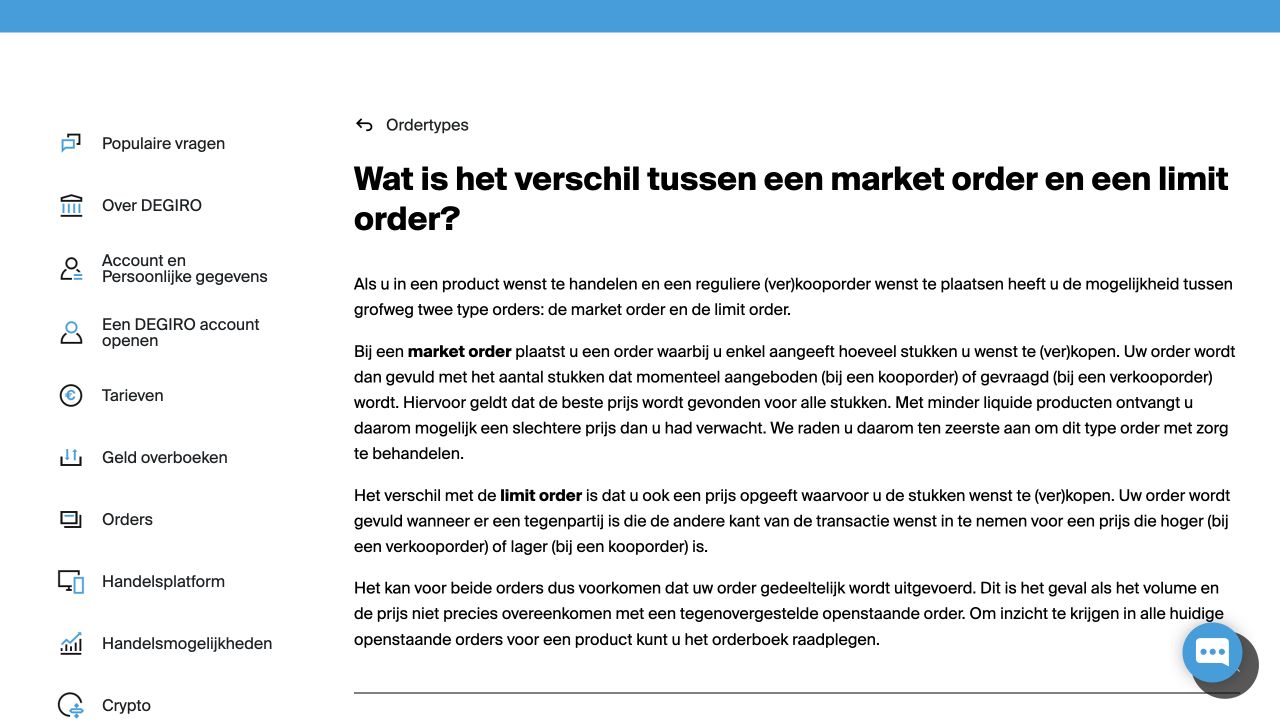
Two common choices are a market order and a limit order. With a market order, you specify a quantity and seek execution at prices available when the order reaches the market. The final execution price can differ from the last displayed trade, especially in a thin market or after a price change. A limit buy order sets the maximum price you are willing to pay per share. It may not fill at all if there is no matching offer at or below that price. It can also fill only partly. DEGIRO's Dutch explanation of market and limit orders describes those distinctions and the possibility of partial fills.
The order type is only one setting. Check the number of shares, order duration, trading venue and whether the exchange is open. A day order and an order kept open longer can behave differently. The exact options depend on the broker and market. Read the broker's own order policy if any label is unclear. Do not press confirm solely because the current quoted price looks familiar: the order preview should identify the security and the conditions you selected.
Place the order and read the confirmation
An example sequence for a real Amsterdam-listed share is:
- Search the company and cross-check its ISIN, ticker, Euronext Amsterdam venue and euro trading currency.
- Verify the result is a real share in the investing account, not a stock CFD or a different listing.
- Decide on a quantity and check available cash, including an allowance for applicable fees.
- Select the order type and, for a limit buy, enter the maximum price you accept.
- Read the preview for instrument, venue, quantity, price conditions, currency and estimated charges.
- Submit the order, then inspect whether it is open, partly filled, fully filled or rejected. A submitted order is not the same as a completed purchase.
- Save the contract note. Compare executed quantity, price, currency and all charges with the preview.
The details of settlement and how quickly a position is displayed depend on the broker and market. A portfolio screen may update before every post-trade process is complete. The contract note and account terms are better records of what happened than a transient app notification. If an order is rejected, read the reason shown by the broker before trying a different order type or amount. DEGIRO's order-rejection explanation shows that price bands, available funds and market rules can all matter.
If only part of an order executes, inspect the remaining open quantity. The unfilled part may continue to rest in the market until the order's expiry or until you cancel it, according to the broker's rules. An investor who immediately places a second order without checking this status could buy more than intended if both orders later fill. The contract note should identify each execution and its charges. Compare the combined result with your original plan. Likewise, if the market is closed, an accepted order may wait for the next session and the opening price may differ from the quote you saw when preparing it.
Understand the holding after purchase
Ownership of one company's share concentrates your exposure to that company's business and the market's valuation of it. Adding shares in other companies may spread company-specific exposure, but the result depends on their businesses and how the holdings move together. An ETF can provide a different form of diversification, although its own holdings and charges still need examination. The AFM's consumer investing overview discusses diversification, low costs and avoiding excessive transactions as general considerations.
If the company pays a dividend, check the broker's statement for the gross amount, withholding and currency conversion. The Belastingdienst explains Dutch dividend withholding and the possibility of foreign source withholding. The treatment depends on the issuer, your circumstances and the relevant tax year. Do not infer it merely from the exchange on which you bought the share. Keep these records alongside valuation statements for the Netherlands investing-tax guide.
Frequently asked questions
Do I own the company if I buy a stock through an app?
That depends on the product and account. A real share is distinct from a CFD on a share price, and fractional interests can have additional terms. Check the instrument description, confirmation and client agreement. A company name in search results is not enough to identify the legal position.
Should I use a market order or a limit order for my first purchase?
Understand the trade-off first. A market order seeks execution at available prices without a purchase-price cap. A limit buy caps the per-share price you accept but may remain unfilled. The broker's official explanation should be read alongside the live order preview and venue rules. This guide does not select an order type for an individual trade.
Is a Dutch listing always cheaper for someone funding an account in euros?
It can avoid a currency conversion on that purchase if the listing trades in euros, but commission, handling fees, market spread and any ongoing account charges still need comparing. Availability, liquidity and the exact security also matter. Calculate the full cost for the specific order rather than assuming the venue alone settles the choice.
What record proves that my order executed?
Read the broker's execution or contract note, which should show the filled quantity and price, instrument, currency and charges. Keep it with account statements and reconcile it with the portfolio view. An open or partly filled order is not the same as a completed purchase.