

 OANDA
We reviewed the Dutch OANDA site, EU help and the OANDA TMS document index. The review examines the Dutch and EU product route, costs and account terms. We use official terms for the applicable EU company rather than UK or US OANDA prices. Our methodology explains the source and scenario checks. Best Forex Brokers compares OANDA with other currency routes.
Which OANDA company and account apply?
The Netherlands site identifies OANDA TMS Brokers S.A., based in Warsaw and supervised by Poland's KNF under its investment-firm authorisation. Its EU legal page gives the same company identity. The brand operates through other firms elsewhere, but their client agreements, compensation arrangements and fee schedules are not evidence of this Dutch-facing route. At signup, confirm that the offered documents name OANDA TMS and the product service you intend to use.
OANDA TMS describes a CFD service and a separate Stocks service. The EU share help says a Stocks account can be created after the OANDA TMS account is opened. Its Dutch product navigation separates shares and ETFs from share CFDs and ETF CFDs. A cash security purchase can participate in dividends and corporate actions. A share CFD is a contract on a price difference and has the derivative account's margin and financing terms. OANDA's share-CFD help describes cash adjustments related to dividends rather than shareholder ownership. Check the exact order label and account before comparing a price or commission.
Experiences on Trustpilot's OANDA TMS (EU) location page show why “account created” and “approved to trade” need separate checks. A customer in Denmark reported a smooth first week of onboarding, accessible support and an easy-to-use app. By contrast, a customer in Sweden said they deposited after the app appeared ready, were then asked to resubmit identity documents and subsequently saw an account-disabled message; they also said a refund had not arrived. OANDA replied that it could not establish the account details publicly and that applications are reviewed before trading approval. The later outcome is not shown. These are individual EU reports, not verified accounts of what happened internally or a Netherlands failure rate. OANDA's own opening guide explicitly allows a deposit after account creation but says approval and trading credentials follow application review. Before funding, distinguish that interim step from final approval, retain the application and deposit references, and use the OANDA TMS contact route if the verification status is unclear.
What can a Dutch resident trade?
The EU-NL product page lists real shares and ETFs as well as forex and CFDs referencing shares, indices, commodities, ETFs and cryptoassets. An advertised category does not mean every symbol is available under every account type or platform connection. The document index publishes instrument lists and specifications. The actual trading account should confirm the exact symbol, currency and enabled service. For a Dutch investor buying a fund, the distinction between a UCITS ETF unit and an ETF CFD is decisive because the latter is a derivative rather than an owned fund unit.
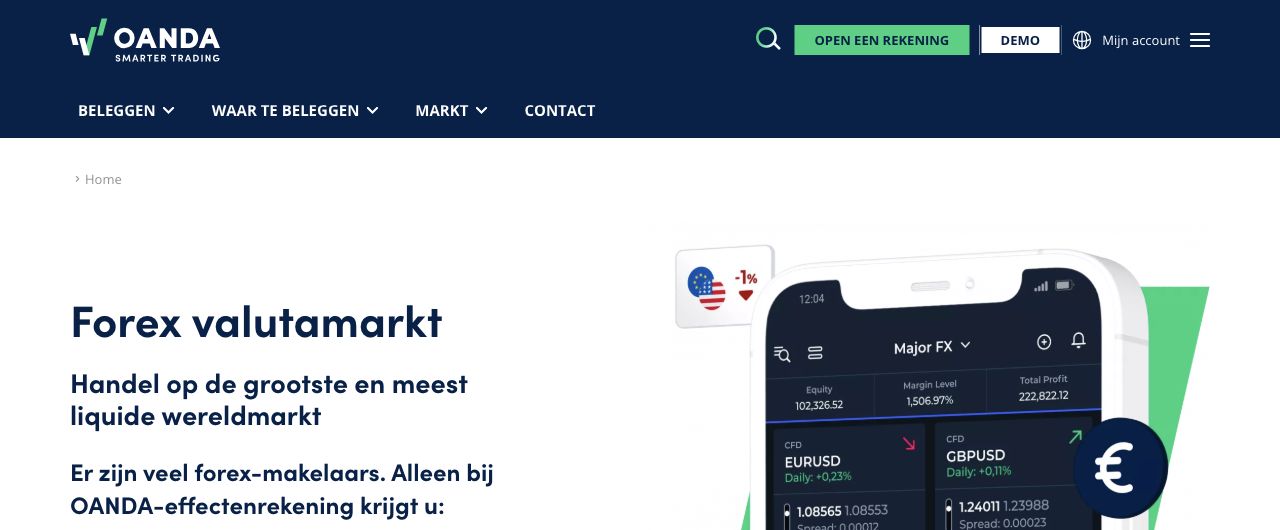
For currency trading, OANDA's Dutch forex page explains the pair interface. A euro balance converted into dollars to buy a US share is a currency conversion connected to a securities order. A EUR/USD CFD position is a different instrument with a spread, margin and possibly holding adjustments. The forex guide sets out that separation before an order is placed. OANDA's presence on both a stock and forex page therefore does not imply one uniform tariff.
Costs: different worksheets for the two services
OANDA's Dutch document index has separate fee tables for Stocks and CFD accounts. We found a current Stocks table, but the publicly linked CFD schedules did not give us an unambiguous currently effective set of numerical CFD commissions. We therefore do not quote a specific share-CFD commission as if verified for this account. The fee categories and the exact order preview remain essential. An omitted number here is an evidence limit, not a statement that the charge is zero.
| Transaction or account item | Published condition for the OANDA TMS route | Cost question to settle |
|---|---|---|
| EUR Stocks account buying US-listed shares | Current Stocks table states no explicit dealing commission for an EUR cash account. | Dollar conversion rate, market spread, venue and applicable taxes or pass-through charges. |
| EUR Stocks account buying specified European shares | Published table covers Spanish, German, British and French exchanges at 0.15%, minimum €5. | Exact listing, trade value and conversion if the line is not in euros. |
| EUR Stocks account buying an ETF | Published ordinary tariff is 0.10%, minimum €1, subject to any qualifying promotion. | Fund, plan eligibility, fund charge, market spread and venue. |
| Currency or index CFD | Spread and any instrument-specific financing or currency adjustment may apply. | Contract specification, live quote, direction and holding period. |
| Share or ETF CFD | Derivative spread or applicable dealing commission, financing and conversion depend on the symbol and account terms. | Current account tariff and pre-order cost disclosure. Do not use the Stocks rate. |
| Cash account not meeting maintenance conditions | The applicable Stocks tariff describes an inactivity charge under its stated account and correspondence conditions. | Activity, held positions, correspondence preference and available balance. |
The numerical Stocks examples above come from OANDA TMS's share and ETF fee table. They describe specific market and account combinations. They are not a claim that Amsterdam shares have the same rate as German shares, nor that a US share purchased from euros has no currency cost. A purchase and sale can each be a separate charged event. Market and fund costs exist outside the stated broker commission. OANDA advertises ETF promotions on some pages, but qualification, trade count and turnover caps must be checked against the promotion's own terms before substituting a promotional zero for the ordinary table.
The EU currency-conversion explanation says the Stocks service converts the full nominal value of a non-home-currency share purchase or sale using a rate with a markup. This matters when an EUR account buys US-listed shares even though the explicit US-share dealing commission in the EUR-account table is zero. For CFDs, the conversion basis can be the resulting cash flow rather than the full security purchase value. Do not move the Stocks calculation across to a CFD. The EU help says conversion details appear in the daily account report. A reader comparing two brokers should use the same intended instrument, order size and account currency on both sides.
For CFDs, start with the live bid and ask and the contract size. A spread measured in points is not a cash cost until multiplied by the position's point value. Then ask whether the exact contract charges daily swap or other holding costs. The CFD instrument and fee documents identify separate specifications and swap tables, which can change by symbol. OANDA's Dutch account page advertises no separate daily financing on named major US/German index and oil/gas CFDs. That statement concerns the named contracts and cannot be applied to every index, future-like or share CFD. The CFD comparison explains how cash and futures-based contracts can carry costs differently.
A cash-account maintenance charge also depends on conditions. OANDA's Netherlands account FAQ says free maintenance requires electronic correspondence and either a transaction within twelve months or an instrument still held. The Stocks tariff describes €10 per month for an EUR account that meets the specified inactive conditions with electronic delivery, and a distinct higher charge if paper correspondence is chosen. This is a relevant long-term cash-balance check, not a charge that every investor pays. The conditions for the CFD service need its own applicable tariff and should not be inferred mechanically from the Stocks table.
Withdrawals through OANDA TMS are bank-transfer-only according to EU help. The recipient name and address must match the OANDA account, and the transfer currency must match the original deposit. Changing the destination bank requires verification. The published Stocks tariff has a condition for second and later small withdrawals in a calendar month, but the bank and the exact account route can add charges. Read the applicable payout disclosure rather than assuming all withdrawals are free. Depositing in a currency different from the account currency can also lead to conversion, as OANDA's deposit help notes.
Two orders that should never share one price comparison
Buying an ETF unit. A resident who wants to own a UCITS fund should begin in the Stocks service, search the fund's ISIN and inspect its exchange, currency and share class. The Stocks tariff gives an ordinary ETF broker rate with a minimum. An eligible promotion may have its own conditions. Add the spread and the fund's own ongoing charge. If the order settles outside the account's home currency, the conversion guidance says the full purchase nominal value is converted at a marked-up rate. For a monthly plan, repeat the transaction calculation for the intended number and size of purchases, and include any transfer-out cost if the holding may move later. A chart of the ETF's price does not answer the custody or cost questions.
Opening a EUR/USD CFD. Here the reader has a derivative on a currency pair, not a cash exchange to buy a security. They should record the live bid and ask, contract size, margin and the account's settlement currency. The CFD document index points to contract specifications and holding terms, but the public material we could verify did not support one stable universal commission figure for this route. Therefore an honest comparison with another forex provider requires the actual pre-order cost disclosure and the same trade size and planned holding period. A low displayed spread on one pair at one moment cannot be treated as the cost of all currency CFDs. If the position lasts overnight, inspect the swap or financing row for that exact contract and direction.
The two orders may appear in the same brand ecosystem, yet their economic records differ. The ETF buyer needs proof of the underlying fund unit, trade confirmation, custody and fund charges. The CFD trader needs contract exposure, margin changes, financing and realised cash-flow conversion. OANDA's Stocks guidance and share-CFD explanation demonstrate the product boundary. Before opening either account, check the OANDA TMS agreement, the exact service permissions and the expected withdrawal route. If the application does not show the desired instrument, that is a more decisive limitation than any promotional platform screenshot.
App, MT5 and TradingView
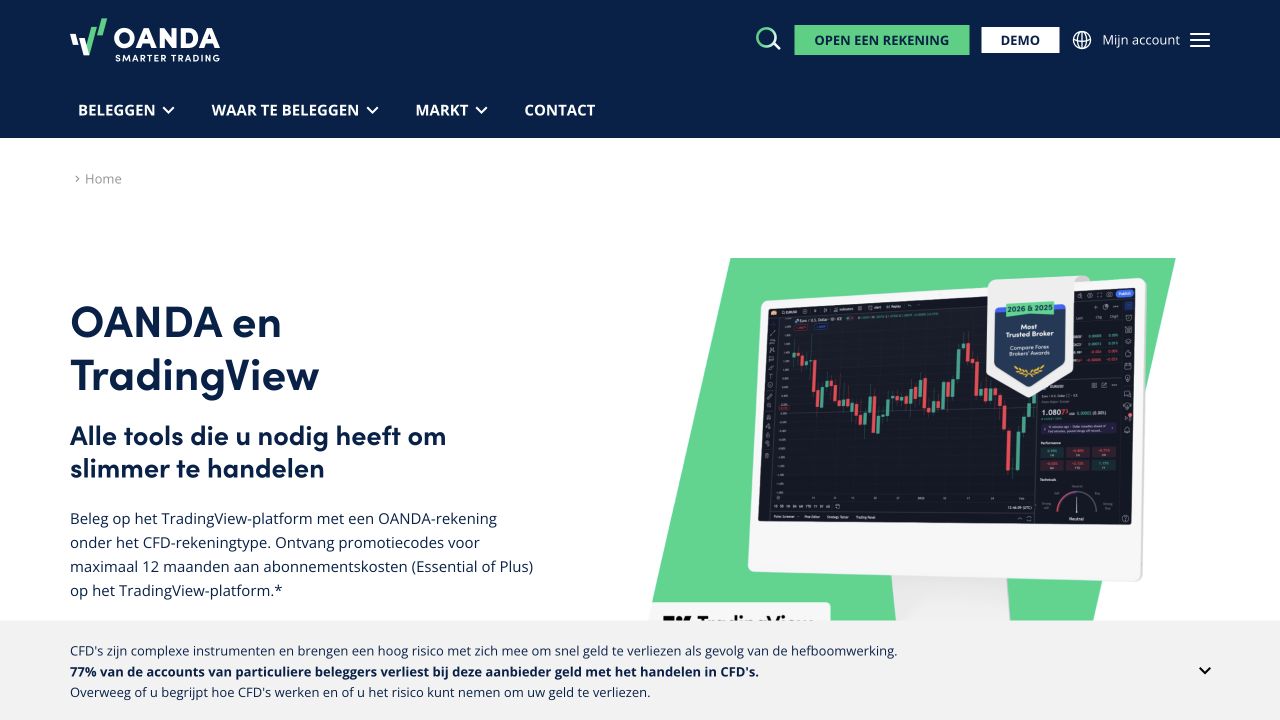
OANDA TMS offers its own mobile trading app and an MT5 route. The Dutch TradingView integration page documents another route for an eligible CFD account. Linking the OANDA CFD account to TradingView is free. A paid TradingView plan is optional and its separate features are set by TradingView. OANDA says the link is not available for demo accounts. Funding and withdrawals still go through OANDA TMS, while TradingView supplies the chart interface and connection.
That separation prevents a common mistake: TradingView can display far more markets than OANDA TMS makes tradable through the integration. OANDA identifies connected symbols with the OTMS suffix. Only broker-enabled instruments can be ordered from the chart. A reader who wants a specific share or ETF should check whether the intended transaction belongs in OANDA's Stocks service rather than expect every TradingView chart to create an underlying-security order. Likewise, an indicator or data subscription available in TradingView does not change the OANDA account's dealing or financing conditions.
OANDA may suit a person who wants its own app for currency and index monitoring but also values the MT5 or TradingView option. It is less convenient for someone who wants one simple screen without deciding between Stocks and CFD services. App reliability, execution speed and support response can vary by account, device and time. The platform comparison treats these as documented workflows, not measured performance results.
Assets, investor compensation and records
OANDA's EU information sheet describes the Polish investor-compensation arrangement for eligible brokerage claims if the firm cannot meet its obligations. The scheme pays 100% up to the PLN equivalent of €3,000, then 90% of the excess, with the covered asset amount capped at the PLN equivalent of €22,000. That is a conditional firm-failure protection, not insurance against ordinary investment losses or adverse CFD price changes. The EU client-money help describes client funds held in bank accounts separate from the firm's own cash. The account contract and applicable scheme rules determine what a particular client can claim.
For a Stocks account, the share documentation should be read for how holdings are registered and transferred. An ETF unit or share held through custody is different from a CFD position with the firm. OANDA's Stocks tariff lists a charge for an outbound transfer of financial instruments, which can matter to a long-term investor who expects to change brokers. We have not assumed that a CFD is transferable as an underlying security. Keep account statements, trade confirmations and currency-conversion records. OANDA's EU help says the daily report shows conversion details. For Dutch tax context, use the investing-tax guide, which links to public-authority sources.
Who should consider OANDA, and who should compare another route?
OANDA TMS is relevant when a Dutch resident deliberately wants a currency or index CFD account with a choice of mobile, MT5 and TradingView interfaces, and is willing to inspect each instrument's spread and holding terms. Its real Stocks service makes it a separate candidate for some share or ETF purchases, but that purchase must be priced with the Stocks table, currency conversion, any promotion conditions and custody or transfer needs. The same brand may fit the derivative task and be less attractive for a recurring ETF order, or vice versa.
A reader wanting a single uncomplicated underlying-investment account may prefer to compare the stock and ETF routes before choosing OANDA. Someone who needs an exact CFD commission figure should consult the account's currently applicable tariff and pre-trade disclosure. The public document index we could inspect was not sufficient to publish that figure confidently. This review deliberately does not turn that gap into a false zero-cost claim. A person comparing forex providers should ask whether the pair, platform and account currency match the intended strategy, rather than use OANDA's general “forex” branding as the whole answer.
Frequently asked questions
Can I buy a real share with OANDA TMS?
OANDA TMS's EU help describes a Stocks account for underlying shares, separate from the CFD service. The actual share, exchange and account eligibility must be checked before ordering. A share CFD in the same brand is a derivative and does not give the same ownership rights.
Does a zero dealing commission on US shares make the purchase free?
No. The Stocks schedule states zero explicit US-share dealing commission for a specified EUR cash-account route, while the conversion guide says a non-home-currency share order converts its full value using a rate with markup. Market spread and any applicable external charges can also matter. Check the live order preview.
Is TradingView a separate OANDA account?
No. The integration is an alternative interface for an eligible OANDA TMS CFD account. OANDA remains the broker and handles account cash, while TradingView supplies charts and optional paid tools. Only OANDA-enabled connected symbols can be traded through it.
Which compensation rules apply to a Dutch client?
The OANDA TMS route is a Polish investment firm. Its information sheet explains a conditional Polish compensation scheme for eligible claims if the firm cannot fulfil obligations. The scheme does not cover a losing trade, and a different OANDA group entity's protection should not be substituted for this route.
Can I withdraw to any bank account?
OANDA's EU withdrawal instructions require a bank transfer to an account with matching name and address, in the original deposit currency. A new receiving bank requires verification. Review the relevant tariff and any intermediary-bank charges before planning a small or repeated payout.
Can I buy an ETF through OANDA's TradingView connection?
The Dutch TradingView page describes a connection to an eligible OANDA TMS CFD account. It is not evidence that a charted ETF creates an owned fund unit. To buy an underlying ETF, follow the Stocks-account route, search the ISIN and check the account's order ticket and custody terms. TradingView's broad chart library can display instruments the linked broker account cannot trade, so the existence of a chart does not establish product access. If the order ticket says ETF CFD, the derivative's spread and holding terms apply instead of the fund-purchase schedule.
Do the same currency charges apply to a US share and a forex CFD?
No. OANDA's Stocks conversion help says a non-home-currency share order converts the full nominal purchase or sale value at a marked-up rate. A forex CFD is a contract exposure with its own quote, spread, cash result and potentially financing. It is not an exchange of the full notional into a security. The account statement and pre-order disclosure should show which cash flows actually convert. A reader comparing OANDA with another provider should therefore use one product, size, account currency and holding period at a time. A single brand-wide “FX cost” number would mix two different transactions.
What records should a Dutch customer retain?
Keep the agreement naming OANDA TMS, a copy of the applicable Stocks or CFD document, order confirmations, currency-conversion reports, deposits and withdrawals, and year-end cash and position values. OANDA's conversion guidance says conversion details appear in the daily report. Those records make it possible to reconcile an apparently commission-free stock order with its currency effect and to distinguish a held security from an open derivative. The broker's records support the resident's own filing work. They do not determine the individual's Netherlands tax treatment.