

 Capital.com
The brand’s two Cyprus investment firms and two fee schedules deserve separate treatment. A CFD position on a share, index or currency pair is a derivative contract. An underlying share or ETF is a security. An apparently simple “no commission” headline cannot tell you whether the position has a spread, currency conversion or financing charge. This review explains the route that a Dutch customer can verify and where the answer remains conditional. Our CFD comparison evaluates the derivative account against other relevant firms. The stock broker comparison focuses on confirmed routes to underlying shares.
Which Capital.com entity and product are involved?
Capital.com’s Dutch regulation page lists Capital Com SV Investments Limited, regulated by CySEC under licence 319/17, and Capital Com Group Ltd, regulated by CySEC under licence 463/25. The Dutch share tariff identifies Group Ltd as the company behind that page. The AFM investment-firm register records Group Ltd as an incoming EU-passport firm and says it is not directly supervised by the AFM. The Dutch CFD tariff and its disclosures identify SV Investments Limited in that CFD context while also listing Group Ltd in the site-wide footer. The applicant’s specific agreement and account screen are needed to determine the contractual firm and products in a particular account. Neither CySEC number should be casually assigned to every Capital.com service.
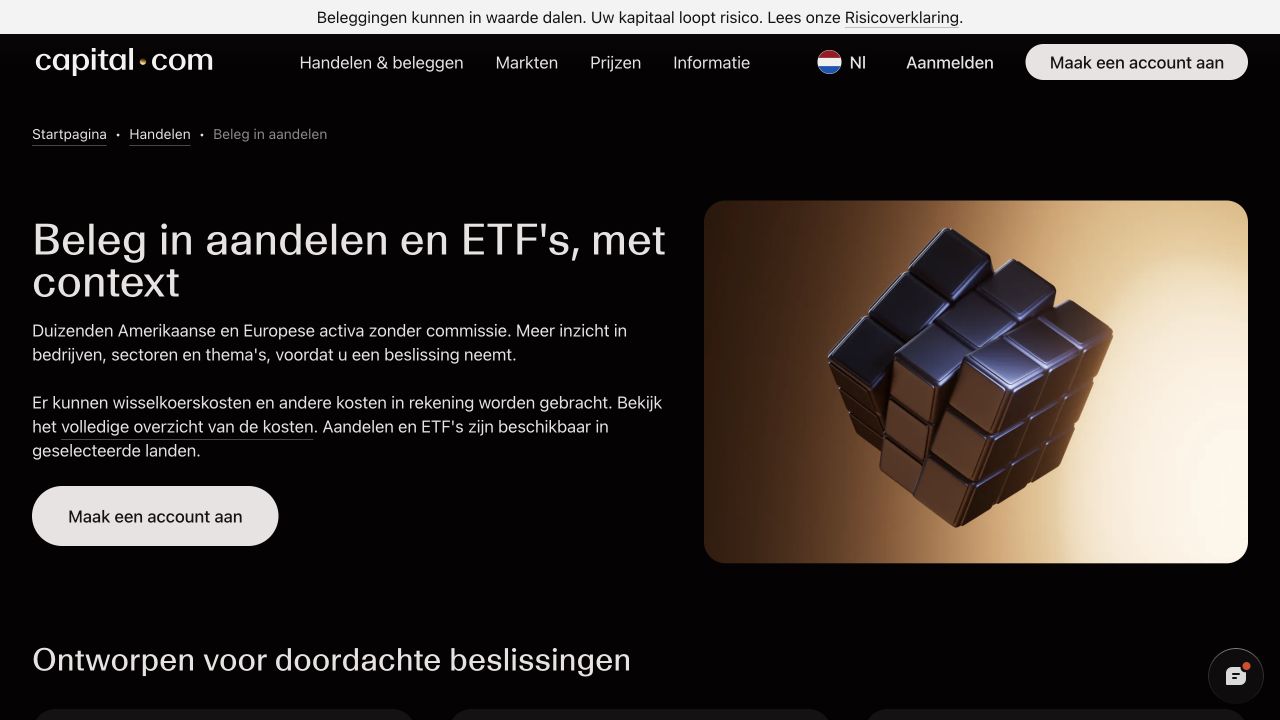
The Dutch share and ETF product page explicitly names the Netherlands among eligible countries and presents an account-opening route for underlying assets. Its public catalogue and claim of more than 2,200 assets establish a product category, not availability of every listing or ETF ISIN to every applicant. A reader should search the intended instrument and inspect the share-account agreement before relying on the route. The legal entity and fee schedule for underlying assets must be distinguished from those for CFD trading, even when one website markets them together.
By contrast, the Dutch CFD schedule openly describes CFDs and knock-outs as a separate trading route. A CFD on an Amsterdam share does not convey ownership of that share or voting rights. It creates an exposure to a reference price under the account contract. The CFD guide explains how notional size, margin and closing costs relate. Knock-out contracts have their own price and premium mechanics, and the provider says availability depends on country. An NL visitor should confirm the exact contract in their account rather than assuming every menu item is tradeable.
Fees: underlying shares and ETFs versus CFDs
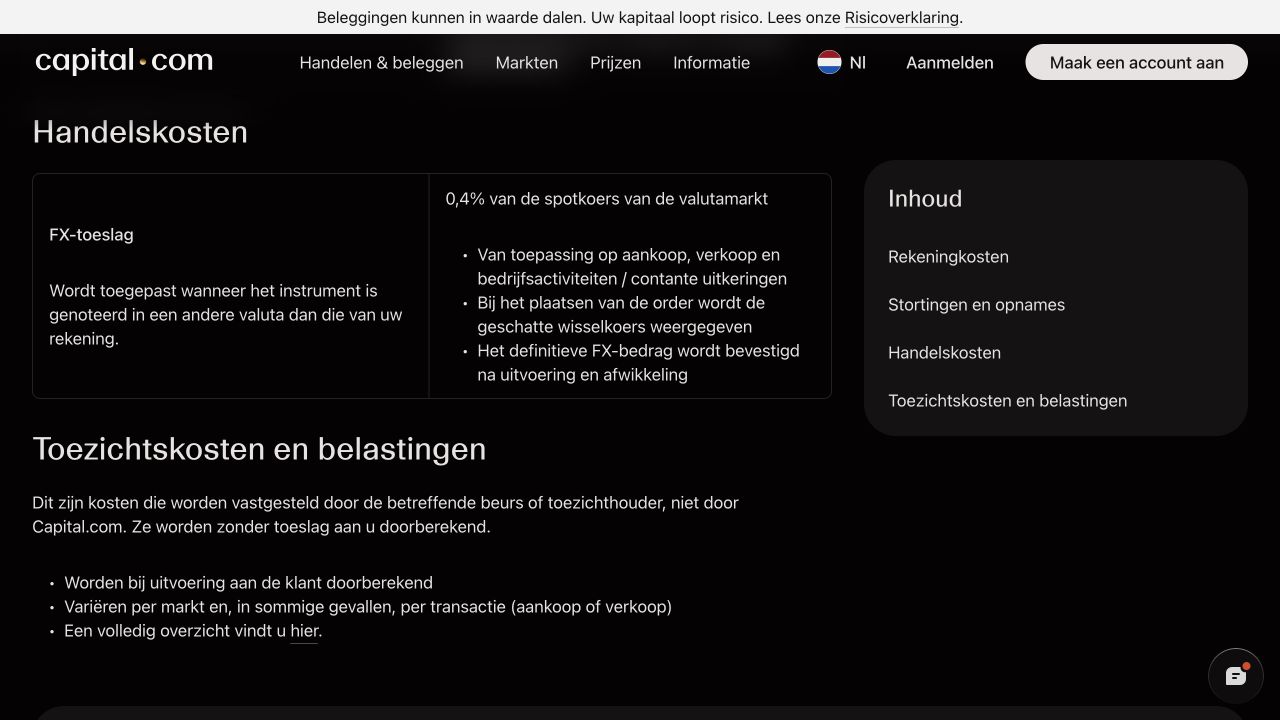
Capital.com’s real-share product page advertises no broker commission on share and ETF purchases, but immediately points to exchange-rate and other costs. The Dutch share tariff lists a 0.4% markup to the spot FX rate when the instrument’s currency differs from the account currency. It applies to buys, sells and cash corporate actions or payouts. It says exchange or regulatory charges are passed through without a Capital.com markup and can vary by venue and trade direction. An ETF also has the fund issuer’s own ongoing charge, while the market bid-ask spread changes the price at which a buyer can enter or exit. None of those categories is erased by “zero commission.”
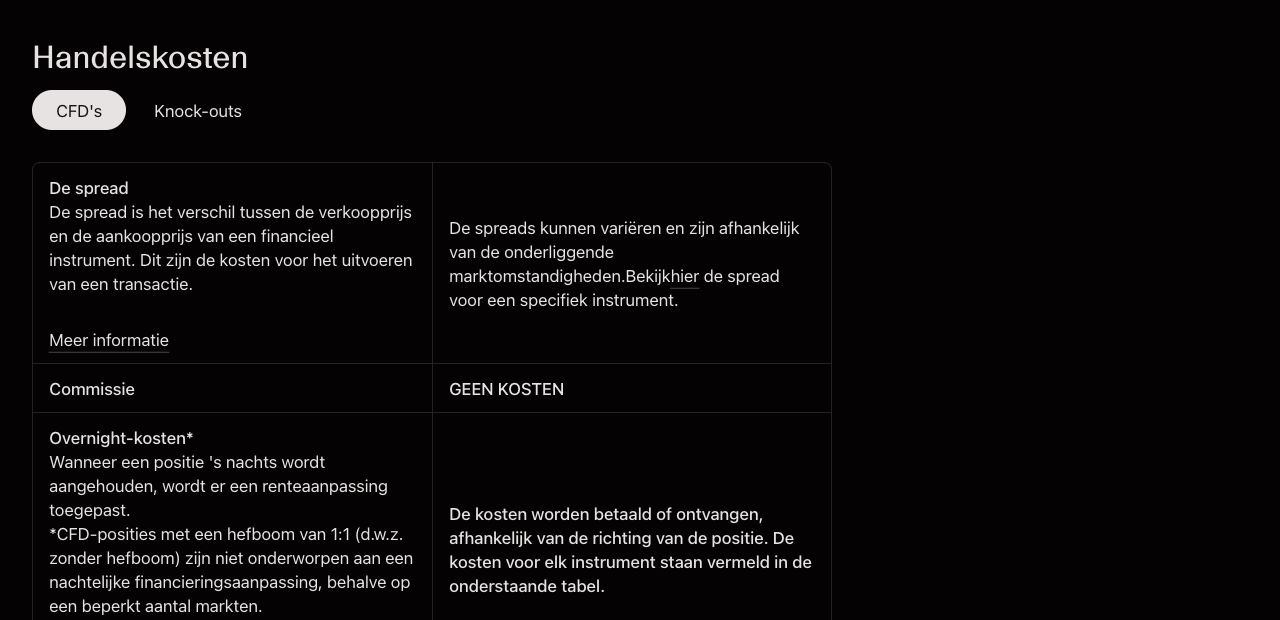
The CFD and knock-out tariff lists no separate CFD trading commission, but a dynamic bid-ask spread. It also lists a 0.7% FX markup for retail currency conversions when a CFD transaction or cash flow is in a currency different from the trading account or when moving funds between subaccounts in different currencies. The markup is included in the conversion rate rather than posted as a separate debit. A CFD held overnight can be debited or credited an instrument-specific financing adjustment. The fee depends on position direction and notional size, and the provider publishes live instrument rows rather than one universal holding rate. A guaranteed stop-loss adds a fee if triggered, shown in the ticket. The 0.4% share FX and 0.7% CFD FX figures apply to different products and must not be combined for the same order.
| Route | Published provider charge | Other cost or eligibility condition |
|---|---|---|
| Underlying share/ETF in an eligible share account | No broker execution commission. 0.4% FX markup when instrument and account currencies differ | Verify the account route and exact instrument. Market spread, pass-through exchange/regulatory cost, ETF fund charge and relevant taxes. |
| CFD on a share, index or currency pair | No separate trading commission. Dynamic bid-ask spread | Variable overnight adjustment when applicable. 0.7% retail FX markup on relevant conversions. Product-specific ticket. |
| Guaranteed stop-loss on CFD | Fee when selected and activated | Premium varies with market, entry price and position size. Shown before order. |
| Account opening/closing, demo and funding/withdrawal | Main Dutch CFD tariff lists no provider charge | Deposit and withdrawal minima depend on method. Intermediary bank or payment provider may impose charges. |
These conditions come from the distinct Dutch stock and Dutch CFD schedules. The provider’s minimum-funding wording varies by method and the exact payment route is not established by a headline amount, so this article does not quote a universal minimum deposit. The amount accepted and the amount that can be withdrawn must be checked on the chosen account and payment method.
The underlying-share tariff has its own FX row, separate from the CFD page. This matters most when the investor funds in euros but buys a foreign-currency security. The published markup is a rate component. The total amount paid also depends on the live conversion rate, market price and any pass-through charges.
Three practical cost cases
A EUR-listed share. Suppose an eligible share account buys a EUR-denominated share using a EUR account balance. The dedicated share tariff advertises no Capital.com trading commission and its cross-currency 0.4% markup would not arise from that EUR-to-EUR order. A market spread and any applicable pass-through exchange or regulatory charge remain, and the exact security, venue and ticket decide what is available. A marketing statement about European shares does not establish a specific Euronext Amsterdam order route.
A US share from euros. If an eligible share account uses euros to buy a dollar-denominated US share, the published 0.4% FX markup applies to the conversion. On a hypothetical €1,000 principal, 0.4% is a €4 rate-markup component before the actual market exchange rate is known. A later sale, or a cash corporate payout requiring conversion, can create its own conversion under the same tariff. This is not a live dollar amount, not a total transaction cost and not a reason to ignore the spread or US-market regulatory charges. The rate shown when the order is placed is estimated. The final conversion is confirmed after execution and settlement, according to the Dutch share schedule.
A CFD held through a night. Imagine a EUR-account client opens a CFD with €8,000 notional exposure and posts €400 margin. The €400 is collateral, not the position size on which a spread or financing formula should automatically be calculated. Capital.com’s Dutch pricing explanation relates spread and overnight calculations to the contract and position value. If a purely illustrative bid-ask difference on that contract corresponds to €8 across the position, that is a spread-cost illustration before any overnight adjustment. It is not a quoted Capital.com spread for an actual symbol. The financing amount cannot be calculated honestly without the instrument, direction, current reference rate and number of nights. If the CFD cash flows are in another currency, the applicable 0.7% retail FX route may also matter. A move of 1% in the reference price would correspond to €80 on €8,000 before charges, which is 20% of the hypothetical €400 margin. This shows why the exposure cannot be analysed using margin alone.
The Dutch tariff says a 1:1 unleveraged CFD generally has no overnight financing, but it identifies exceptions including natural gas, US cocoa, the VIX and currency pairs with the Turkish lira. This exception list on the provider’s overnight section matters: neither “all CFDs have a swap” nor “unleveraged CFDs never have a swap” is accurate. The trade ticket and the symbol-specific fee table determine the applicable holding charge.
A Netherlands-based Trustpilot reviewer reported a fast payout and a useful TradingView connection, but found overnight costs too high for their swing-trading style. Capital.com replied that it understood the concern about holding costs; it did not confirm a particular charge or instrument. This is one trader's experience, not a price survey. Its practical lesson is to estimate the cost for the specific CFD, direction and expected number of nights before deciding that a low entry commission makes a multi-day position inexpensive. The Dutch tariff confirms that the overnight rate depends on the instrument and position, while the current ticket supplies the applicable figure.
Platform and account workflow
The Dutch web-platform page describes charts, watchlists, technical indicators, price alerts and order controls in one interface. The site also advertises a mobile app, TradingView connectivity and MetaTrader integrations. The Dutch MT4 description says a linked MT4 account is available to clients under its CySEC route, subject to the listed country exceptions. That does not establish that every account product, including underlying shares, can be traded on every linked platform. Confirm the exact account type and symbol before relying on a feature in a platform comparison. Our platform page considers charts and order controls. The app page considers the phone workflow.
The TradingView connection also appears in that mixed Dutch customer review; the customer's opinion about its speed is personal, not a latency measurement. Capital.com's connection guide gives a more useful check: sign in through TradingView's Trading Panel, select the Capital.com account and confirm the market's CAPITALCOM: symbol and the account currency before placing an order. Its guide describes CFD trading through this connection; do not infer that an underlying share or ETF is available there just because it appears on Capital.com's website.
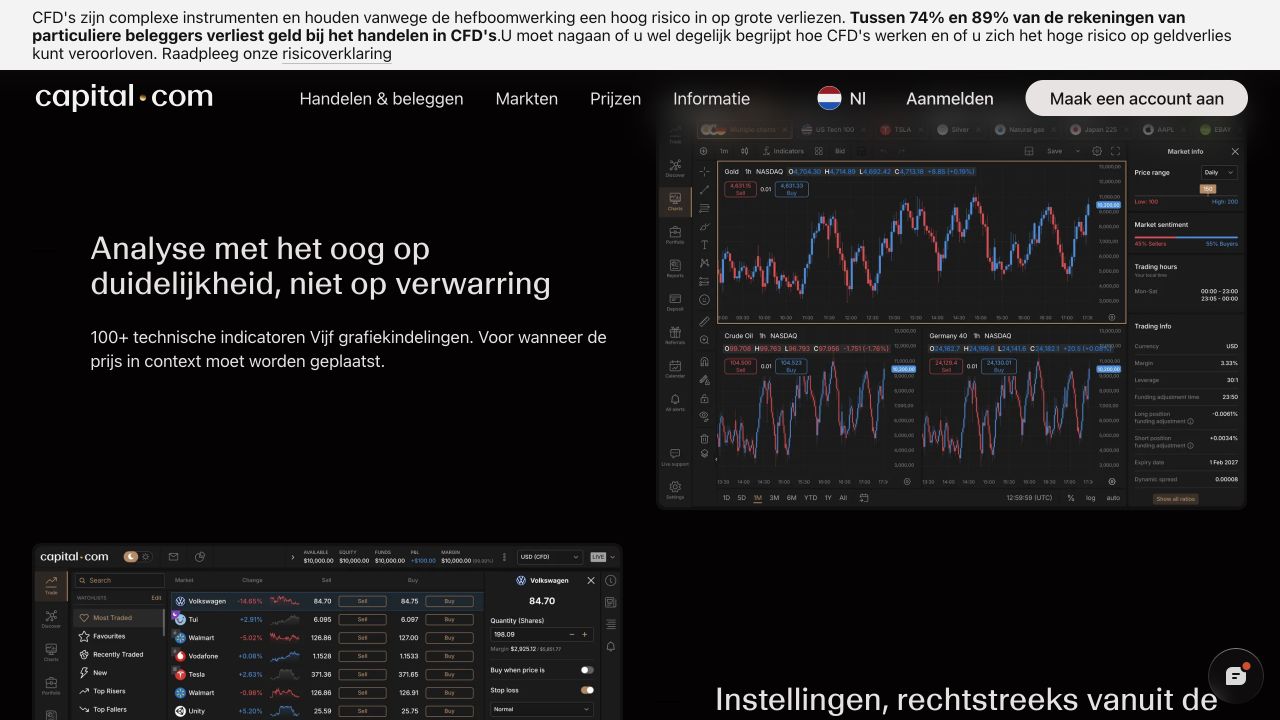
For a CFD, inspect the bid and ask, position size, margin, spread, overnight row and any guaranteed-stop premium before submission. A stop-loss that is not guaranteed can execute at a different price when the market gaps. The Dutch tariff distinguishes it from a guaranteed stop that costs money when triggered. For a real share or ETF, the relevant details instead include the underlying instrument, currency, venue, FX estimate and possible pass-through charges. The same visual platform may show both products, but the ticket must identify which account and instrument is being used. The actual order ticket and execution report determine the account-specific result.
The main Dutch CFD schedule lists no provider charge to open or close an account, run a demo, deposit or withdraw. A withdrawal still requires an eligible balance and payment route. Capital.com’s withdrawal help says it normally processes requests within 24 hours, while bank or card receipt can take longer. This is a process description, not a delivery guarantee. It also shows withdrawal history under Reports on web and in the app. The statement help explains how to generate a statement for a chosen account and period. For a Dutch filing, retain statements, year-end values and cash flows. The tax guide addresses the Netherlands rules separately.
Customer reports show why the withdrawal path deserves its own check. In a positive Dutch review, a customer said support resolved a withdrawal difficulty and they could then take money out; Capital.com acknowledged that account in its reply. In a negative Dutch review, another customer said a €50 withdrawal had not arrived; the company's public reply asked them to contact support for investigation, and the page does not establish the later outcome. Neither reviewer identified the precise account product or cause, so these reports cannot establish a failure rate or a standard payout time. The actionable check is to distinguish a pending request from one marked processed, retain its reference, and contact support if the expected arrival window passes. For card payouts, Capital.com's Dutch help explains where to find the ARN/RRN that a bank can trace. Its bank withdrawal rules require an account in the customer's own name and may require proof of ownership when automatic verification fails. Those rules are possible checks, not an asserted explanation for either review.
How to check a proposed Capital.com account
Start with the asset, not the app download. A reader who wants an Amsterdam share should write down the company name and ISIN, then use the share-account instrument search and order preview. The public share catalogue describes categories and selected countries, but it does not identify the legal company and settlement currency that will appear in an individual application. A reader who instead wants a CFD should record the exact reference market and contract name, because a share CFD and a cash share with a similar label have different ownership, margin and holding-cost rules. Do this check before comparing a displayed commission with another broker's underlying-share tariff.
Next, read the firm name in the application and agreement. Capital.com's regulation page lists two Cyprus investment firms, and the public share and CFD pages do not justify transferring every term from one to the other. Confirm which company will receive the application, which product permissions are enabled and which account currencies are available. Keep a copy of the signed terms. For underlying investing, check whether the desired ETF's issuer document and order line are accessible. For a CFD, check the instrument information and current spread and overnight details in the ticket. The website's examples are not executable quotes.
Finally, compare the entire funding and exit path. If euros are deposited but a security or derivative cash flow is in dollars, note when conversion occurs and which product's markup applies. A zero provider fee for a withdrawal does not establish the exchange rate used on a conversion or the bank's own charge. The statement instructions matter because a Dutch resident should be able to reconstruct deposits, conversions, positions and withdrawals from downloadable records. If the platform does not offer the exact product or evidence the reader needs, that is a stronger reason to compare another provider than an attractive homepage commission headline.
Custody and compensation
The Dutch regulatory page says both Cyprus firms hold client money separately from their own money and participate in the Cyprus Investor Compensation Fund. It describes conditional compensation up to €20,000 for an eligible claim if the firm defaults. That is not a guarantee against ordinary price movements or a promise that every account balance and product has identical treatment. An applicant should read the compensation policy for the entity named in their agreement. The broker-safety guide explains how to match a trading brand to its licensed legal firm.
For an underlying share or ETF, the client should confirm the holding and custody terms of the share-account agreement, including how dividends and corporate actions are handled and whether an in-kind transfer is supported. The Dutch legal-document index provides separate share-dealing terms and order-execution policies for the Cyprus entities. The public summary pages do not justify saying that every share can be directly registered, transferred intact, or purchased by a new account. A CFD has no underlying security to transfer. An open position is closed according to the derivative contract. The distinction between client cash segregation, securities custody and a CFD claim should stay clear when comparing providers.
Who might choose this route, and who might not?
Capital.com can suit a Dutch resident who specifically wants to examine CFD positions through a chart-led web or mobile workflow and understands that spread, financing and FX are separate. Its tariff puts the dynamic spread, overnight method and optional guaranteed-stop charge in public view, and the user can compare the ticket for the exact symbol. A reader seeking underlying shares or ETFs can also investigate its separately advertised investment route, including the no-broker-commission proposition and 0.4% cross-currency markup, after confirming eligibility and the intended instrument.
It is less suitable for someone who wants to choose a specific Euronext Amsterdam stock or UCITS ETF without first checking whether that listing is available in the share account. A trader who dislikes checking currency cash flows and changing overnight charges may prefer a simpler product or account. Our ETF broker comparison focuses on fund-purchase routes. The review directory links to alternatives with different product scopes. The conclusion depends on the product and account actually available to a particular resident, not on a brand-wide headline.
Frequently asked questions
Can a new Netherlands customer buy real shares at Capital.com?
The Dutch share/ETF page lists the Netherlands among eligible countries and offers an account-opening path. That supports a Dutch new-customer route in principle. The application and agreement still determine individual eligibility and the instrument catalogue, so confirm the exact share or ETF before choosing the account.
Is a share CFD the same as owning a share?
No. The CFD is a derivative contract referencing a price and does not convey the underlying security. Capital.com separately describes underlying shares/ETFs and CFDs on its Dutch product homepage. The ticket and account documentation identify the actual instrument.
Which FX rate applies: 0.4% or 0.7%?
The underlying-share tariff lists 0.4% when the security currency differs from the account. The CFD tariff lists a 0.7% retail markup on applicable conversions, included in the exchange rate. Identify the account and product first. Do not add both rates to one transaction.
Does a commission-free CFD have no trading cost?
No separate commission is listed, but the bid-ask spread affects entry and exit. Overnight financing may apply, and cross-currency cash flows or an activated guaranteed stop can add charges. The exact symbol and direction determine the ticket.
Are CFD overnight charges based on my posted margin?
The financing and spread economics relate to the contract’s notional exposure and symbol rules, not simply to the cash posted as margin. Check Capital.com’s pricing explanation and the live position ticket for the applicable calculation.
Does Cyprus investor compensation cover a losing trade?
No. The provider’s regulatory explanation describes a conditional ICF claim if the relevant firm cannot meet obligations, with an upper amount of €20,000. It does not repay a market loss on a share, ETF or CFD.
Can I assume a listed share can be moved to another broker?
No. The Dutch legal-document index points to separate share-dealing and custody terms. The public product page does not establish that every holding is transferable in kind, that every receiving broker accepts it, or that a new applicant has the same entitlements as an existing account. Before building a long-term portfolio, ask for the exact instrument's transfer procedure and charges. A CFD cannot be transferred as ownership of its reference share. It is closed under the derivative contract.