

What the contract gives you—and what it does not
For a real share, the investor acquires an interest in the issuer under the applicable holding arrangement. For a share CFD, the investor has a contract with the CFD provider based on the share's reference price. The shareholder rights, custody arrangement and income treatment are not the same. A CFD on an index similarly follows the agreed index reference. You do not own the index's constituents. This distinction is why the trading screen's product label and contract specification are more important than a familiar stock or index name.
A CFD's contract specification should identify the underlying reference, whether the position is long or short, the currency, the unit or point value, minimum size and any adjustments for events such as dividends. Two providers can offer instruments with similar names but different contract sizes or pricing rules. A comparison should therefore avoid treating every “S&P 500 CFD” as the same product. Check the specific market page and legal terms for the account available to a Netherlands resident.
How long and short results arise
A long CFD position gains from a rise in the reference price before charges and loses from a fall. A short position has the reverse directional exposure. Both begin with a buy/sell quote rather than a single neutral price. The difference between those quotes is the bid–ask spread. A position can therefore show a negative amount immediately after opening even if the reference price has not visibly moved, because closing it at the opposite side of the quote would cross the spread.
Take a hypothetical index CFD worth €10 per point. If the entry and exit reference levels differ by 30 points in your favour, the gross directional result is €300. If they differ by 30 points against you, it is minus €300. That is before the bid–ask spread, any commission and any financing or other adjustments. The €10 point value is an illustration, not a broker tariff. Actual contract size and quote conventions must be taken from the provider's specification. A 30-point move can matter very differently for a contract worth €1 per point.
| Position | Reference move | Gross directional result at €10 per point | What still needs accounting |
|---|---|---|---|
| Long | +30 points | +€300 | Entry/exit spread, commission, financing, adjustments |
| Long | −30 points | −€300 | The same charges can make net loss larger |
| Short | −30 points | +€300 | Short financing or other contract adjustments |
| Short | +30 points | −€300 | Margin may change before closing |
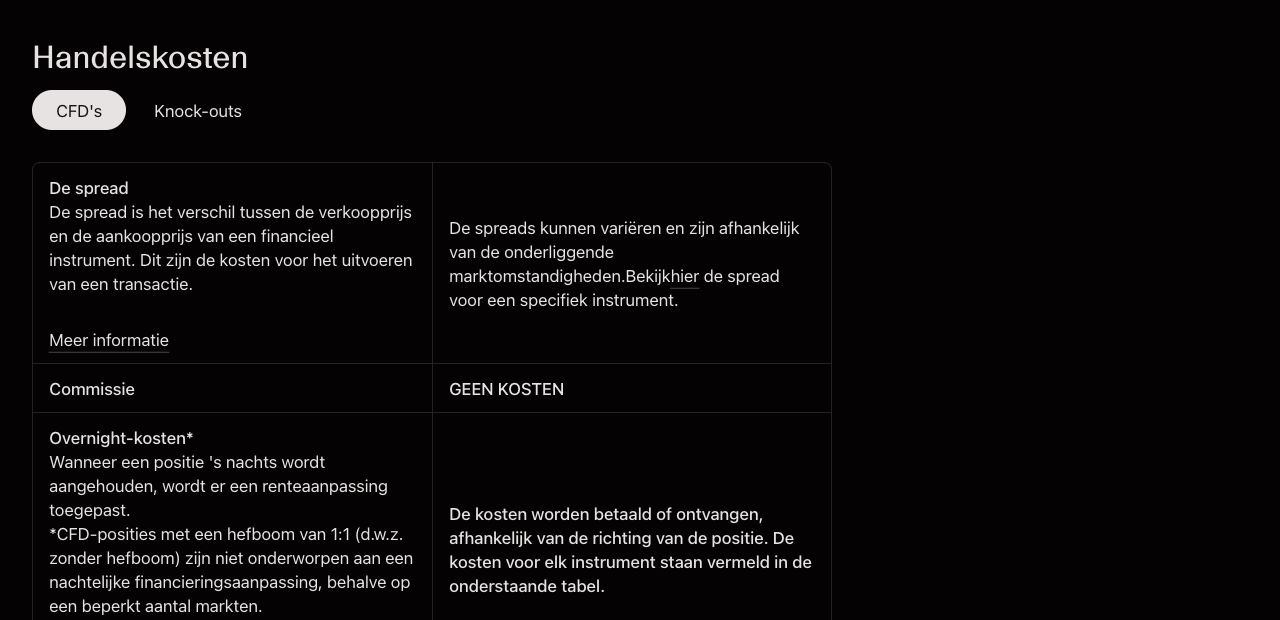
This illustration uses no claim about an available provider's prices or probability of any outcome. The calculation is a way to understand the contract. For an actual position, use the live bid and ask, contract value, account currency and official fee schedule. The Capital.com Netherlands fee explanation, for example, describes how a CFD's spread and overnight adjustment are calculated in that provider's products. Those terms must not be projected onto another broker.
Margin is a deposit against a larger exposure
Margin is the amount of account equity required to open or maintain a position under the provider's rules. It is not the total market value of the position and it is not a purchase price for the underlying asset. If a contract gives exposure of €10,000 and the initial margin is €1,000, a 1% move in the reference value corresponds to €100 before charges. Relative to the €1,000 margin, that gross move is 10%. A move against the position has the same magnifying arithmetic. The example is hypothetical and ignores changes in margin requirements, spreads and financing so the relationship is visible.
The relevant comparison is between exposure and available account equity. A broker may require additional margin as a position moves against you. If equity falls to the close-out level defined in the applicable rules, positions can be closed. The AFM's CFD product-intervention explanation describes limits on leverage, timely closure of losing positions and protection against a residual debt for retail clients. Those are rules around a leveraged contract. They do not remove loss on the funds in the account. The actual margin rate and close-out calculation for a particular CFD belong in that provider's product and client terms.
Add the costs before comparing outcomes
The all-in result of a CFD position depends on more than the direction of the market. The spread is embedded in the buy and sell prices. Some products or accounts also charge a commission. A position held through a financing cut-off may incur an overnight adjustment. There can be currency conversion if the contract or account is denominated differently, and product events can cause further adjustments. The AFM lists financing of leveraged products among ongoing product costs. Its detailed CFD decision also discusses transaction costs on the full notional exposure and holding costs.
Write the cost equation in plain terms: net outcome equals directional price result minus or plus spread impact, commission, financing, FX and contract adjustments. For a day trade, financing may differ from a position kept overnight. For an instrument quoted in a foreign currency, FX can affect the result even if the underlying reference moves as expected. Avoid comparing only a quoted “minimum spread” across providers. Ask whether it is typical or variable, for which instrument and time, and whether a commission is added.
The Capital.com NL pricing page illustrates its spread, overnight, guaranteed-stop and conversion charges. It is an example of the level of detail to request. It is not a recommendation, and its examples are not a substitute for current terms for the specific Dutch-client entity and instrument. In our CFD-broker comparison, each provider's total-cost scenario must use its own verified contract specifications.
When does the position close?
A CFD may be closed when you manually submit a closing order, when a conditional order triggers under the provider's rules, or when margin close-out terms require closure. A stop order is an instruction subject to its execution rules. It should not be interpreted as a guarantee that the exit will occur at the exact requested price unless the specific product explicitly provides that feature and its charge is understood. In fast markets, the reference price and available quote can change between display and execution.
The account display should show the live position size, current bid/ask, available equity, used margin, unrealised result and accumulated financing or adjustments. Learn where those figures appear before placing a trade. If a provider offers a demo, it can help identify controls, but a simulation does not establish actual execution quality.
Which legal entity provides the CFD?
The brand behind a CFD app can offer real shares through one account and CFDs through another. Check the contracting company named in the CFD agreement and whether it may serve residents of the Netherlands. The AFM investment-firm register distinguishes Dutch-authorised firms from firms operating through a European passport. Our broker-verification guide shows how to match a legal name to the register and why the client entity matters for the applicable terms. A group-level statement such as “regulated in Europe” is not precise enough for a product comparison.
Also check whether the reference market, order size and account category shown in a provider's international marketing material are actually available to Dutch retail clients. Cross-border groups may use different terms by region. For any cost claim, use the official tariff for the Dutch-client entity and account, not a price shown on a US or professional-client page.
CFD versus buying the underlying share
| Feature | Real listed share | CFD referencing a share |
|---|---|---|
| What the account holds | A security interest under the broker's custody arrangement | A derivative contract with the provider |
| Exposure | Share price and any applicable shareholder rights | Contract-based long or short price difference, with adjustments |
| Funding | Generally the purchase value plus costs | Margin against a larger notional exposure, subject to provider rules |
| Holding costs | Broker and custody terms, possible FX | Spread/commission and potentially overnight financing and adjustments |
| Main document to inspect | Share/venue details and client custody agreement | CFD specification, margin and close-out terms, fee schedule |
The table is a comparison of product mechanics, not a claim that either product is universally preferable. The intended holding period, ownership objective, tolerance for short-term price movements and all-in costs determine which question the reader should investigate next. Someone looking to own an Amsterdam-listed company should use the real-share purchase guide. Someone exploring leveraged price exposure should first understand the contract and its margin process.
Frequently asked questions
Do I own the share when I open a share CFD?
No. The CFD references a share price but is a contract with the provider. The AFM's description of CFDs distinguishes this from direct ownership of the underlying product.
Can a CFD lose more than the initial margin?
The position's loss can exceed the amount initially set aside as margin because the market exposure is larger. For Dutch retail clients, applicable CFD rules include protection against a residual debt under the conditions described by the AFM. That does not make the initial margin a fixed maximum loss for the position or prevent losses of account funds. Read the exact account and close-out terms.
Is a zero-commission CFD free to trade?
No. A spread, overnight adjustment, FX conversion or other product charge may still affect the outcome. The provider's detailed NL pricing explanation is an example of where to look for those components.
Why can a CFD show a loss just after opening?
The buy and sell quotes differ. Closing immediately at the opposite side of the spread can produce a negative result even before the reference market moves. Depending on the product, commissions or other charges may also be applied at opening.