

 Trading 212
We checked Trading 212's country-to-entity list, Dutch product pages, EU GmbH custody and protection explanations, and account-specific fee help. The stock broker comparison and ETF broker comparison assess the company alongside other routes. This page examines Trading 212's account split and practical costs in depth. Our methodology explains how we verify account routes and costs.
Who Trading 212 fits
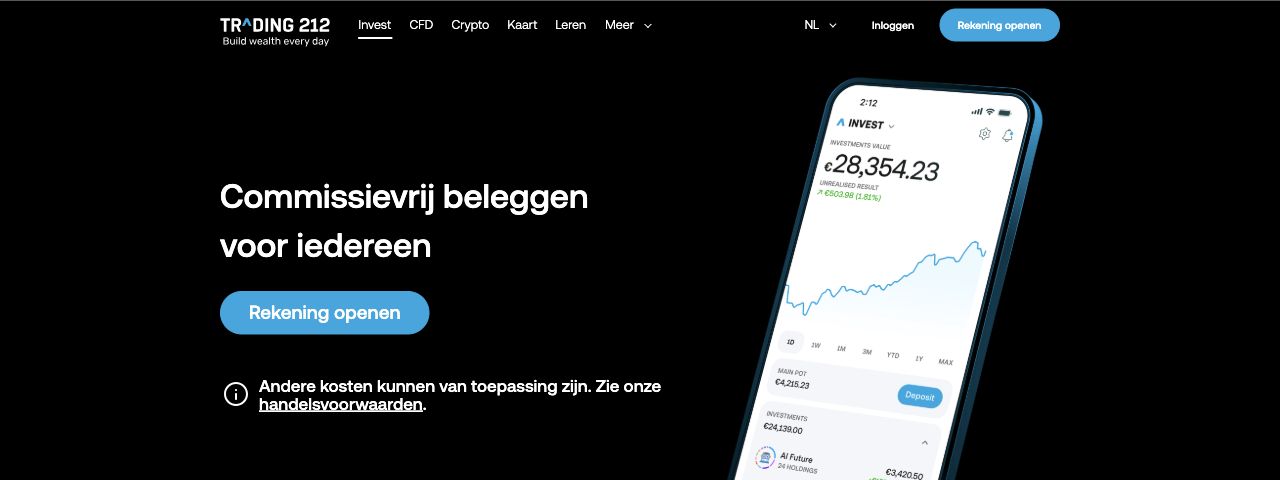
Invest can fit a self-directed buyer who already knows the security they want, checks the ISIN and currency, and wants to place either a whole-unit or eligible fractional order. Trading 212's Dutch Invest page shows shares, ETFs and fractional dealing. Its fractional-share help says most, rather than all, Invest instruments support fractions. The provider also documents a pre-confirmation cost view and downloadable statements, which help a person check an order and retain records. Readers can check these functions in their own account route.
It can fit less well when a buyer needs an ETF on a particular exchange that the account does not offer, wants to transfer fractional units to another broker, or prefers a single account without any derivative product alongside real securities. The client must confirm that the order ticket says Invest rather than CFD. A CFD can be suitable only for a deliberately different price-exposure task with its own margin and financing conditions. Someone seeking an adviser or full-service portfolio management should also consider a different route. We do not call Trading 212 universally preferable simply because its Invest dealing commission is zero: currency conversion, funding, fund charges and the bid/ask spread can change the real cost.
Dutch client entity and Invest versus CFD
Trading 212's official assignment list places the Netherlands under Trading 212 EU GmbH, a German investment firm. A prospective user should check that name in the final account agreement. The public Dutch-language site contains information for the wider Trading 212 group, including panels that refer to another entity's compensation arrangement. The NL-language page alone is therefore not a substitute for the EU GmbH-specific protection explanation or the relevant legal terms.
In an Invest order, the buyer selects an available stock or ETF for an investment account. Trading 212's EU GmbH custody description explains that the client has a beneficial entitlement while legal title sits through its custody chain. For a fractional order, the fractional-share FAQ says whole shares are held on behalf of fractional holders. An underlying ETF position remains distinct from the fund's own assets and expenses.
A CFD instead represents a contract on a price movement. It does not create the same shareholding or ETF-unit entitlement. The Dutch CFD terms describe separate spread, overnight and FX treatment. The Invest ETF tariff must not be reused for an ETF CFD, and a CFD position must not be counted as a transferable share. This distinction is central to our CFD broker comparison.
Invest costs and funding
Trading 212's Invest fee help lists zero Trading 212 dealing commission and custody fee and a 0.15% FX fee when a trade requires currency conversion. It also names external taxes and exchange charges that can apply to particular markets or sales. A fund's ongoing charge and the market bid/ask spread are separate from broker commission. The order-cost help says the app shows an estimated breakdown before the final order, including applicable fees. Read that account-specific screen instead of inferring the total from a zero-commission headline.
| Invest item | Published Trading 212 treatment | What still needs checking |
|---|---|---|
| Eligible share or ETF dealing | No Trading 212 trading commission | Venue, bid/ask, any external tax and the exact instrument. |
| Invest custody | No Trading 212 custody fee | Fund-level ongoing charge still exists for an ETF. |
| FX on an Invest order in another currency | 0.15% of the conversion | Whether the account already holds that trading currency. |
| Bank or instant bank-transfer deposit | No Trading 212 deposit fee | The payer's bank may have its own terms. |
| Card and supported wallet deposit | Free up to a cumulative €2,000 deposited, then 0.7% | Allowance does not reset for each payment. Check payment method. |
| Withdrawal | No Trading 212 withdrawal fee | Third-party bank/payment charges can remain. |
The funding conditions come from Trading 212's funding-fee help. A person who buys a euro-traded ETF with euros already deposited by bank transfer avoids the Invest FX charge for that order, but not the fund and spread costs. A person repeatedly funding by card after the cumulative allowance is used could pay a charge before even placing a commission-free order. The FX FAQ says the 0.15% appears on the Review Order page and also applies to foreign-currency instruments in a Pie. The platform's multi-currency help says using a balance in the instrument's currency avoids a conversion for that trade. Obtaining that balance can itself require a conversion elsewhere.
For a €1,000 euro-denominated ETF buy funded by free bank transfer, the published Trading 212 dealing and FX charges for that specific route are zero. That is not a zero-cost ETF: the trading spread, issuer's ongoing charge and any applicable external charge must still be checked. For a €1,000-equivalent US-share buy that requires converting euros, the published 0.15% FX component would be approximately €1.50 on €1,000 converted, in addition to market spread and any relevant external charges. The actual order value and conversion rate determine the final amount. A later sale or conversion back can add costs. The AFM cost guide explains why broker, product and transaction costs need to be read together. These two examples compare product routes within one account. They are not a prediction of fill price or investment result.
CFD costs are a separate schedule
Trading 212's Dutch CFD fee page lists zero trading commission and custody fee for the CFD product, but a dynamic spread, instrument-specific overnight financing for held positions, and a 0.5% FX fee on the result when closing an instrument priced in a different currency from the account. These are not the 0.15% Invest FX terms. The cost of a CFD depends on the chosen symbol, direction, position size and holding period. The provider directs users to the instrument details for the current spread and overnight amount. A fixed table of one CFD rate for all symbols would be misleading.
| CFD cost element | How to evaluate it |
|---|---|
| Spread | Inspect the specific instrument's bid and ask before opening and closing. It changes with conditions. |
| Overnight financing | Read the instrument-specific rate and count the nights a position is held. |
| Result-currency FX | Check whether the position's price currency differs from the CFD account currency. The page specifies 0.5% on the closing result when applicable. |
| Margin and exposure | Use the full position value, not only the cash margin, when comparing a market move and financing. |
Those categories explain why a CFD with no explicit commission can cost more than an Invest purchase held as an underlying security. They also make a CFD unsuitable as a silent replacement for an ETF savings plan. The CFD guide explains the contract and overnight arithmetic in context. We do not publish an unverified live spread or a generic overnight rate as if it applied to every account.
Pies, savings plans and fractional units
Trading 212's Pies and AutoInvest help says an EU GmbH customer can set up a savings plan for a single eligible stock or ETF as well as an allocation across a Pie. That may fit a Dutch resident who has selected a recurring investment task and understands the assets in the Pie. It does not remove the need to check each ETF's ISIN, share class, trading currency and fund cost. The same help describes scheduling, but a user should verify the actual payment method offered in their Netherlands account rather than assume a country-specific German debit method is available.
One Dutch customer's June 2026 Trustpilot review liked Pies and AutoInvest, but said they could not find some Polish-listed companies and worried that beginners might mistake other users' forum posts for reliable investment advice. Trading 212 acknowledged both concerns in its reply. The report does not identify the customer's legal entity or prove that every Polish listing is unavailable now. For a planned Pie, search the exact ISIN and venue in the offered Invest account before building the allocation. Treat community portfolios and comments as ideas to check against the fund documents and your own plan: Trading 212's own guide says social and model Pie allocations are not personal investment advice.
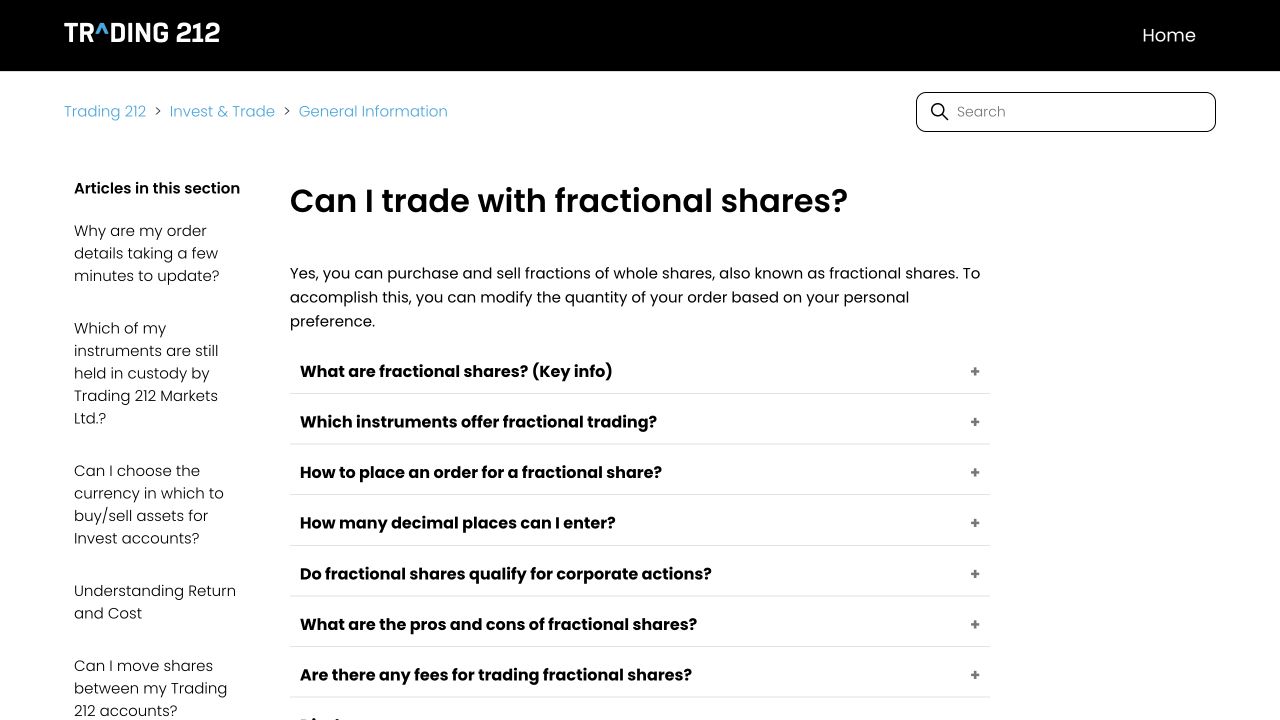
Fractional dealing can let a small contribution buy part of an expensive share. The fractional-share FAQ says most Invest instruments support it and that Trading 212 holds the relevant whole share on behalf of fractional holders. The benefit is flexible amount sizing. The limitation is portability. The provider's transfer guide says only whole shares move in kind. A holder of 100.5 shares could transfer the 100 whole units but would need to sell the 0.5 fraction before taking its value away. A fractional ETF plan should be assessed with that exit constraint in mind, not only by its purchase convenience.
Trading workflow and records
Trading 212's cost-preview help describes a Cost information step immediately before an Invest or CFD order. At that point, check the account label, exact instrument, side, quantity, currency and estimated costs. A market order's final fill can differ from the indicative price. A limit order can remain open without buying anything if its price condition is not met. For a first ETF purchase, the beginner-platform comparison gives a broader order checklist.
A separate Dutch Trustpilot reviewer in October 2026 reported being asked to repeat identity checks and losing account access intermittently. Trading 212 replied that additional security or regulatory checks can occur after an earlier verification and invited the customer to contact support about recurring requests. The public exchange does not establish the trigger, duration or eventual outcome. Trading 212's login guidance confirms extra checks can be requested on a new device or for certain actions, but does not explain this person's case. If you need access for a time-sensitive order, keep your verification method available, check for an outstanding request in the app and use the in-app support channel if checks repeat. Do not assume an account will always be ready at the moment a market opportunity appears.
After trading, Trading 212's document FAQ lists account activity, monthly and trade confirmation statements available through the app. A Dutch resident should retain the actual order and year-end position/cash records rather than rely on a phone screenshot of a fluctuating portfolio value. The provider's reports support recordkeeping but do not decide a person's Dutch tax treatment. See our Netherlands tax guide for that question.
A full year of small Invest orders
Imagine a resident putting €100 each month into one eligible euro-traded UCITS ETF through a Pie. The AutoInvest help explains the scheduling function, but it does not by itself establish that the selected ISIN, funding method and account entity are suitable. Before enabling the plan, check the fund's name, domicile, share class, trading currency and ongoing charge, then inspect the first cost review screen. If euros are already in the Invest balance and the ETF trades in euros, the published 0.15% foreign-exchange fee does not arise from that order. Zero broker dealing commission still leaves the bid/ask spread and the fund expense. A small allocation may be filled as a fraction, which matters when the position is moved later. Twelve such orders should be assessed as one annual routine, not as twelve identical “free” labels.
Funding can change the conclusion. Trading 212's funding explanation says bank transfer has no Trading 212 deposit charge, while card and supported wallet payments share a cumulative free allowance of €2,000 and then a 0.7% provider charge. A reader making twelve €100 card deposits has not automatically crossed that allowance during the first year, but previous deposits count too. The threshold is cumulative, not a new monthly quota. A bank may also impose its own payment charge. Record the actual funding route and bank statement alongside the investment records, because a purchase-price screen will not necessarily show a fee paid at the deposit stage.
Now change the plan to a dollar-traded security. The Invest FX explanation applies the 0.15% conversion fee when the order actually exchanges currency, including an eligible Pie order. If the account already holds enough dollars, the multi-currency help says the trade need not convert again. The earlier acquisition of that dollar balance has its own cost history. The annual comparison should therefore record the amount and frequency of conversions, not assume either twelve conversions or none. A future sale, cash withdrawal or switch back to euros creates another exit step.
Before relying on fractions for many years, inspect the transfer policy. Whole units may move in kind when the receiving broker accepts them, but fractions generally require sale. For a small recurring plan, that can leave several cash remainders and market-price exposure during a move. Monthly statements, trade confirmations and the year-end position record should be downloaded from the document area before switching accounts. These operational steps are part of the plan's real convenience, just as much as the purchase button.
Custody and protection for EU GmbH
Trading 212 EU GmbH's custody explanation says client securities are held in segregated omnibus accounts via Interactive Brokers LLC and Bank of New York Mellon, with the relevant depository depending on market and fund domicile. The customer has a beneficial entitlement recorded by Trading 212. Legal title is held within the custody chain. This differs from a share registered directly in an individual's name at a central depository. The provider says holdings are kept separate from its own assets, but an omnibus custody chain still has operational and shortfall conditions to understand.
For uninvested money, the EU GmbH protection page describes segregation and relevant German partner-bank deposit schemes for eligible cash, generally up to €100,000 per person per bank across that person's deposits with the same bank. It separately describes an investor-compensation route under EdW for 90% of eligible missing funds up to €20,000 if the firm fails to safeguard them. These are different failure cases and should not be added together as a promised payout. Neither covers a normal fall in the price of an ETF or share. The specific partner bank and distribution of client cash can be inspected in the app according to the provider. This EU GmbH material, rather than a generic group page's Cyprus panel, is the relevant starting point for a Dutch applicant. Our broker-safety guide explains the entity and custody checks.
Moving a portfolio
The portfolio-transfer help says Trading 212 EU GmbH Invest supports eligible stock and ETF transfers in and out and does not charge its own transfer fee. The other broker might. The explicit Germany-resident exclusion in that help should not be generalized to a Netherlands resident. Only whole shares transfer in kind, and availability also depends on the receiving provider and exact instrument. Once a transfer is underway, the invested positions may not be tradable until the process finishes, while their market prices can still change. Consider that constraint when planning a switch rather than assuming that an easy fractional purchase produces an equally easy in-kind exit.
When another route fits
Trading 212 Invest can fit someone who checks the account label, uses the cost preview, values eligible recurring/fractional purchases and is comfortable with omnibus custody. A reader who prioritizes a specific exchange, whole-unit portability, a different cash custody arrangement or a single-product platform may prefer another provider. A person who wants leveraged short-term exposure is considering a different product, the Trading 212 CFD account, and should compare symbol-level financing rather than the Invest commission. Our review directory and broker comparison place those choices in a wider Netherlands context.
Frequently asked questions
Are Trading 212 Invest shares the same as CFDs?
No. Invest provides an entitlement in the underlying eligible share or ETF through the custody structure described for EU GmbH. A CFD is a contract on price movement with separate spread, overnight and FX conditions. Check the account and product label before confirming an order.
Does commission-free Invest mean no cost?
No. A foreign-currency trade can incur the published 0.15% FX charge. Card or wallet funding beyond the cumulative free allowance can add 0.7%. External taxes, market spread and ETF issuer costs may also apply. The app's cost preview and the chosen instrument's documents show which items matter for that order.
Can I transfer a fractional share to another broker?
The provider's transfer guide says only whole shares can be transferred in kind. A fraction must generally be sold before its cash value is moved. Check the receiving broker's eligibility and charges for the whole units as well.
Which protection applies to a Netherlands resident?
Trading 212 assigns new Netherlands applicants to Trading 212 EU GmbH. Its EU-specific documents describe segregated custody and separate arrangements for eligible cash at partner banks and compensation if the firm fails to safeguard eligible assets. The exact customer agreement and cash-bank allocation matter. A generic Dutch-language marketing panel for another group entity should not be treated as the Dutch client's scheme.
Can an EU GmbH customer use a recurring single-ETF plan?
Trading 212's AutoInvest help describes a single-instrument savings-plan route for EU GmbH customers. The chosen ETF, account eligibility, funding method and currency still need to be checked in the Netherlands account. A scheduled purchase may execute at a different price from a manually chosen limit order. Review each executed order separately, because the plan does not remove instrument or currency costs.