

Start with tax residency and the asset, not the broker brand
The same share can be held through a Dutch or foreign platform. The broker's location does not, by itself, remove a Dutch resident's obligation to report an asset. The Belastingdienst's 2026 Box 3 guidance says to declare relevant assets in the Netherlands and abroad. The account arrangement still matters because it determines which statements show the securities, cash balances, debts and taxes withheld.
Before using this page, establish the tax year and whether the holding is private Box 3 property. A holding connected to business activity, employment or a substantial interest requires a different analysis. A fiscal partner can change the allocation of the Box 3 tax base. Residence during only part of a year, emigration or immigration may also affect the return. The following workflow is for a typical private portfolio and should not be transplanted to those special cases without checking the applicable Belastingdienst instructions.
What Box 3 asks you to identify
Box 3 is the Dutch category for income from savings and investments. For the 2026 tax year, the starting point in the Belastingdienst's 2026 calculation is the value of relevant assets and debts on 1 January 2026. It distinguishes bank and savings balances from investments and other assets, applies its year-specific calculation and then accounts for the tax-free allowance and the person's share of the tax base. It is therefore misleading to take one annual trading profit number from an app and label it “Box 3 tax.”
For a broker account, make a separate inventory of securities, cash, any margin debt and other account positions at the reference date. The tax classification of a cash arrangement should follow the official tax guidance and the legal account structure. The fact that a platform calls the balance “cash” is not conclusive. Record each position's value in euros using the applicable statement and valuation rules. The annual statement can be a useful starting point, but it is a record from the broker, not the tax authority's decision about classification.
| Record from the broker | Why it matters | Check against |
|---|---|---|
| Portfolio valuation at the reference date | Identifies shares, funds and other securities held | Holdings and prices on the statement. Tax-year guidance. |
| Cash balance or cash-fund position | Helps distinguish money from an investment product | Account agreement and balance details. |
| Margin loan or other debt | May be relevant under Box 3 debt rules | Loan statement and applicable threshold. |
| Dividend and tax-withholding notes | Separates gross income from amounts withheld | Payer, country and individual payment record. |
| Transaction history | Helps reconstruct purchases, sales and actual return | Dates, quantities, fees and cash movements. |
Notional return and actual return are different calculations
The Box 3 calculation has changed in response to court decisions and remains year-specific. The Belastingdienst currently describes a method based on notional returns for asset categories and a route to report a lower actual return. The Belastingdienst explains the comparison between notional and actual return and says the more favourable amount is used when actual-return information is supplied under the applicable process. Check the tax year's official page rather than carrying a percentage or allowance from an older article into a new return.
Actual return is not simply the realised gain on shares sold. The Belastingdienst includes income such as interest and dividends and changes in asset value over the calendar year, with the treatment of purchases, sales and debts set out in its examples. Its worked examples of actual-return calculations explicitly adjust the change in investment value for purchases and sales and add dividend. A broker's “performance” chart may use deposits and time-weighted methods that serve a different purpose. Do not copy that percentage into the tax field without reconciling the underlying amounts.
For a return where actual return is relevant, keep the opening and closing values, purchase and sale history, cash interest, gross dividends and applicable debt interest together. The Tax Administration's English record checklist sets out the details it asks for, including annual investment income and supporting account statements. It also addresses investments denominated in foreign currency. These are records to gather. This article does not assume that supplying them is always advantageous.
A simple record-reconciliation example
Imagine that a portfolio of shares is worth €10,000 at the start of a calendar year and €11,000 at the end. During the year, the investor buys €2,000 of additional shares, sells €500 of shares and receives €100 of dividends. The raw €1,000 increase in portfolio value is not the investment's actual return: it includes the effects of money added and securities removed. Following the structure of the Belastingdienst's investment example, the illustrative investment component is €100 + €11,000 − €10,000 − €2,000 + €500 = −€400. This is a record-reconciliation illustration only. A person's actual Box 3 outcome depends on all relevant assets and debts, tax-year rules, valuation and the return as a whole.
This exercise shows why a deposit is not a profit and a sale receipt is not automatically income. It also shows why a broker's end-year value alone cannot answer the question. Check how the broker defines “portfolio value”: whether it includes cash, unsettled trades or accrued income can matter when matching that number to the categories requested by the tax authority. Preserve the original PDF or CSV and your reconciliation so a revised statement does not erase the trail.
Dividend withholding is a separate line of work
When a Dutch company distributes a dividend, Dutch dividend tax is generally withheld by the payer. The Tax Administration explains that a Netherlands-resident recipient can usually offset Dutch dividend tax through the income-tax return and must state the amount withheld. This is distinct from classifying the shares and their value for Box 3. A net cash credit in the broker account may not show the gross dividend and tax clearly enough. Use the dividend note or detailed account statement.
Foreign-source dividends may have foreign withholding tax. The amount withheld depends on the source country, the security and potentially a treaty process. It is not automatically the same as Dutch withholding. The Belastingdienst explains that treaty-based relief or refunds may be available for foreign withholding. Record the issuer's country, gross payment, foreign tax and any broker processing separately. Do not assume that all foreign withholding can simply be entered in the same field as Dutch dividend tax or recovered in full.
Funds introduce another layer: the investor may receive a distribution from the fund, while the fund may itself have incurred withholding on investments inside its portfolio. The investor's broker statement usually reports what reached the investor, not every tax paid inside a fund. That is one reason comparing “dividend tax” between two ETFs solely from a brokerage cash ledger can be misleading. Use the fund's official documents for its structure and the tax authority's instructions for the investor's own return.
Gather documents before filing
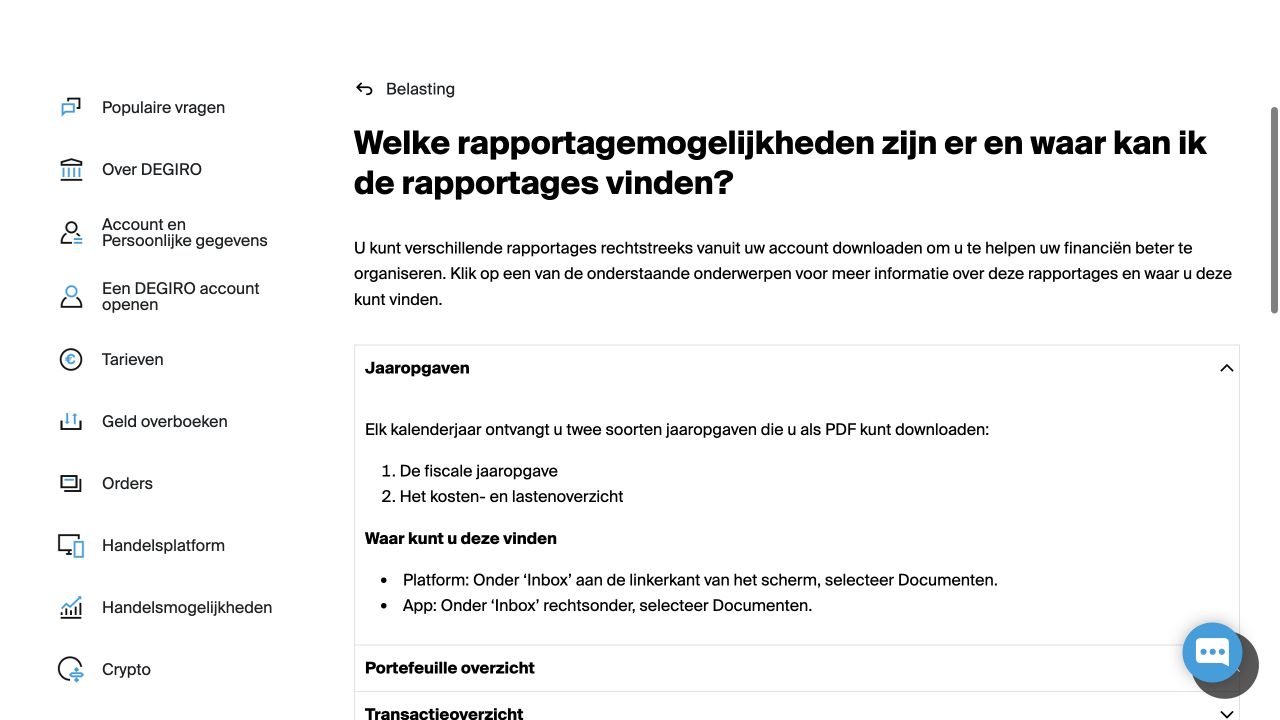
Download the broker's annual statement, portfolio valuation, transaction history, cash-account statement and dividend notes for the relevant calendar year. For example, DEGIRO lists a fiscal annual statement, costs overview, portfolio report and transaction report for its customers. Other brokers may provide different names and formats. The DEGIRO help page itself cautions that its annual statement may need checking. That is a good reminder to reconcile any broker-generated report with the official questions in the return.
Use this sequence:
- Fix the tax year, residence position and whether there is a fiscal partner.
- List every broker, bank and other relevant holding. Include foreign accounts.
- Record the required reference-date values and identify the correct categories.
- Keep the gross dividend and Dutch and foreign withholding amounts separate.
- If considering the actual-return route, gather the additional opening and closing values, purchases, sales and income for the full year.
- Check the completed return against the Belastingdienst guidance for that year, then retain the source statements and your reconciliation.
An app's prefilled data can save typing, but it should be reviewed. Missing foreign holdings, an old cash balance or a security misclassified as bank money can change the result. A provider may deliver a corrected annual statement after the return has been prepared. Track versions and check whether a correction is needed under the tax authority's process.
Where this guide ends
This page is about a typical Dutch resident's private investing records. It does not cover every treaty claim, substantial-interest rule, business asset, pension wrapper or change of residence. Tax law and the Box 3 method can change between years. The primary source for a particular return is the Belastingdienst guidance for the applicable year. A tax adviser may be needed for a complex case. Our starting-investing guide covers the investment workflow, while the stock-broker comparison considers account features and costs separately from an individual's tax liability. Our research methodology explains how we verify broker information.
Frequently asked questions
Does using a foreign broker remove my Dutch Box 3 reporting obligation?
No general exemption follows from the broker being abroad. The Belastingdienst says relevant domestic and foreign assets must be declared. The exact treatment still depends on residency and the holding.
Is the profit shown in my trading app the amount taxed in Box 3?
Not necessarily. The notional-return calculation starts with asset categories and a reference-date value. The actual-return route has its own rules and considers the relevant holdings and income over the year. An app performance figure can be calculated on another basis.
Is Dutch dividend tax the same as Box 3 tax?
No. Dividend withholding is deducted when a payment is made and may be creditable through the income-tax return for an eligible resident. Box 3 concerns the tax treatment of savings and investments. Keep both records rather than netting them without explanation.
Which broker document is enough for my return?
There is no universal single document. An annual tax statement may help with positions and balances, but dividend notes, cash statements and transactions may be needed, especially for an actual-return calculation or a discrepancy. Use the Belastingdienst's requested fields to decide which records to gather.