

 Swissquote
We used the Luxembourg Trading Account page, the applicable rate card and account terms, and the AFM's Dutch register entry. The review examines the Luxembourg account route and terms. The methodology explains how we check a country route. See Best Stock Brokers for comparison with other real-share accounts and Best ETF Brokers for recurring fund purchases.
Which Swissquote company serves a Dutch applicant?
Swissquote's EU account-opening guidance points EU and EEA residents toward the Luxembourg entity when they want the protections of EU regulation. The Trading Account and its footer identify Swissquote Bank Europe SA, supervised by Luxembourg's CSSF. The AFM register lists it as an EEA credit institution and records investment services including custody and administration. That cross-border entry identifies a firm and permissions. It does not guarantee that every security or service is enabled for every applicant.
The Swissquote brand also appears on Swiss and other group websites. A Swiss-country price in CHF, a forex account marketed by another entity, or an investor-protection statement from a different country is not automatically the condition for a Dutch resident's Luxembourg Trading Account. At the application stage, match the company name on the agreement and the fee document to Swissquote Bank Europe SA. If the offered company differs, repeat the product, tariff and protection checks before relying on this review.
A customer experience to check before applying. In an October 2026 Trustpilot review, an applicant who explicitly named Swissquote Bank Europe said their documents were received, then they waited more than six weeks for a rejection they discovered after following up. Swissquote's public reply acknowledged poor communication while saying compliance rules can limit what it discloses about individual decisions. This was an application for a personal bank account with an IBAN, not a confirmed Trading Account application; it cannot establish the usual approval time or rejection rate for Dutch investors. It does show why an applicant should retain the document-submission confirmation, check the status before transferring a planned portfolio, and ask the Luxembourg team for a clear next step if the promised update does not arrive. The reason for this applicant's rejection is unknown.
What the Trading Account offers
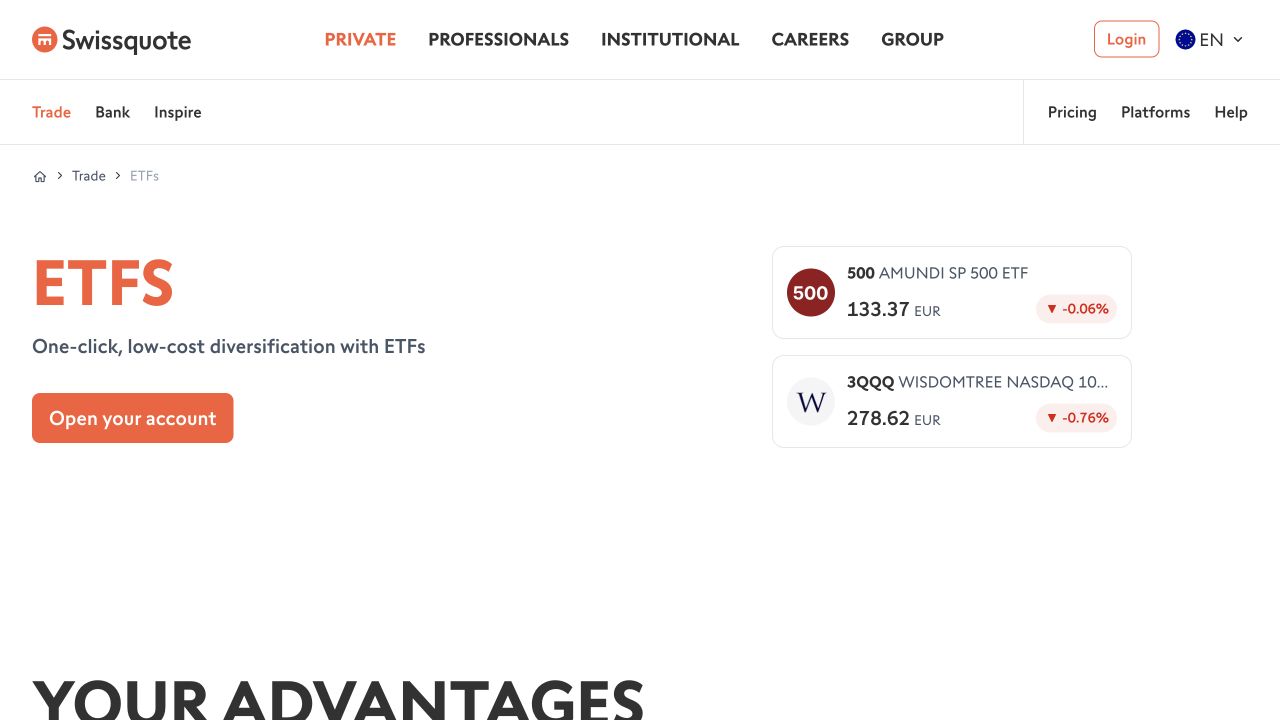
The Luxembourg product page describes real stocks, ETFs and mutual funds in a multi-currency account, and lists options, futures and other products as possible routes. Its trading FAQ describes share access across international exchanges. The investor should still search the exact ISIN, exchange and currency in the offered account. A security's availability can depend on account permissions and the issuer's documents. The number of market names in a brochure does not prove the particular fund share class is tradable.
The multi-currency balance is important for a resident funding the account in euros and buying an American share. Holding an available dollar balance can avoid an automatic EUR-to-USD conversion for each purchase, but creating or replenishing that balance has its own conversion terms. A euro-listed Dutch share may require no currency exchange at all. Swissquote's FAQ says orders can settle in a selection of available currencies depending on the account funds. The order preview must still identify the settlement currency and available balance. The mere presence of a USD wallet is not a promise of a free exchange.
An ETF purchase has two cost layers. The broker charges for the market order under its own schedule unless a specific free-buy condition applies, while the fund's issuer charges an ongoing expense within the ETF. The market bid–ask spread belongs to the transaction price. Swissquote's ETF page describes a selected purchase offer rather than a zero-cost rule for every ETF, every venue and every sale. Check the selected fund list and the exact order conditions before using it in a recurring plan.
Trading and account fees for the Luxembourg route
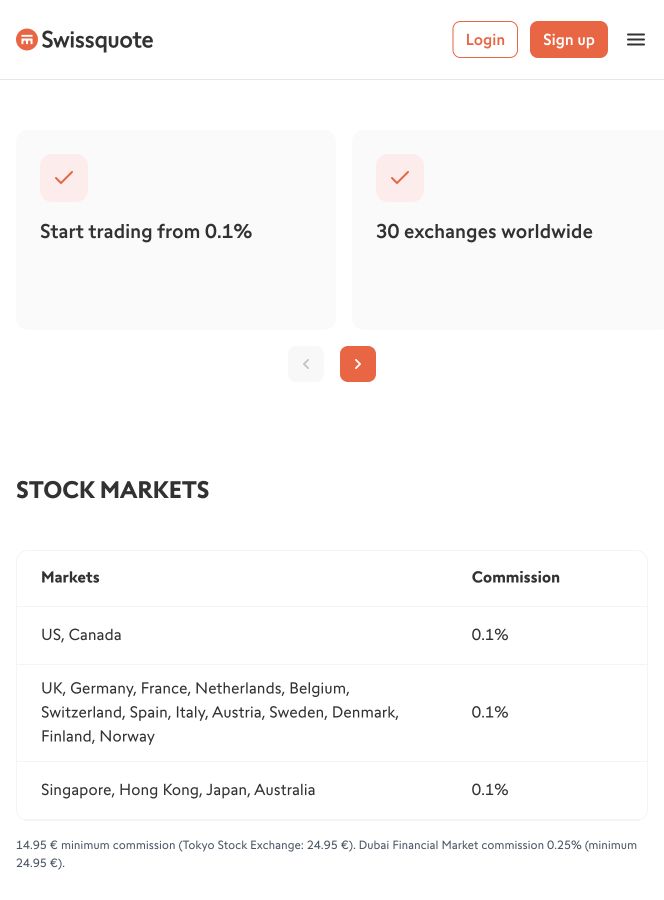
The applicable Swissquote Bank Europe stock-and-ETF tariff lists the Netherlands market at 0.1%, with a general €14.95 minimum commission. It also lists a Euronext market fee of €0.15 plus 0.63 basis points for France, Belgium and Netherlands where applicable. These are distinct layers. The market bid–ask spread can add to both. The rate applies to the account and market described, not to an unrelated Swiss account. A special bundle or VIP tier can change a customer's price, but we use the ordinary route for the examples here.
| Item for a Dutch Trading Account | Documented price or condition | Why it matters |
|---|---|---|
| Dutch-listed share or ordinary ETF order | 0.1% broker commission, €14.95 minimum. Applicable Euronext fees separate. | Small orders can be dominated by the minimum. |
| US or Canadian listed share | 0.1% broker commission, €14.95 general minimum. Settlement currency and external charges separate. | EUR-to-USD conversion can outweigh a percentage comparison. |
| Selected free-buy ETF purchase | Zero broker purchase commission only for a qualifying fund and order under the offer's terms. | The fund charge, spread, conversion and eventual sale still require inspection. |
| Currency conversion | Spot conversion tiers begin at a 0.9% spread for smaller amounts. Auto-forex at settlement uses 0.9%. | Holding multiple cash currencies does not make an actual conversion free. |
| Standard account/custody | Ordinary opening, maintenance and custody shown free for EU residents. | Exceptional account inactivity and specialist holdings have separate rules. |
| Cash and securities movement | SEPA outgoing cash transfer free at the broker. Outbound securities transfer €25 per line. | Bank intermediaries or moving a portfolio may add cost. |
For a hypothetical €1,000 Amsterdam share purchase, 0.1% is €1, so the €14.95 minimum governs the broker commission. At the published Euronext formula, €0.15 plus 0.0063% of €1,000 is about €0.21 if it applies to that order. A roughly €15.16 sum of those two published components is not an all-in execution quote: the actual security's spread, any relevant tax or other pass-through charge and the final order terms remain. The tariff page says exchange charges and taxes can be passed to trades. On a sale, check the commission again rather than treating the original purchase fee as covering the round trip. The minimum is especially material for a small investor making many separate orders.
Swissquote Bank Europe's rate card gives spot currency conversion tiers. The smallest published band uses a 0.9% spread. Larger conversions have lower published percentage bands. It separately says auto-forex conversion for trade settlement or overnight cash rebalancing uses a flat 0.9% spread. A €1,000 US-share purchase from an EUR-only balance may therefore involve a conversion component even though the dealing commission is separately shown in the stock tariff. Do not add 0.9% mechanically if a sufficient USD balance is already available and used. Check the order's cash movement, its currency source and whether conversion is automatic or a deliberate spot transaction.
The Luxembourg account-fee page lists ordinary opening, EU-resident maintenance, custody, dividend/corporate-action processing, statements and SEPA cash withdrawal as free at the bank. It lists €10 for other outgoing cash transfers, €25 per line for securities transfers out, and a 0.5% SEPA card-funding charge. A bank in the payment chain can charge separately. Those conditions make a bank transfer preferable to card funding for a reader who wants to avoid the card fee. They do not mean every possible funding or withdrawal route is costless.
An account with no trades for three years or more can be classified as inoperative and attract a quarterly administrative charge of 0.10% of assets, minimum €50, according to the same account-fee schedule. A separate no-contact condition can lead to research charges. These are not ordinary annual custody fees on an active account. A long-term holder who plans to leave a portfolio untouched should account for the rule instead of concluding from the “free custody” row that there can never be an account-level bill.
Two full-account cost paths
Twelve small ETF purchases. Consider a resident who invests €250 in the same ordinary ETF every month on Euronext Amsterdam. The Luxembourg stock-and-ETF schedule puts the €14.95 minimum above the 0.1% percentage charge for each €250 ticket. Twelve such purchases would therefore create €179.40 of broker minimum commissions before venue charges, spread or the fund's ongoing expense. That is about 6% of the hypothetical €3,000 principal purchased during the year, before any sale. This is why a small recurring investor should check the specific ETF's eligibility for Swissquote's selected free-buy offer and compare the offer's terms with a suitable plan elsewhere. A fund shown in the general ETF catalogue does not automatically qualify. If the purchase takes place in dollars from euros, conversion adds another question.
One large Dutch share purchase and a later sale. At €20,000, the ordinary 0.1% commission component is €20, so the €14.95 minimum no longer determines that example's broker commission. The crossover from a €14.95 minimum to 0.1% occurs at about €14,950 of order value. Applicable Euronext charges, market spread and any other pass-through items still sit beside the broker percentage. If the share is sold later, model the sale as a second trade with its own commission and current market price. The initial purchase cost does not pay for both directions. Someone who expects only one or two large orders may view the fixed minimum differently from someone placing twelve small ones. This arithmetic uses the published formula, not an execution quote for any named security.
A foreign-currency portfolio. A Dutch resident who deposits euros, buys a US share and later receives a USD dividend needs a cash-flow map: deposit currency, order settlement currency, any spot conversion or auto-forex, dividend currency and final withdrawal currency. The EU rate card has different language for deliberate spot conversion and automatic settlement conversion. A multi-currency account can reduce repeated conversions when a suitable balance is already held, but it does not remove the cost of first obtaining that balance. Ask the order ticket which wallet will settle the trade and inspect the statement afterward. If holding an ETF instead, add the fund's own ongoing charge and any selected-offer eligibility. These steps identify the actual comparison unit: a full year of planned transactions and holdings, rather than the cheapest isolated headline.
The bank's platform and records
The Luxembourg platform page describes Swissquote's securities trading interface and mobile app. A resident can inspect holdings, search instruments and submit orders through those channels subject to account eligibility. The stock/ETF pricing page says real-time quotes for listed securities are free, while streaming market-data feeds can require a subscription. A screen displaying a quote and an execution venue are different things. Verify timestamp and venue before choosing a limit price. Platform performance can vary with market and account conditions.
There is a favourable but limited customer view: an August 2026 Trustpilot reviewer liked the platform's clarity and features and reported fast executions, while noting that reaching an adviser had become less easy. Swissquote acknowledged both points in its reply. The review does not identify the account's legal entity, so it is evidence of one person's Swissquote platform experience, not a verified result for the Luxembourg Trading Account. Before committing to this route, inspect the actual account's order preview and ask support a specific question about the market or report you need; those checks are more useful than assuming the reported execution speed applies to your orders.
Swissquote's trading FAQ and tariff explain that a modified open order is cancelled and sent anew. If fills happen before and after that modification, commissions can apply to both orders. Multiple fills for one order on the same day normally receive one commission. Fills across more than one day can be charged on each day. This matters for thinly traded shares and limit orders, where the price control can be valuable but the execution may not happen in one batch. Keep confirmations and account statements so the cash, currency and security movements can be reconciled.
Custody, cash protection and the firm behind them
Swissquote's Trading Account page says securities are held through global custodians and the multi-currency cash account accompanies the investment account. The investor should read the custody and transfer terms for the exact security, including whether an ETF is eligible for in-kind movement and any charge for transferring it to another broker. Custody is a legal and operational arrangement, not the same as the bank's published dealing commission.
Swissquote Bank Europe is supervised in Luxembourg by the CSSF and is a member of the Luxembourg FGDL deposit-guarantee scheme. The bank's own Trading Account page says eligible cash deposits have protection up to €100,000. This is a cash-deposit statement, not a guarantee that a share or ETF cannot fall in value or that every security has the same €100,000 coverage. We do not state a separate securities-compensation limit without a current specific source for this account. A reader can use the broker-safety guide to match the account's legal entity, regulator entry and custody wording.
The Netherlands does not become the bank's home supervisor merely because the AFM register lists its incoming services. The register is evidence of the cross-border route. The Luxembourg agreement, CSSF status and FGDL eligibility remain the relevant legal documents for the bank account. If an applicant is sent to a different Swissquote company, these conclusions need to be checked again.
When Swissquote may fit, and when it may not
Swissquote Bank Europe can fit a Dutch resident who wants real securities through a Luxembourg bank, a multi-currency cash arrangement and access to several international exchanges. It becomes more plausible when individual order sizes make the €14.95 minimum a smaller share of the trade and the investor can plan currency holdings deliberately. The account can also suit someone who values keeping cash and investments under one bank relationship and expects to use the documented app and reporting functions.
It is less compelling for a small recurring purchase where each ordinary ETF order triggers the minimum, unless the exact ETF qualifies for a special free-buy offer and the rest of the cost is acceptable. It also requires care for an investor who moves securities between brokers or lets an account go unused for years. A reader focused on a different derivative product should not assume the Luxembourg Trading Account's stock tariff describes Swissquote's forex or CFD route. Compare the broader account options and the mobile workflows for those distinct decisions.
Frequently asked questions
Is Swissquote Bank Europe the same as the Swiss Swissquote bank?
No. They belong to the Swissquote group but are different legal companies. For this Dutch-oriented review, the EU account guidance, Luxembourg Trading Account and Dutch AFM register entry point to Swissquote Bank Europe SA. The actual agreement presented at signup decides which entity and tariff apply.
What would a small Amsterdam share purchase cost?
The published EU bank stock tariff lists 0.1% for Netherlands with a €14.95 general minimum, plus applicable Euronext fees. For a hypothetical €1,000 order, the minimum governs the broker commission. Market spread and any other applicable pass-through cost require the live order summary. The example is not a quote for a specific share or execution.
Are all ETFs commission-free to buy?
No. Swissquote describes a selected free-buy ETF offer with eligibility conditions. The ordinary stock/ETF tariff still matters for other funds or a sale. Even a qualifying zero-broker-commission purchase has market spread and the fund's own ongoing charge.
Does a multi-currency account remove FX cost?
It can avoid a conversion on a purchase if the required currency balance is already held and used, but an actual conversion has its own terms. Swissquote's EU rate card distinguishes spot-conversion tiers and auto-forex. Check which cash balance settles the order and how that balance was obtained.
What does the €100,000 protection refer to?
The Luxembourg bank page describes eligible cash deposits under the FGDL scheme. It does not insure the market value of an ETF or share. Securities custody and any failure claim follow different rules, which should be checked in the actual account documents rather than inferred from the cash-deposit number.
At what order size does the Netherlands percentage exceed the minimum?
At the ordinary Luxembourg Netherlands-market rate of 0.1%, a €14.95 commission equals 0.1% of €14,950. Below that hypothetical ticket value, the €14.95 broker minimum governs. Above it, the percentage may govern. This is only the broker commission calculation. Euronext charges, the market spread, taxes and any special tier or promotion still need to be checked on the actual order. The threshold helps a reader see why twelve €250 purchases and one €20,000 purchase produce very different cost patterns, even though both use the same tariff page.
Does free custody mean I can leave the account unused forever without a fee?
No. The Luxembourg account-fee schedule distinguishes ordinary free maintenance and custody from an inoperative account after three years without trades, and from a separate no-contact process. A passive investor should check how those conditions apply to their planned activity. A tiny annual ETF contribution might preserve an active pattern but can incur the ordinary per-order minimum unless a specific ETF offer applies. Conversely, closing or transferring positions can create dealing or transfer charges. Model the whole intended holding period rather than interpreting one “free custody” line as every possible account cost.
Which documents should I compare before opening the account?
Use the EU account-opening guidance to identify the offered bank, then match the agreement to Swissquote Bank Europe SA and the Luxembourg market tariff. Check the rate card if a foreign currency will be needed, and the account-fee schedule if you expect transfers or long inactivity. Finally search the intended ISIN in the offered Trading Account and inspect the order currency and venue. A Swiss parent-company price or protection statement may describe a different legal account and should not replace the Luxembourg documents for this Dutch-resident route.