

 Interactive Brokers
The account may suit an investor who holds Dutch, other European and US securities or needs listed options and more detailed order controls. It may suit less well for someone who wants a single monthly EUR ETF purchase with almost no tariff choices, or who expects all real-time exchange feeds to be included automatically. Our broker comparison weighs the full account by use case. The platform comparison treats the interface separately. The methodology describes our public-document checks.
Entity and Dutch availability
The available-country list includes the Netherlands. The EU site identifies Interactive Brokers Ireland Limited (IBIE) as the Irish investment firm regulated by the Central Bank of Ireland, reference C423427, in its entity disclosure. The Dutch AFM investment-firm register also lists the Irish company. The final client agreement still governs a particular applicant's account. Do not confuse the direct IBIE account with Interactive Brokers LLC in the United States, or with an introducing broker using IBKR's infrastructure. An introducing broker can set an additional commission schedule. IBKR's pricing notes explicitly warn that rates for introduced or advised clients can differ.
IBIE's permissions inventory lists Netherlands stocks and ETFs, options, futures, currencies and CFDs among product categories, but access to an individual product depends on permissions and the account's eligibility. A listed share or ETF is a security, a listed option is a derivative, spot currency conversion exchanges cash, and a CFD is a contract whose exposure and financing differ from owning the underlying share. Do not assume that an exchange symbol appearing in a search result is immediately tradeable in a new account. The order ticket and account permissions are the final checks. Our CFD broker comparison covers that product type. It is not interchangeable with the Dutch stock tariff below.
Dutch share and ETF commissions
The official Europe stock schedule, Netherlands section publishes three routes for EUR-denominated Dutch-market shares and ETFs in its first monthly value band. Tiered charges 0.05% of trade value with a €1.25 minimum and €29 maximum, then adds applicable exchange, clearing and regulatory charges. Fixed with IB SmartRouting charges 0.05% with a €3 minimum and includes the listed ordinary third-party fee categories, subject to the schedule's ETF note. Fixed with direct routing charges 0.10% with a €4 minimum. Higher monthly-volume bands reduce the Tiered percentage. They do not justify quoting the lower band for an ordinary occasional investor.
| Netherlands EUR-denominated share/ETF route | First-band commission | Minimum | Other cost condition |
|---|---|---|---|
| Tiered | 0.05% of order value | €1.25 | Exchange, clearing and regulatory charges can be added. €29 broker-commission maximum for whole shares. |
| Fixed, IB SmartRouting | 0.05% of order value | €3 | Standard third-party categories are included as shown in the tariff, with the Euronext ETF exchange-fee exception. |
| Fixed, direct routing | 0.10% of order value | €4 | Route and venue are selected directly. This is not the same as SmartRouting. |
The same tariff footnote specifies a €0.75 per-execution Euronext exchange fee on ETF products in France, the Netherlands and Belgium. It matters for a recurring small ETF order even when the fixed commission looks straightforward. Tiered exchange charges depend on execution venue and order details. The published minimum is the broker portion, not a promised all-in result. The page also warns that modifying an order can create a new minimum if the venue treats the remainder as a new order. Fund issuer charges, bid-ask spread and relevant taxes are separate from the commission choice.
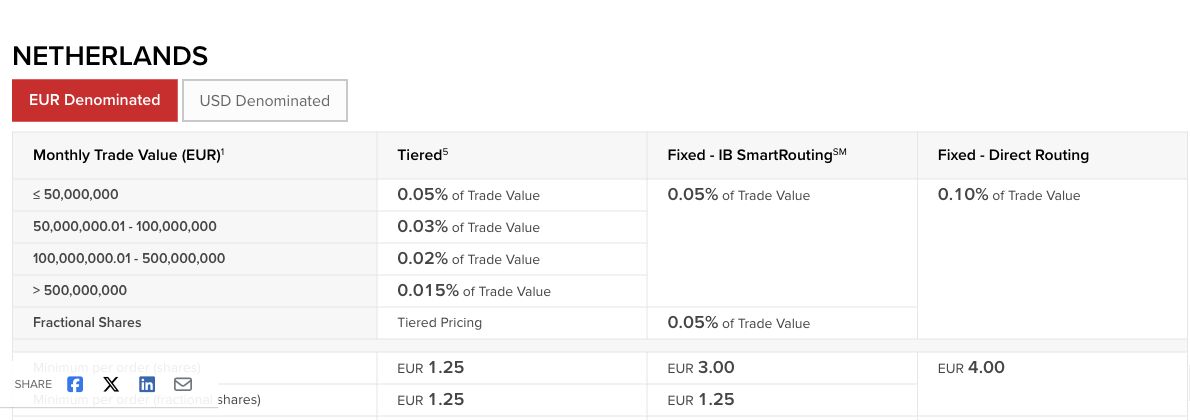
For a €1,000 Euronext Amsterdam EUR share buy, 0.05% is €0.50, so Tiered starts at its €1.25 commission minimum, before applicable exchange/clearing/regulatory fees. Fixed SmartRouting starts at €3 because its minimum also exceeds €0.50. Fixed direct routing starts at €4 because 0.10% is only €1. A later sale incurs a separate commission. A buyer cannot conclude Tiered is always cheaper merely from €1.25 versus €3: the tiered route can add venue charges, while the market spread and actual fill can change the economic outcome. The provider's Netherlands table and fee notes are the source for these calculations.
For a €200 EUR-denominated Euronext ETF buy each month, the percentage on €200 is €0.10, so the published commission minimum again determines the broker component: €1.25 Tiered or €3 Fixed SmartRouting. On this ETF venue, the specified €0.75 per-execution exchange fee must also be considered according to the tariff's note. Under a Tiered route, other venue charges can apply as well. The fund's ongoing cost and trading spread remain. A recurring-investment instruction does not itself establish a free ETF order. Check the selected fund and the resulting order's cost preview. The ETF broker comparison evaluates that recurring-use question across providers.
US shares and two currency routes
The US share schedule uses per-share pricing, not the Netherlands percentage table. In the first monthly share-volume band, Tiered is $0.0035 per share, with a $0.35 minimum. Fixed is $0.005 per share, with a $1 minimum. The page lists a 1% of trade-value cap and third-party fee categories. A small order can hit the minimum, while a larger one can scale with share count. Fractional shares have specific rules and should not be priced by casually dividing a whole-share fee. The US order is billed in dollars, so a euro-funded customer must also decide how dollars are obtained.
The spot-currency schedule states a manual first-tier conversion commission of 0.20 basis point of traded value, subject to a $2 minimum or currency equivalent. A basis point is 0.01%, so 0.20 basis point is 0.002%. For a €1,000-sized conversion, the percentage component is about €0.02, below the equivalent of the $2 minimum. The minimum dominates. This is an illustrative order-size calculation, not a live EUR/USD conversion quote. Currency spread and the final account-currency amount depend on execution. The permissions description distinguishes ordinary currency conversion from optional spot-currency trading permission.
The same currency price notes explain a separate automatic conversion route: IBKR typically adds or subtracts 0.03% to the exchange rate that otherwise applies and does not charge an additional separate commission for that auto-conversion trade. On a €1,000 equivalent, 0.03% is about €0.30 as an illustrative rate adjustment, not a $2 commission. The two routes should not be added together as though they occur on the same conversion. The chosen account setting and order flow determine which applies. An investor holding an existing USD balance may not need a new conversion for a US purchase.
Suppose a Dutch investor buys 100 US shares in a small order after funding from euros. Under the first-band Fixed schedule, 100 × $0.005 is $0.50, so the $1 minimum determines the stock commission. A manual euro-to-dollar conversion has the $2 equivalent minimum if the percentage result is lower. Auto conversion instead uses the stated 0.03% rate adjustment with no separate commission. These are distinct USD and EUR amounts. A complete euro total needs the actual FX rate, execution venue, share price and any US third-party charge. The stock broker comparison holds currency assumptions constant when comparing share-account use.
Options, market data and account charges
For a Dutch listed option, the Netherlands options tariff is separate from the share schedule. The first EUR-denominated stock-option Tiered band is €1 per contract plus applicable exchange and clearing charges. Fixed is €1.50 per contract. Dutch EUR index options have their own table, and Mini-AEX has a distinct fixed rate. Permission, exercise/assignment and product terms matter. An option premium is not a stock purchase price, and a position can expire or require margin. Do not use the €1.25 Netherlands share minimum as an option rate.
The individual/joint account-minimum page lists $0 account minimum and $0 inactivity fee for the standard account. This does not make every service free. The market-data schedule lists exchange-specific subscriptions. A platform may show delayed data or require a paid real-time feed for the desired venue and depth. Margin borrowing, short positions, CFDs and futures also bring financing or other instrument costs under their own schedules. A cash-funded share illustration above excludes them deliberately. The order preview should expose the relevant selected product's estimated charges.
IBKR's other-fees page currently allows two free withdrawal requests per calendar month. Later EUR SEPA-type withdrawals are listed at €1, while a later EUR bank transfer uses a different €8 line. Third-party banks can charge separately. An investor making periodic withdrawals should distinguish these routes and the number already used. The provider's tariff also lists special handling for some security transfers and ADRs, so a future portfolio move deserves a security-specific check. We do not apply a generic transfer amount to every position.
Which IBKR interface to use
IBKR's platform directory offers Client Portal in a browser, IBKR Desktop and Trader Workstation on desktop, and IBKR Mobile and GlobalTrader on a phone. Client Portal is framed around account management, portfolio views and simpler trades. Trader Workstation exposes more detailed tools and order types. IBKR Desktop sits between a simplified workspace and active-trader tools. GlobalTrader presents a narrower mobile investing workflow than the full TWS workspace. They are routes into the same account ecosystem, not independently regulated brokers.
A Dutch customer's four-star Trustpilot report gives a useful mixed view of that interface: they liked IBKR's layout, ease of use and service, yet said that after logging in they were repeatedly not taken through to the platform. IBKR replied with a phone-support route, but the public exchange does not show whether the login problem was fixed. This is one person's account, not evidence of a general outage. Before depending on IBKR for a time-sensitive trade, test the platform you intend to use, keep the official individual-account phone-support route to hand and check that you can reach both the order ticket and your account records. IBKR says login issues must be handled by phone with identity verification.
The permissions page says permissions are selected by asset class and country and may require review. Real-time market data is a separate choice. Before an Amsterdam order, confirm the exact ISIN or symbol, trading venue, currency and account permission. Review whether SmartRouting or direct routing is selected and which price plan applies. A platform demo can teach the controls, but it does not verify an individual's available instrument, live quote, fill or eventual commission. Our trading-app comparison evaluates phone tasks. The beginner platform comparison evaluates whether the tariff and order controls are understandable on a first trade.
IBKR's recurring-investment description permits eligible shares on a daily, weekly or monthly schedule and uses fractional-share trading for eligible products. This is an automation tool, not an automatic waiver of the normal instrument commission or exchange charges. For an ETF investor, verify the particular fund's eligibility and final cost before treating it as a substitute for a zero-fee plan elsewhere. The schedule and account permission must match the intended market.
Custody, investor compensation and records
IBIE's client-protection explanation says client assets are segregated and certain eligible private clients are covered by the Irish Investor Compensation Scheme. The scheme covers 90% of an eligible shortfall, up to €20,000 per investor, when the firm cannot return assets under the scheme's conditions. It is not an insurance policy against a share or ETF falling in price. The same explanation says certain securities can be held with IBIE's US affiliate, IBLLC, where conditional SIPC coverage may apply to assets custodied there. The US coverage is not a blanket second guarantee on every position in an Irish account, and products such as futures can be excluded. A Dutch resident should read the actual custody disclosure and position statement for the relevant chain.
For records, the year-end reporting guide describes an Annual Statement and Dividend Report in the account's Reports area. The Annual Statement details trades and gains under the selected accounting method. The Dividend Report shows dividends and withholding in the account base currency. Keep year-end values, transaction history, FX conversions and income records for a Dutch filing. These reports aid recordkeeping but do not decide an individual's Netherlands tax treatment. The investing-tax guide addresses the local framework and links to the tax authority.
Account exit deserves a rehearsal too. In a one-star Dutch Trustpilot report, a customer said they spent about half an hour looking for the online closure option and could not find it. IBKR's reply pointed them to its Client Portal closure guide; the public record does not say whether they subsequently closed the account. The guide locates the request at User menu → Settings → Account Configuration → Close Account and says open positions must first be sold or transferred. It also calls for checking currency balances, bank instructions, pending deposits and statements. Save the records you need before submitting a closure request; the customer's search difficulty alone does not establish that closure is unavailable.
How to model a year before choosing IBKR
Start with a list of intended orders rather than one headline commission. A resident buying one Amsterdam share and one Euronext ETF each month should make 24 separate order rows in their own worksheet. For each, note the ISIN, exchange, order value and whether the direct IBIE account uses Tiered, Fixed SmartRouting or direct routing. The Netherlands tariff applies a minimum to small orders, and the ETF note adds a specific Euronext execution charge. Do not multiply a €1.25 minimum by 24 and call it an all-in annual price: the Tiered route has external venue charges, the ETF has its fund expense and every market order has an execution price. A later sale adds another order. This annual view is more useful than comparing a single lowest displayed row with an app's promotional zero.
If the portfolio includes US shares, add a separate currency column. The US stock schedule is charged per share in dollars, while the conversion schedule offers distinct manual and automatic routes. A reader who buys US shares repeatedly may choose to convert a larger amount once and hold USD, or let small conversions occur automatically. Neither choice is inherently free: one has a commission and current FX execution, the other a rate adjustment, and holding USD introduces currency exposure to the account's euro value. The correct comparison records the number and size of conversions as well as stock trades. Avoid adding the manual $2 minimum to the auto-conversion percentage on the same cash movement.
Then add platform and account tasks. The market-data list should be checked for each exchange where a live feed is essential. An occasional investor may not need the same subscriptions as an active trader. The other-fees page distinguishes free monthly withdrawal requests from subsequent SEPA-type and bank-transfer lines. The reporting guide helps confirm that the needed annual statement and dividend records can be produced. Finally, run one intended order through the actual account's preview after permissions are granted. That preview settles more of the cost question than a brochure, while the final execution report remains the record of what was actually charged.
Who should consider another route?
IBKR may fit a resident who values multi-market access, explicit currency choices, Dutch-market listed options and a spectrum from Client Portal to TWS. Its complexity becomes a cost when a user chooses a rate column without understanding venue fees, confuses auto and manual FX, or pays for data they do not need. A smaller, simpler account may be easier for a single recurring EUR fund. Equally, a simple app may be too limited for an investor who needs several exchanges and order controls. The review directory contains focused alternatives. There is no universally preferable account without specifying instruments, frequency and workflow.
Frequently asked questions
Is the Amsterdam share commission €1.25 or €3?
Both are published minimums for different direct-account schedules. Tiered starts at €1.25 plus applicable external venue fees. Fixed with SmartRouting starts at €3 under its stated inclusion rules. Fixed Direct Routing starts at €4. The selected tariff, instrument, value, route and exchange determine the actual order cost.
Does a recurring ETF order have zero commission?
The recurring-investment feature automates eligible orders but does not itself erase the selected market's commission. The Netherlands EUR ETF order follows its applicable stock/ETF tariff, including the Euronext ETF exchange-fee note where relevant, plus issuer cost and spread.
Which FX figure applies to a US share funded in euros?
Manual spot conversion has 0.20 basis point with a $2-equivalent minimum at the base tier. IBKR's auto-conversion route typically adjusts the rate by 0.03% and charges no separate commission for that auto conversion. They are different routes. Confirm which the account and order flow uses.
Does the Irish scheme protect the market value of my ETF?
No. It is conditional compensation for an eligible failure to return assets, covering 90% of the eligible shortfall up to €20,000. It does not reimburse an ordinary decline in the ETF's price. Separate US-affiliate custody protection applies only under its own conditions to eligible positions actually held there.
Is the direct IBKR tariff the same as a Dutch introducing broker's tariff?
No. A broker that introduces or manages an account may charge additional amounts. IBKR's direct-client pricing notes say introduced/advised clients can pay different rates. Compare the account agreement and exact rate card of the provider actually serving you.
Are live Amsterdam quotes included in every IBKR screen?
The market-data schedule separates exchange subscriptions from basic account access, and the chosen platform can display a delayed or otherwise qualified quote. Check the time label and exchange on the intended instrument before setting a limit price. A live data subscription can matter to an active trader but may be unnecessary for a slow monthly ETF purchase. The subscription cost belongs in an annual account comparison if it is essential to the investor's workflow. It should not be assumed automatically free or automatically required for every user.