The AFM entry for Trading 212 EU GmbH, StoneX Europe, IC Markets (EU) and Admirals Europe show incoming EEA passport routes. A register record is an identity and service check, not an execution-quality score. Before opening any order, confirm that the agreement shown to you names the entity in the row and that the exact CFD appears in the instrument list.
Where each route fits
IG: separate the index ticket from the share ticket
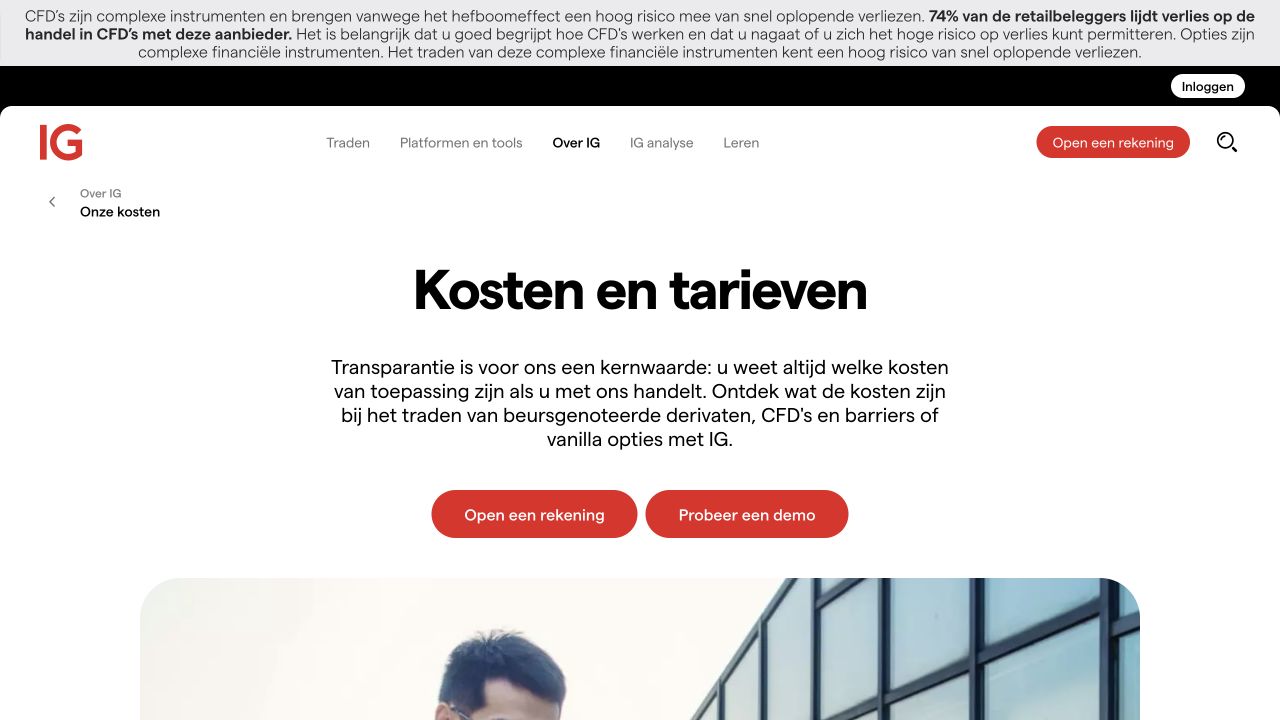
IG's Dutch CFD overview identifies IG Europe GmbH and offers indices, shares, forex and commodities. It says most CFD dealing costs are in the spread, while share CFDs carry a commission. That difference matters when the reader moves from an index view to a single company: a zero additional share spread is not a zero-cost round trip. Its Dutch tariff page has separate cash-CFD, futures and options sections. IG can suit a trader who wants to inspect several market types and their distinct contract sheets. It is less suitable for someone who reads one minimum-spread number across all those products. Its share/ETF-CFD conditions are specific to derivatives and should not be confused with buying the underlying.
The Dutch CFD page names Capital Com SV Investments Ltd and offers a route across indices, shares, commodities and currencies. Its pricing explanation works through spread examples for several classes and explains that overnight adjustment applies to notional position value rather than just the margin deposited. This is useful for someone comparing an intraday index order with a held one. It is weaker as a source of a current individual quote: the worked examples are illustrative, and the actual ticket is still decisive. Any optional guaranteed-stop charge and account-currency conversion must be added when the order uses them. Our Capital.com review examines the broader account.
Trading 212: keep the CFD account separate from Invest
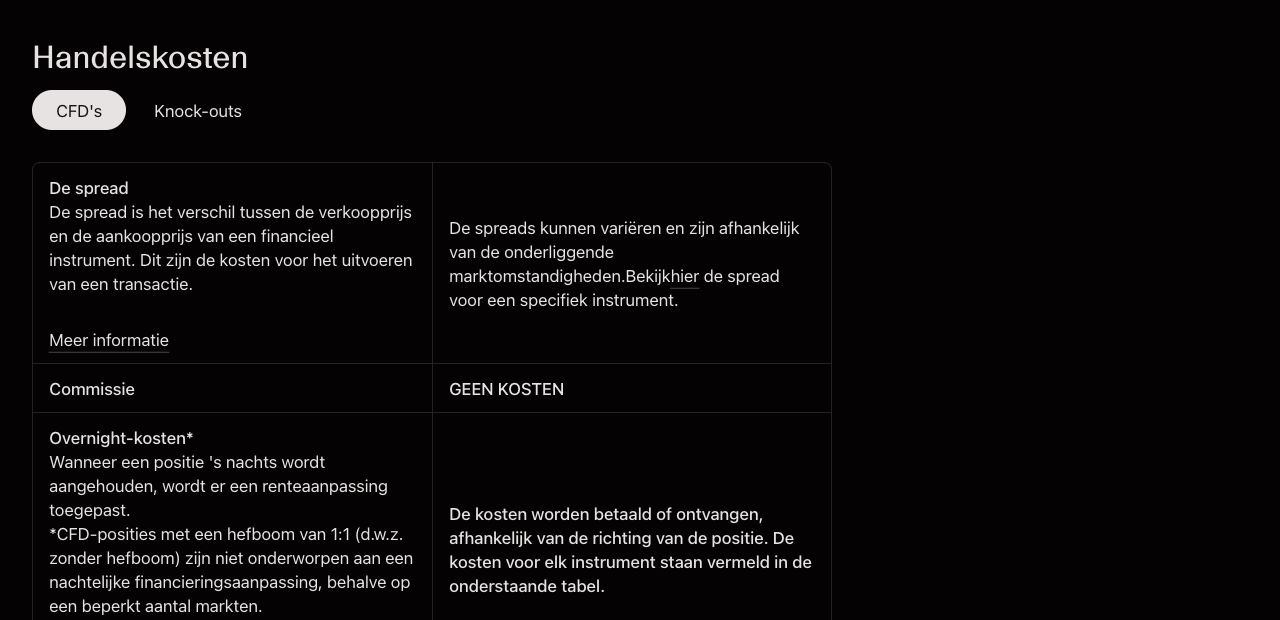
The official country list assigns Netherlands residents to Trading 212 EU GmbH. Its instrument guide separates actual shares and ETFs in Invest from forex, stock, ETF, index-future and commodity-future CFDs in the CFD account. Its Dutch CFD terms describe dynamic spreads, overnight interest and an FX charge on a non-account-currency result. This may suit a person who wants an app-based pre-trade breakdown: Trading 212 says the cost information appears before CFD orders for its EU GmbH accounts. It is less suitable if the user assumes the Invest account's ownership and charging model applies to every CFD symbol. See our Trading 212 review.
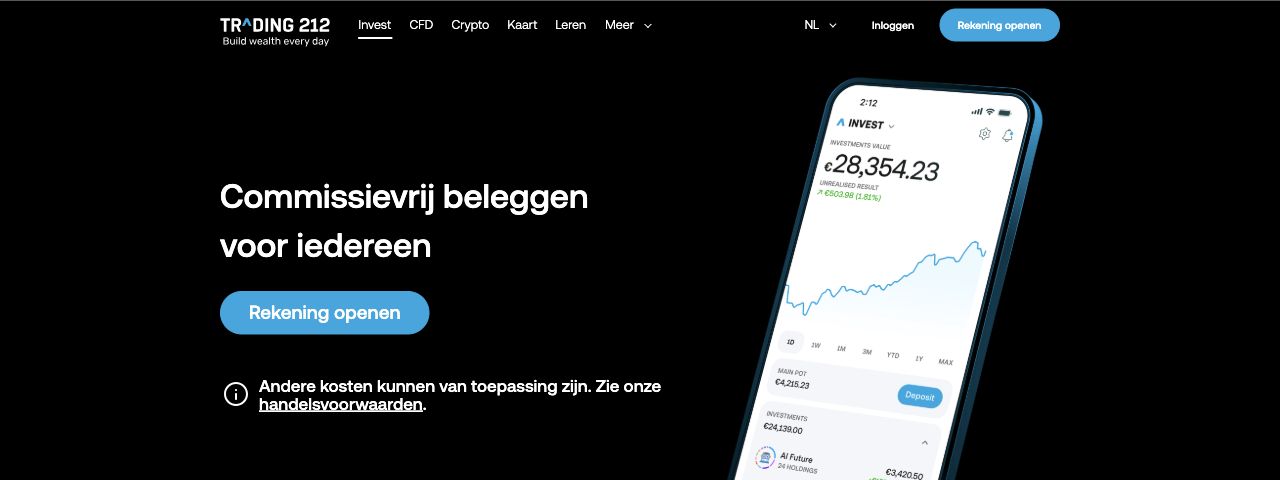
The European terms name StoneX Europe Ltd and explicitly include Netherlands in the passported service region. Its market help describes index, share and commodity CFDs as well as forex. StoneX Europe acts as the market-maker execution venue for client orders. That is a different order relationship from an exchange order to buy the underlying share. FOREX.com can fit a trader who wants a dedicated CFD and forex platform with contract information organised by market. It is less suitable if someone uses a US FOREX.com fee page to price an EU account or assumes all shares have the same spread-only cost. Read the StoneX Europe product sheet for the intended symbol and holding period.
OANDA: inspect the particular index structure
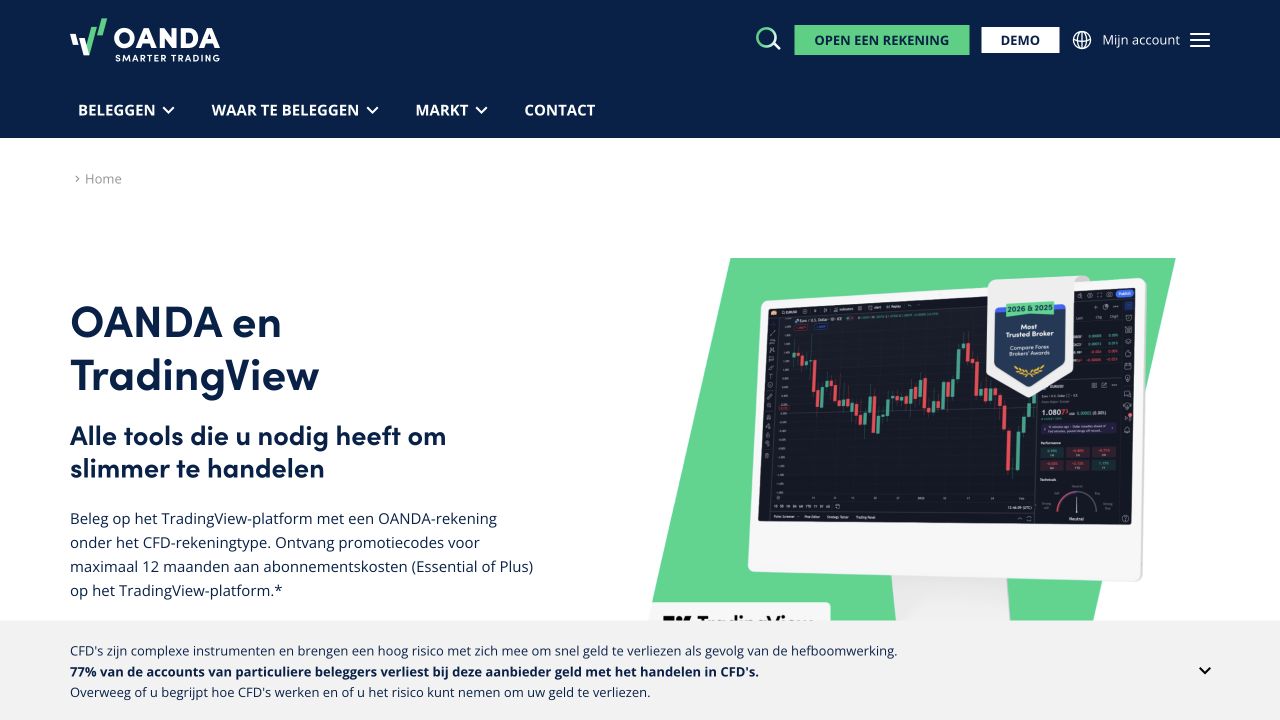
OANDA's Dutch service names OANDA TMS Brokers S.A. and lists share, index, commodity-future and currency CFDs separately from its stock account. Its EU execution policy describes the CFD classes and how OANDA TMS acts for its own account as the execution venue. Some index contracts use futures references, and OANDA's index FAQ says its cited stock-index route has no separate overnight swap. That can suit a trader comparing a specific future-based index contract with a cash CFD elsewhere, but the two quotations need their spread and expiry mechanics considered together. It is less suitable to declare “OANDA has no overnight costs” across all products. Our OANDA review covers the account route.
IC Markets: symbol costs matter beyond the forex account headline
IC Markets (EU) Ltd has an incoming AFM passport entry. Its EU product FAQ lists index, stock, commodity and forex CFDs, and its index page distinguishes equity-index and futures-index routes. IC Markets can fit a trader familiar with MetaTrader or TradingView who will inspect the exact symbol specification and overnight adjustment. It is a weaker fit if the decision is based solely on the firm's forex Raw Spread marketing: that account's EUR/USD spread and commission do not price an index or stock CFD. Account base currency, product and market hours all need checking.
Admirals: use the Dutch Europe-entity documents
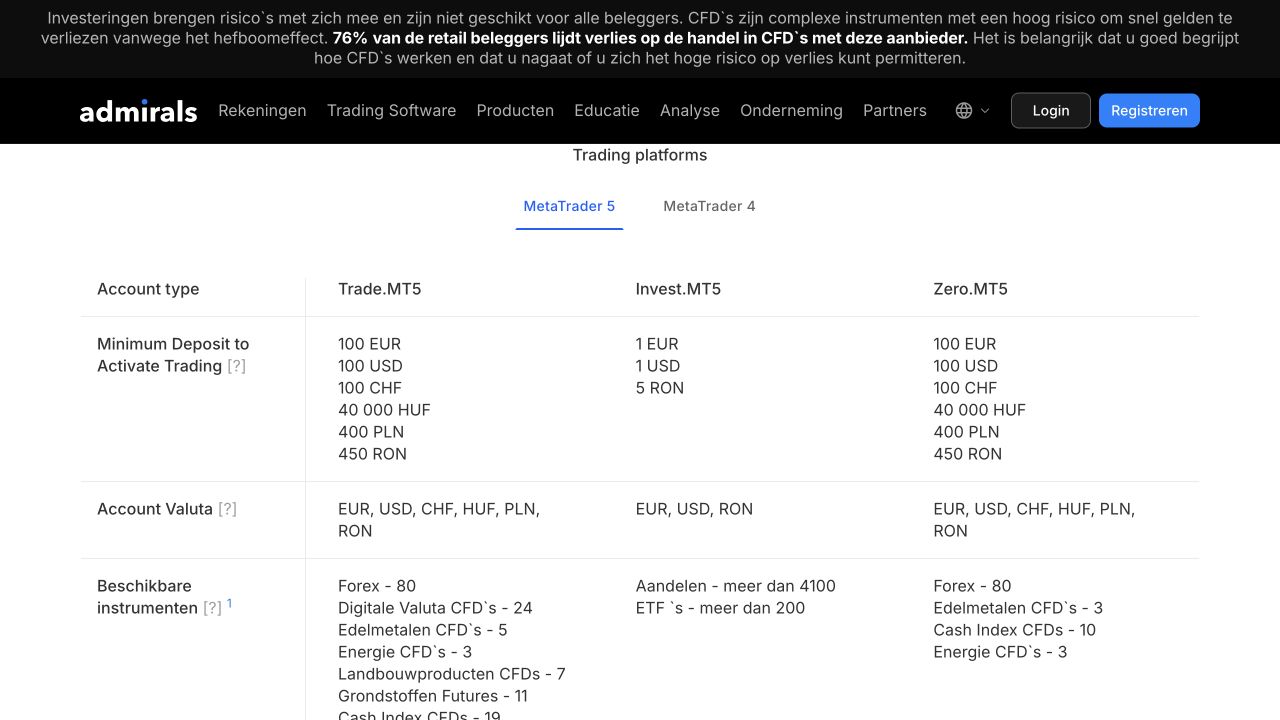
The Dutch account comparison and account-opening route identify Admirals Europe Ltd. Its Dutch index-CFD, share-CFD and commodity-CFD documents give product categories for that entity. The Dutch fee page separates spread, swap and share/ETF-CFD commission, with exact values in contract specifications. This route can suit a MetaTrader user willing to identify the account tier and symbol. It is less suitable for a reader copying an Admirals Estonia or another group company's tariff into a Dutch Europe-entity account.
XTB: confirm the Cyprus account's product list
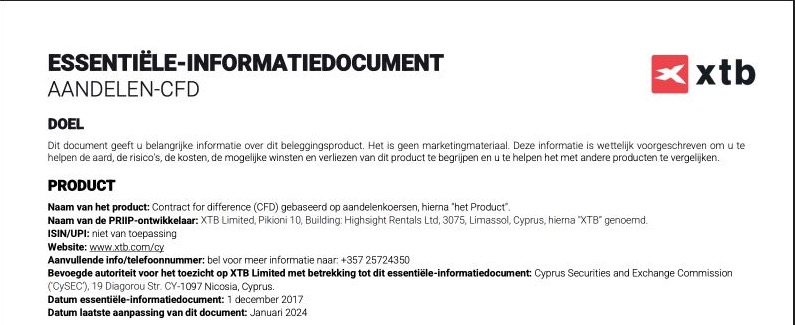
XTB's EU onboarding guidance directs a new EU resident to XTB Limited Cyprus. That route documents forex, index, commodity, stock and ETF CFDs. Its stock and ETF help answer says only CFDs are available, but the newer Cyprus instrument list includes organized-market instruments and fractional rights. We cannot establish from those conflicting public pages whether a newly opened Dutch account can buy real shares or ETFs. For this CFD comparison, xStation can suit a trader who checks the exact derivative contract, spread and swap. A reader seeking ownership should confirm the enabled security and agreement in the actual application before treating XTB as a stock broker. See our XTB review.
Plus500: apply the Dutch issuer's terms
The Dutch agreement page identifies Plus500EE AS as the issuer, and its fee explanation separates the bid–ask spread from overnight funding, account-currency conversion and inactivity terms. Plus500 offers an interface centred on CFD orders across underlying markets. That may fit someone who wants to see the symbol's current dealing conditions without navigating a separate investment account. It is a weaker fit if the plan is to own a share or ETF, or if the review's price is copied from Plus500CY or another group entity. Read the actual instrument information before estimating a held trade.
eToro: check whether a stock line is real or a CFD
eToro's Dutch CFD page lists currencies, commodities, indices and shares among its CFD routes, while its product explanation distinguishes some unleveraged stock/ETF transactions from leveraged, short or copy-trading CFD transactions. The entity page names eToro (Europe) Ltd. It can fit someone who understands the order label and wants to manage several asset classes in one interface. It is less suitable if the user assumes an “AAPL” or index name alone answers whether ownership transfers. Its Dutch fee page points to CFD spread and overnight information. The ticket and position type determine the relevant line. See our eToro review.
Index-CFD order and overnight worksheet
Consider a hypothetical index CFD referencing an index at 8,000 points, with one euro of exposure per point and a one-point bid–ask spread. Its notional exposure is €8,000. If the index mid-price did not move and the position were opened and closed across that spread, the spread component would be €1 for the round trip. This example is a mathematical contract, not a quote from any of the ten providers: their point values, spreads, minimum sizes and currency denominations differ. First inspect the actual contract specification. A provider quoting “1.0 points” can be more expensive in cash than one quoting “1.5 points” if the contract's euro value per point is larger.
If the initial margin rule for this hypothetical contract were 5% of exposure, the required opening collateral would be €400. With €1,000 of free account equity before the trade, a 100-point adverse index move at €1 per point would reduce equity by about €100, plus spread, financing and any other cost. It would not cap the loss at the €400 margin. The required margin can also change as exposure, instrument terms and account equity change. When equity falls toward the maintenance requirement, the platform can close positions under its margin-close-out rules. The realised close price can differ from the level a user expected. The AFM's retail CFD measures set a framework for leverage, close-out and negative-balance protection, while the provider agreement and instrument ticket specify the operational details.
For a same-day position, record entry and exit spread, any dealing commission and conversion. For a cash index CFD held across the provider's cut-off, add each overnight financing adjustment using the notional exposure and the applicable direction and currency. Capital.com's Dutch worked examples show why a charge on a €8,000 position is not calculated only on its €400 margin. A futures-based index CFD can instead reflect carry in its quoted price and expiry/roll. OANDA's index explanation is a reminder not to add a nonexistent separate swap to every index product. Do not compare a cash CFD's spread alone with a futures CFD's full holding cost.
A share CFD changes the worksheet. IG's Dutch product summary says share CFDs use commission rather than its added index-style spread. The share still has a market bid–ask difference, and an open position can have financing or borrow-related terms. A commodity CFD may reference spot or a future. The spread, financing and expiry path vary with the contract. The object of the comparison is the cash cost of the same economic exposure over the same time, not which product page has the shortest fee list.
| Item | Cash index CFD | Future-based index CFD | Share CFD |
|---|
| Open and close | Contract spread × cash value per point. Possible other fees | Contract spread and any expiry/roll effect | Share market spread and applicable dealing commission |
|---|
| Held position | Check daily financing and cut-off | Check embedded carry, expiry and roll. No universal separate swap | Check financing and any short-borrow condition |
|---|
| Position size | Point value × index level × contracts | Future-reference specification × contracts | Share price × CFD quantity |
|---|
| Exit | Bid/ask, slippage and margin rules | Same plus expiry timing | Same plus underlying market hours and liquidity |
|---|
Margin, product and account checks
Write down the full contract name before comparing prices: cash Germany 40 CFD, future-based Germany 40 CFD and an ETF CFD linked to a German fund are three different exposures. For a share, distinguish a real security in an investment account from a CFD in a derivative account. XTB's Cyprus product statement and Trading 212's account-type guide show why a group name alone cannot establish ownership. The CFD guide explains the contract mechanics, while the stock-buying guide covers actual share orders.
Next inspect the order ticket's quantity, notional value, point value, bid, ask, margin and available order instructions. A stop may trigger an exit instruction, but its execution price can differ when the market gaps or liquidity changes. A guaranteed stop, where offered, has its own conditions and possibly a fee. Compare a published minimum spread with the live quote only as a lower-bound reference, never as a promised fill. For a held trade, identify the provider's overnight cut-off, direction and whether a weekend day is bundled into an adjustment. A fixed “spread from” badge cannot answer the holding-cost question.
Then check account-level costs: funding channel, withdrawal, currency of the contract and account, conversion and inactivity. Trading 212's Dutch CFD terms describe conversion on a non-account-currency result. Plus500's Dutch fee page has an inactivity condition. Neither item necessarily applies to the illustrative euro index contract, but both can affect a person's actual pattern. A payment provider or bank can also impose a charge outside the broker's own withdrawal tariff. The total cost is the applicable set of terms for the actual order and account, not a sum of every fee named on the website.
Finally, identify the legal entity and regulator on the agreement. AFM registration can show a Dutch authorisation or an incoming European passport. It does not mean AFM directly supervises every passported provider: its Admirals Europe entry expressly notes that distinction. The broker-safety guide explains how to match the website, contracting company and account documents. If the signup route changes the entity, revisit every fee and protection claim before acting.
Frequently asked questions
How do opening and holding costs combine?
Opening and closing normally cross a bid–ask spread, whose cash effect depends on contract size. A share CFD can also carry a commission on each side. A held cash CFD may add overnight financing calculated on notional exposure. Other instruments may reflect carry through a future-linked price instead. Conversion and account charges apply only under their stated conditions. Compare the complete cost for the same symbol, size and holding period, not just the minimum spread.
What happens to margin when the position moves?
Profit and loss change account equity against the full position exposure, while the initial margin is collateral. A losing move can reduce equity toward the maintenance threshold, causing a platform close-out. The hypothetical €8,000 index position above needed €400 initial margin under the assumed rule but a 100-point move at €1 per point changed equity by €100 before costs. Margin is therefore not the maximum loss figure. The exact close-out and balance terms come from the account agreement and retail CFD rules.
Which products are actually available to a Dutch resident?
The table lists documented Netherlands or EU routes and the main CFD categories they advertise. The exact tradable symbols can vary by entity, account, platform and product classification. XTB's older Cyprus help answer describes stock and ETF CFDs only, while newer Cyprus documents also list organized-market instruments. Trading 212 separates Invest and CFD accounts. Search the symbol on the intended account, read its key information and instrument specification, and confirm the company on the agreement before depositing.
Is a CFD on an AEX share the same as owning that share?
No. The CFD is a contract on the price difference with the issuing provider. It does not place the share in the account as a security or create the same ownership and transfer rights. The share's price can be the reference, but the spread, commission, financing, margin and issuer terms are those of the CFD. If ownership is the goal, use a real-share route in the stock comparison.


 Capital.com
 Trading 212
 OANDA
 XTB
 eToro