

 Saxo
We examined Saxo's Dutch account-level schedule, AutoInvest terms, product and platform pages, Dutch help and the bank's client-asset protection explanation. We distinguish the Netherlands branch from global or other-country Saxo pages, which can have different products and costs. Our methodology explains the source checks. The broker comparison and ETF broker comparison evaluate Saxo beside other providers. This page focuses on its account.
Who Saxo fits
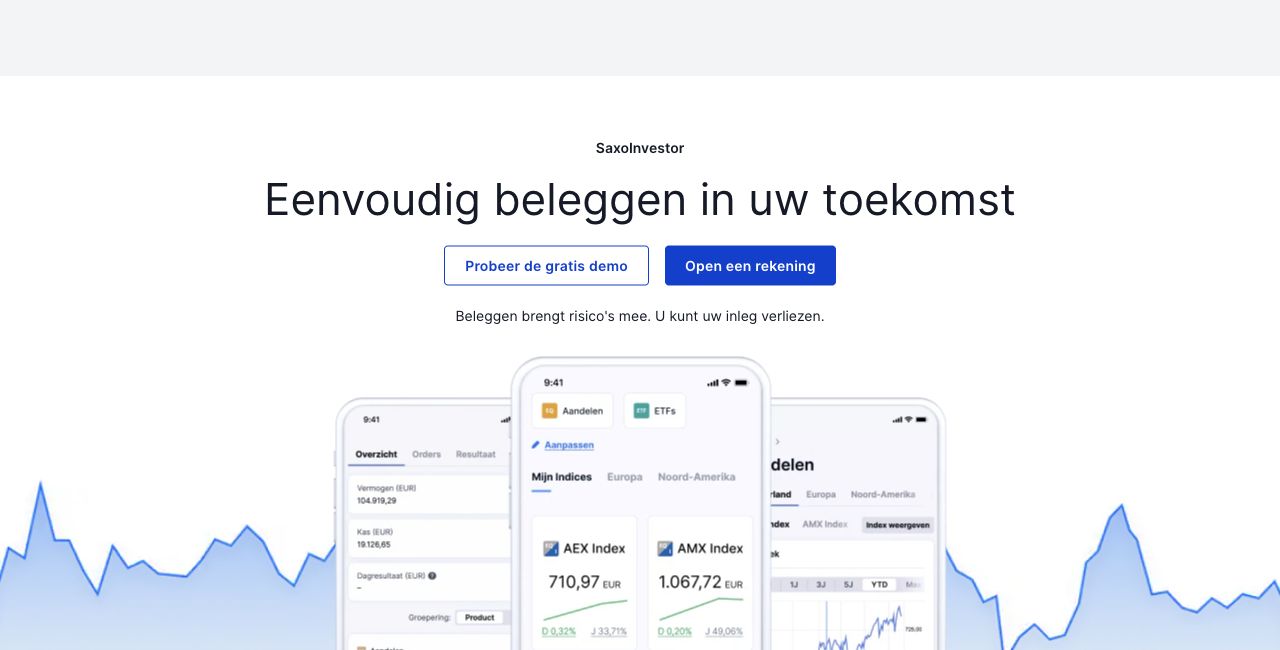
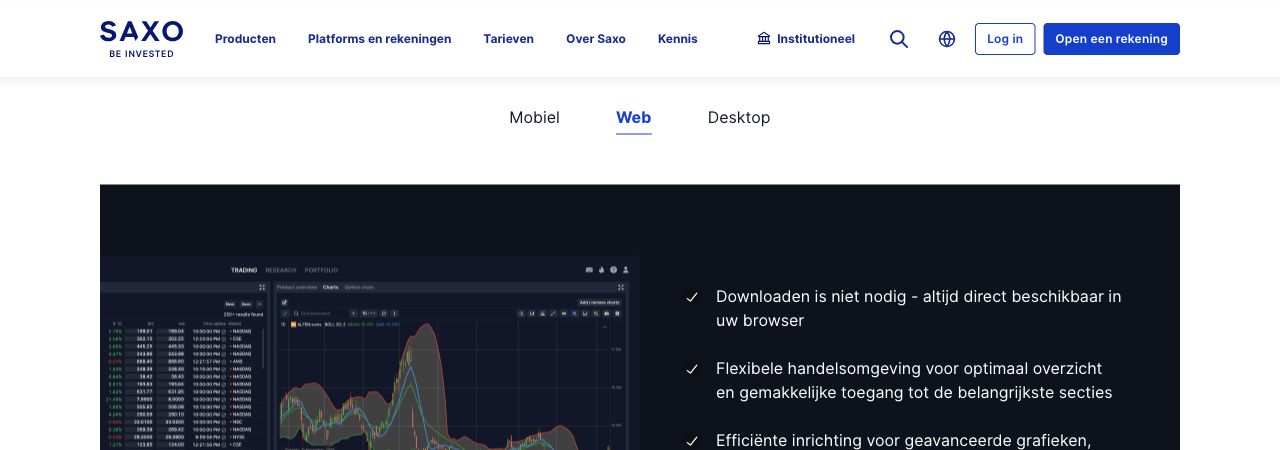
Saxo can fit a self-directed investor who wants both manual orders and, for eligible funds and ETFs, a monthly plan in a Dutch branch account. The SaxoInvestor page shows a web, smartphone and tablet investment route with orders and portfolio history. The SaxoTrader page describes a more detailed web and desktop workspace with charts and order controls. These are two interfaces to evaluate for different tasks, not two separately ranked brokers. An investor who uses complex orders may value SaxoTrader. Someone buying a regular ETF may prefer the simpler SaxoInvestor and AutoInvest path.
The fit weakens for a very small, inactive portfolio because a charge based on invested value can continue between trades. It also weakens if the selected ETF does not carry an AutoInvest icon or the monthly contribution is too small to buy a non-fractional unit. Saxo's Dutch plan FAQ says not all supported funds and ETFs are fractional and an order may fail for insufficient balance. A person seeking a standard Dutch CFD account should not rely on global Saxo platform advertising: Saxo's Dutch tradable-products list does not list CFDs. The CFD comparison uses confirmed Dutch routes.
Dutch entity, account and products
Saxo Nederland is the Dutch branch of Saxo Bank A/S, a Danish bank. The Dutch branch operates under the Danish banking licence, with local registration and supervision described in its Dutch documents. The final agreement and the account's legal notices should confirm the applicant's relationship. A global Saxo webpage can illustrate a platform but does not establish that every asset or tariff on it is available to a Netherlands resident.
The Dutch product help lists shares, ETFs, bonds, investment funds, listed options and futures, turbos and forex. Those are different legal and economic products. Buying a listed share or ETF creates a security position. An option or future is a derivative with margin, expiry and product-specific charges. Saxo's forex route is distinct from paying an FX conversion fee on a US stock purchase. Neither a forex pair nor a turbo should be treated as an ordinary ETF line. The account's product permissions and order ticket determine the actual available route.
The standard individual account begins at Bronze. Saxo's Dutch account-level page sets Silver at €200,000 and Gold at €1,000,000 of combined portfolio and cash value. The higher level can lower percentage commission while retaining a minimum and the portfolio service fee. If value later falls below a threshold, the provider describes a transition period before a possible downgrade. A typical new investor should use Bronze in a cost example instead of borrowing the Gold headline.
Bronze, Silver and Gold pricing
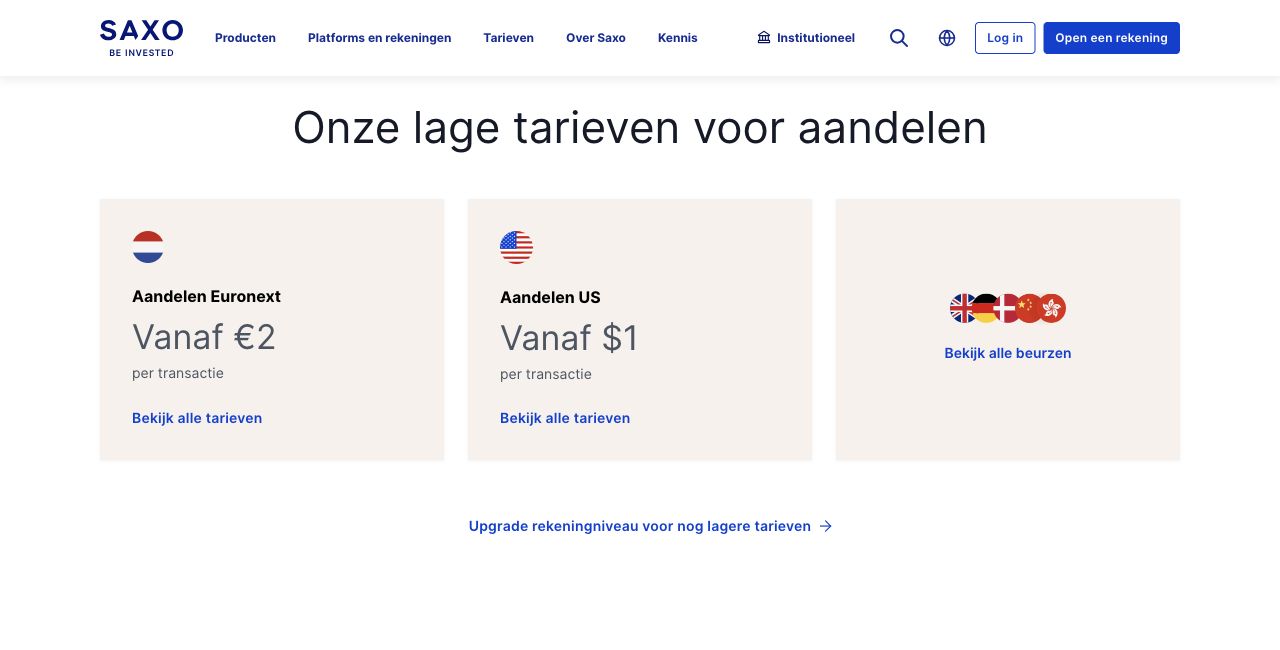
The Dutch tier schedule publishes these headline rates for the listed examples. The exact exchange, security, account and order ticket still matter, and external taxes, fund charges, spread and currency conversion can add to a trade.
| Dutch account item | Bronze | Silver | Gold | Condition |
|---|---|---|---|---|
| Euronext listed share or ETF | 0.08%, minimum €2 | 0.05%, minimum €2 | 0.03%, minimum €2 | Check selected exchange and instrument. |
| US listed share | 0.08%, minimum $1 | 0.05%, minimum $1 | 0.03%, minimum $1 | FX may apply in a euro account. |
| Listed EUR or USD option | €0.75 or $0.75 per contract | Same listed headline | Same listed headline | Product permission, venue and exercise costs need checking. |
| Portfolio service fee | 0.01% monthly, maximum €40 | Same | Same | Calculated on invested portfolio value, excluding derivative positions. |
| Next-month transaction-cost credit | Prior month's service fee credited | Same | Same | Valid for one month. It is not a cash refund. |
| AutoInvest monthly eligible fund/ETF buy | €0 purchase transaction charge | Same | Same | Service fee, fund, FX and spread conditions remain. Sales use standard tariff. |
The monthly service fee is a key difference from a pure pay-per-order model. Saxo says it applies to the portfolio value excluding derivatives, not simply the cash balance, and is capped at €40. The following month, Saxo credits the amount for transaction costs. The credit lasts one month, so a person who does not trade may not use it. The tier explanation should be read in full rather than treating the credit as a refund to the cash account. The service fee is charged once for the relevant invested portfolio. Using AutoInvest does not create a second identical service fee on top of it.
Saxo's Dutch order-cost help says its order ticket groups investment-service costs, instrument costs and third-party payments, and makes the instrument's charges available through its information icon. That is the appropriate place to inspect a specific market line. For a foreign-currency trade, Saxo's Dutch currency-account help specifies a 0.25% margin on conversions between Saxo currency accounts. Its general conversion terms describe a conversion of up to plus or minus 0.25% around the spot mid-price when a traded instrument differs from the account currency. Confirm the live order ticket and whether a pre-funded currency account changes the conversion needed for the transaction. Do not use a Belgian phone-order tariff or a global custody schedule as if it automatically governs the Dutch branch.
Optional market data is another account-specific item. Saxo's Dutch tier page includes specified real-time European and US share data for retail customers after activation and points to subscriptions for other feeds. The Dutch data page distinguishes Level 1 quotes from Level 2 market depth. A platform login does not make every exchange feed or depth display free. Borrowing against securities or using margin products brings financing costs set by the applicable product and account terms. A cash-funded ETF example below does not include borrowed money.
Three cost scenarios
For one €1,000 Euronext Amsterdam share purchase in a Bronze account, 0.08% of €1,000 is €0.80, so the published €2 minimum sets the Saxo transaction commission for that order. The actual purchase value and spread depend on execution, and a sale has its own commission. If the resulting portfolio remains invested at €1,000 for a full month, 0.01% of that value is €0.10 of service fee for that illustrative month, subject to Saxo's calculation and monthly cap. The corresponding next-month cost credit is useful only if spent on eligible transaction costs before it expires. This is a commission-plus-service example, not a guarantee that total investing cost is €2.10: any security-specific tax and market spread remain. The Dutch schedule confirms both rates and the credit rule.
For a €1,000-equivalent US share purchase from an account funded in euros, the Bronze US commission is 0.08% with a $1 minimum. The commission is denominated in dollars, so a euro comparison requires the actual conversion. If €1,000 is converted with a 0.25% currency margin, the percentage component is roughly €2.50 on that euro amount, before the market spread and any external US sale charge later. This arithmetic is illustrative. The USD share price, order size and live conversion rate determine the actual debit. A separate dollar cash balance may change when conversion is needed. The order ticket cost view is where the reader should check the specific account and security.
For a monthly AutoInvest ETF purchase, Saxo's Dutch AutoInvest page says the scheduled eligible fund or ETF buy transaction has no transaction commission. The account still pays the 0.01% monthly service fee on invested value, and the ETF has issuer-level ongoing cost and a trading spread. FX may apply to a non-euro line. Suppose the invested portfolio averages €10,000 for a month: 0.01% gives €1 service fee for that illustrative month, with a one-month transaction-cost credit in the next month. It is wrong to call the monthly purchase entirely free or to deduct the credit as cash. A standard sale has its regular transaction charge. The chosen fund also must be marked AutoInvest-eligible. The provider warns that a non-fractional unit priced above the available contribution can prevent execution.
SaxoInvestor, SaxoTrader and the order ticket
SaxoInvestor's Dutch product page describes orders, market discovery, portfolio views and historical transactions on computer, smartphone and tablet. Its Dutch demo can help a new user locate the main controls, but a demo does not prove a live instrument's eligibility, feed or fill. SaxoTrader's Dutch page describes a web/desktop workspace with charts, watchlists and more detailed order types. An active user may want those controls, whereas a monthly ETF buyer may find the Investor interface more direct. Our platform comparison evaluates the larger-screen workflow, and the app comparison evaluates phone tasks.
For either interface, search by ISIN or another reliable identifier, confirm the exchange and trading currency, open the instrument's conditions, then inspect the order ticket. Saxo's Dutch help says the product page, order ticket and position view can show the relevant costs, exchange and hours. A real share, ETF, option and rolling forex position can all be visible in the Saxo ecosystem, but their margin and settlement mechanics are different. Treat the displayed cost breakdown as an estimate for the selected order and check the execution report later. Our stock-buying guide explains the first limit-order choice.
One Dutch five-star customer report describes staff helping the investor buy a Canadian company through its NYSE listing. The company reply acknowledges that account-specific help, but the review does not identify the share or prove every dual-listed line is available. It illustrates why the listing matters alongside the company name: check the ISIN or ticker, selected exchange, quoted currency and any FX charge in the ticket, then ask Saxo about the exact line if it is unclear.
A one-star Dutch customer report describes difficulty after changed login security: their PC appeared as a new device, push/SMS verification was confusing, and the process interrupted their order workflow. Saxo's reply acknowledges a recent verification change, without establishing that every user had the same difficulty. The customer's statement that a code was needed for every order is broader than Saxo's current Dutch help, which says the extra code is required before the first trade of a login session, after a short wait; later orders in that session do not need another code. Saxo's trusted-device guide also explains SMS, app push and recovery steps. Test both login and the first order-ticket verification on the device you actually intend to use, especially if a trade may be time-sensitive.
Cash and security protection
Saxo's Dutch deposit-guarantee explanation says qualifying cash held with Saxo Bank A/S is covered by the Danish scheme up to the equivalent of €100,000 per account holder, rather than the Dutch bank guarantee merely because the account is served locally. The bank's asset-protection statement says client financial instruments are normally returned if the bank enters resolution or bankruptcy. If it cannot return belonging instruments, the Danish investor backstop covers the missing value up to an equivalent of €20,000, within its rules. Cash cover and missing-instrument compensation address different failures. Neither promises that a share or ETF will retain its price.
The custody terms for an exact security and optional service deserve attention. Saxo's Dutch securities-lending page describes an optional route in which legal title to lent securities moves while the customer retains economic exposure, with collateral and a possible loss of voting rights during a loan. It is not the default conclusion to draw from the ordinary stock-pricing card. A person who considers activating it should read the separate agreement and collateral terms. The broker-safety guide distinguishes firm identity, custody and cash protections.
Records and portability
Saxo's Dutch fiscal-year statement help gives a download path on the website and in the app. Its reporting help describes selecting an account and period and exporting a PDF or spreadsheet. A Dutch resident should retain order confirmations, year-end values, cash and dividend records, rather than assume a portfolio chart is a tax statement. Saxo says its overview helps with filing but does not provide individual tax advice. Our Netherlands investing-tax guide explains the tax-authority context.
The archive path can matter after an account changes. In another positive Dutch review, a customer says Saxo staff helped them obtain a transaction report and fiscal year statement from an old account; Saxo's reply confirms the reported assistance. That is a useful example of human help, not a promise that every historical report is automatically visible or immediately available. Before closing or moving an account, export the periods you need and check that the PDF or spreadsheet covers the correct account and year.
Before choosing a broker for a long holding period, check the outgoing transfer conditions for the exact security and receiving account in Saxo's instrument and service documents. An incoming-transfer promotion, if shown, does not prove an outgoing transfer is free, and a fractional or unsupported product may not move in kind. We do not publish an unverified fixed transfer charge. A future sale instead of transfer would incur transaction, spread and potential FX costs. Portability is therefore part of the account decision even when the immediate order fee is modest.
When another route fits
Saxo may fit a resident who wants a Dutch-branch bank account, broad listed-product choice, a simple investment front end plus a more detailed trading desk, and an eligible ETF plan. It may fit less well if the investor trades rarely in a small portfolio and would not use the service-fee credit, or if they need an AutoInvest product Saxo does not offer. A price comparison should use the same ISIN, venue, currency, frequency and portfolio size. The review directory lists other account reviews. No broker is unconditionally preferable: the right route depends on the actual product and cost scenario.
Frequently asked questions
Is Saxo's Euronext order charge always €2?
No. €2 is the published minimum for the named Euronext share/ETF rate in the Dutch tier table. Bronze, Silver and Gold have different percentage commissions, and larger orders can exceed the minimum. The service fee, market spread, product charge and any applicable tax are separate. Check the specific order ticket.
Is AutoInvest free for a Dutch ETF buyer?
The eligible monthly fund/ETF purchase transaction has a zero transaction charge under Saxo's Dutch plan. The account still has the monthly portfolio service fee. Fund ongoing cost, spread and possible FX remain. Standard sale charges apply. The fund must be eligible, and not all products allow fractions.
Does Silver or Gold eliminate the service fee?
The Dutch tier page shows a 0.01% monthly service fee capped at €40 across tiers, on invested portfolio value excluding derivative positions. Higher tiers reduce certain transaction percentages but retain minimums and the service-fee structure. The next-month transaction-cost credit is not cash and can expire.
Can I use SaxoTrader to buy every product on Saxo's global site?
No. The interface is not evidence of a Dutch account's product permission. Saxo's Dutch tradable-products help lists the relevant categories and does not establish retail CFD availability there. Check the local product list and actual order ticket before choosing the platform on that assumption.
Which protection applies to cash and securities?
Qualifying registered cash is covered under the Danish deposit-guarantee scheme up to the equivalent of €100,000 per eligible depositor. Saxo says belonging financial instruments are normally returned separately. If it cannot return them in the specified insolvency case, the Danish investor backstop covers eligible missing value up to the equivalent of €20,000. These are not guarantees of investment performance.
How should I price one year at Saxo rather than one order?
Choose the actual account level and estimate the portfolio's monthly invested value. Saxo's account-level page and rate documents separate trade commissions from the monthly service fee and its transaction-cost credit. A reader with only one or two small orders may receive a different effective annual result from an active investor who uses the credit frequently. Add any FX conversions and the fund's issuer cost. An AutoInvest-eligible purchase has its own execution condition. It does not make the rest of the account or the fund free. Compare the same ISIN, venue, funding currency, order frequency and average invested value against another broker.
Which Saxo interface should a new investor inspect first?
The SaxoInvestor page describes the simpler investment and portfolio route, while SaxoTrader describes a more detailed workspace. Start with the interface that makes the intended task clear: find the security, confirm ISIN and exchange, inspect the order type and preview all costs. A demo can show where controls are, but it cannot establish that the live account has a particular product permission or that an order will fill at its displayed price. A monthly ETF buyer and a trader using multiple asset classes can reasonably prefer different interfaces within the same Saxo relationship.
Which Saxo records matter for a Dutch resident?
Retain confirmations, cash movements, dividend records, currency conversions and the fiscal year overview. Saxo's Dutch fiscal-statement help explains where to find the annual overview, and its reporting help explains exports for a chosen account and period. Compare the reported cash and positions with your own order history, especially if you used AutoInvest or several currencies. The broker's overview aids recordkeeping. The Dutch tax treatment of a household's assets still follows the relevant public rules and personal circumstances.
Does a Saxo fiscal statement complete my Dutch return automatically?
No. Saxo's Dutch fiscal-year overview help explains how to retrieve a broker record. The resident should reconcile positions, cash, dividends, conversions and any other accounts against the reporting required for their own situation. A missing or delayed document should be resolved with the broker before relying on it. The statement is evidence for filing, not a personalised ruling on Box 3 or any other Dutch tax question. The tax guide links the public authority context.